
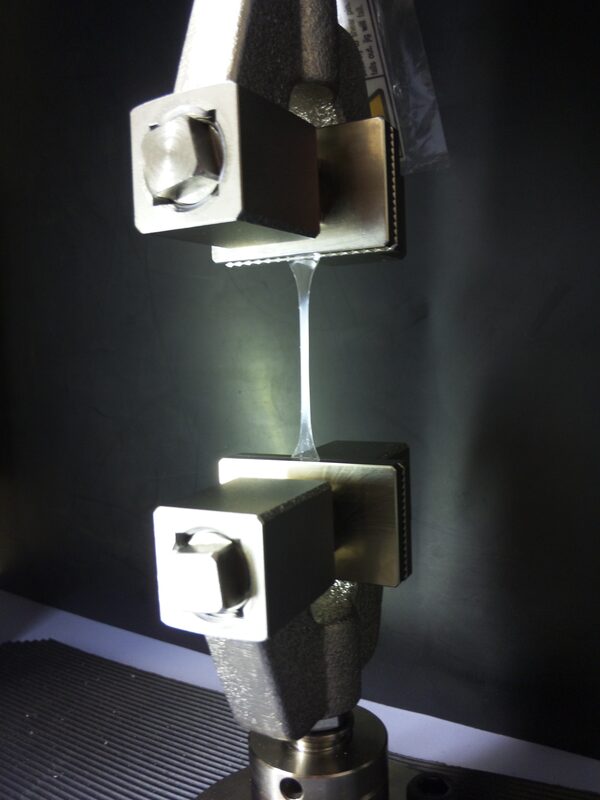
Soft, rubbery 3D-printed parts have a reputation problem: they tear too easily and crack under repeated flexing long before a molded equivalent would. Researchers in Esther Amstad's Soft Materials Laboratory at EPFL say they've found a fix that doesn't require exotic printers or new chemistry, only a smarter way to structure the ink itself. In a paper published in Science Advances, the team describes "double network granular elastomers" (DNGEs) — printable inks built from stiff elastomer microparticles suspended in a softer secondary polymer network — that achieve up to 15 times the fracture toughness and 3 times the fatigue resistance of conventional single- or double-network elastomers made from identical base chemistry, using standard extrusion 3D printers.
That's a striking result because it doesn't come from a new polymer. It comes from architecture. The same chemical ingredients, rearranged into a granular composite instead of a continuous network, behave completely differently under stress.
Why Printed Rubber Usually Fails
Conventional elastomer networks — the kind used in most direct-ink-write or extrusion-printed silicone and rubber parts — are essentially uniform polymer meshes. When a crack starts, it has an easy, straight path to follow: the material ahead of the crack tip is just as compliant as everywhere else, so a tear propagates in a clean line with minimal resistance. Double-network elastomers (a well-established toughening strategy that combines a rigid, sacrificial network with a stretchy one) improve on this by letting the stiff network fracture first and absorb energy, but that sacrificial network still tends to be distributed evenly through the material, which limits how much it can redirect a growing crack.
DNGEs take a different approach: instead of blending two networks uniformly, the EPFL team built the ink out of discrete stiff microparticles — essentially pre-formed pellets of elastomer — packed together and bound by a second, softer polymer network that fills the gaps between them. According to the Science Advances paper, this granular architecture means the material isn't mechanically uniform at the microscale. It's a composite of stiff domains sitting inside soft interstitial regions, and that mismatch is exactly what makes it hard to break.
How the Toughening Mechanism Works
When a DNGE part is stretched or stressed, strain doesn't distribute evenly. Instead, it transfers from the stiff microparticles into the softer material occupying the space between them. That softer interstitial network responds by letting its polymer chains slide and rearrange relative to one another — a process that dissipates mechanical energy rather than storing it up for a crack to release all at once.
The practical effect is that a crack trying to propagate through a DNGE part can't take the shortest path. It gets deflected around the stiff microparticles, forced into a winding, tortuous route through the compliant matrix. Winding cracks grow more slowly and require more energy per unit of travel than straight ones — the same basic principle that makes plywood harder to split than solid wood along certain grains, or that makes toughened glass resist shattering better than plain glass. The granular structure essentially builds crack-deflection into the material at the microscale, without needing any change to reinforcement fibers, printer hardware, or post-processing.
Because the toughening comes from geometry rather than chemistry, the EPFL team was able to layer it onto other established reinforcement tricks. They also printed fiber-reinforced DNGE composites and structures inspired by mussel byssus threads — the tough, sacrificial-bond fibers mussels use to anchor themselves to rocks — suggesting the granular network is compatible with, rather than a replacement for, other biomimetic toughening strategies already being explored in soft-materials research.
Printed on Ordinary Hardware
Perhaps the most notable detail for the maker community: none of this required specialized printing equipment. The DNGE inks were deposited using extrusion-based 3D printing on commercial printers — the same basic material-deposition approach used across desktop and industrial FDM-adjacent silicone and elastomer printing today. The innovation lives entirely in the ink formulation and the particle/network architecture, not in a new toolpath strategy, nozzle design, or curing regime. That's the detail that separates a laboratory curiosity from something with a plausible path to commercial ink cartridges down the line.
What It Means for Makers
Nothing here is shipping as a filament or cartridge yet — this is a peer-reviewed materials-science result, not a product announcement. But the implications are worth tracking for anyone printing soft, flexible, or wearable parts:
Durability could stop being the weak link in printed rubber. Printed TPU and silicone parts have historically underperformed molded equivalents on fatigue life — the number of flex cycles before failure — which is why printed gaskets, wearables, and soft robotic actuators often need conservative design margins or get replaced with molded parts in production. A 3x fatigue-resistance gain, if it translates to commercial inks, would narrow that gap significantly for anything that flexes repeatedly: watch bands, prosthetic liners, robotic grippers, cable boots.
The toughening trick is ink-side, not printer-side. Because the effect comes from how the ink is formulated — stiff microparticles bound in a softer network — it's the kind of advance that could eventually reach desktop users through new material cartridges rather than requiring new hardware. That's a much lower barrier to adoption than techniques requiring specialized multi-material print heads or in-situ UV curing setups.
It's aimed squarely at soft robotics, wearables, and biomedical devices. The EPFL team explicitly frames applications around robotics, wearable electronics, and biomedical devices — areas where a part needs to survive thousands of flex cycles in contact with a body or in an actuator, not just look good on a bench. The team is also targeting biodegradable and recycled formulations in future work, which would matter for wearables and single-use medical applications where disposability is a design requirement, not an afterthought.
The honest caveat: this is a July 2026 Science Advances publication describing lab-scale ink formulations, not a material anyone can buy. Translating a granular double-network architecture into a stable, shelf-stable, commercially producible cartridge ink is its own engineering problem, and timelines for that kind of translation in soft-materials research have historically run several years. Still, a toughening mechanism that works through particle architecture rather than new chemistry — and that already prints on off-the-shelf extrusion hardware — is a more direct path to market than most lab breakthroughs get.
