
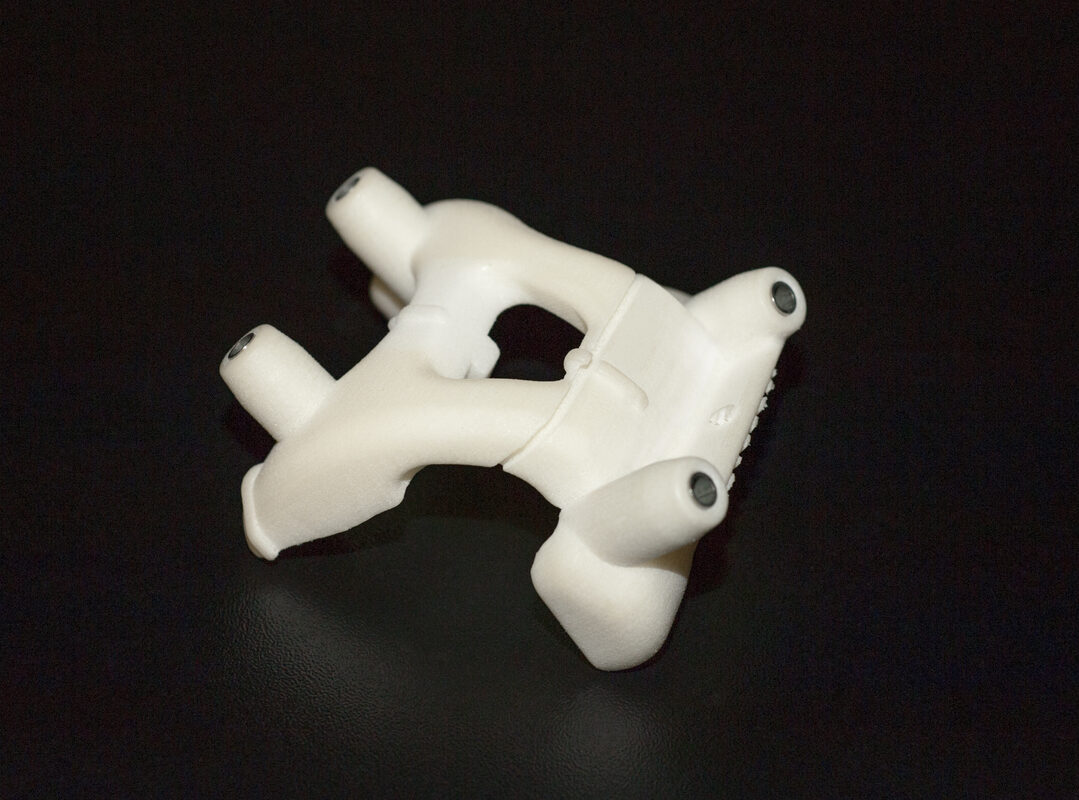
Dutch resin manufacturer Liqcreate has introduced Bio-Med Flex, a clear, flexible photopolymer designed for medical applications that require a part to bend, stretch, and — critically — go through an autoclave without falling apart. The material passes a trio of ISO 10993 biocompatibility tests and holds up under steam sterilization at both 121°C and 134°C, according to Liqcreate's product listing and a report from 3D Printing Industry published this week.
That combination — flexibility plus autoclave survival plus biocompatibility — is a narrow needle to thread. Most flexible resins on the market are formulated for wearables, gaskets, or prototyping, where a printer operator never has to worry about whether the part reacts badly to living tissue or whether it degrades after a trip through a steam sterilizer running well above boiling. Bio-Med Flex is aimed squarely at the gap between those two worlds: flexible anatomical models used for surgical rehearsal, housings for wearable sensors, and soft fixtures that touch a patient but don't need the higher-tier certifications reserved for permanently implanted devices.
What's Actually in the Data Sheet
Liqcreate lists Bio-Med Flex with a Shore A hardness of 73, putting it in roughly the same tactile range as a shoe sole or a rubber gasket — firm enough to hold shape, soft enough to flex under load. The resin is formulated for standard 385–405nm DLP, LCD, and SLA printers, meaning it doesn't require specialized hardware; anyone running an open-source resin printer with the right wavelength light engine can process it. It ships in 1kg bottles under order number LBMF01000.
Mechanically, 3D Printing Industry's report puts tensile strength at 5.0 MPa with elongation at break between 180% and 250%, and tear strength between 20 and 28 kN/m. Those numbers describe a material that stretches to roughly two to three-and-a-half times its original length before failing — well into "flexible" territory — while resisting propagation of a nick or tear once one starts, which matters for parts that get handled, flexed, and re-flexed repeatedly, such as a wearable sensor pod strapped to a limb.
The biocompatibility claims rest on three specific ISO 10993 sub-tests: ISO 10993-5:2009 for cytotoxicity (does the material kill or damage cells on contact), ISO 10993-10:2021 for sensitization (does it trigger an allergic or irritant immune response), and ISO 10993-23:2021 for irritation. Passing these three doesn't clear a material for implantation or long-term internal contact — those require additional ISO 10993 sub-parts and a much longer testing regimen — but it does clear the bar for external and short-term patient-contact use, which lines up with Liqcreate's stated targets of anatomical models, sensor housings, and soft fixtures.
The Sterilization Trade-off
The steam-sterilization numbers are where the data sheet gets more interesting, and more honest. Bio-Med Flex holds up to autoclave cycles at both 121°C and 134°C, the two standard steam sterilization temperatures used in clinical and lab settings. But 3D Printing Industry's reporting notes that sterilization at 121°C drops the resin's tensile strength from 5.0 MPa to 3.7 MPa — roughly a 25% reduction, with elongation shifting to about 183% and Shore A hardness settling at 70. At the harsher 134°C cycle, tensile strength drops further still, to 3.6 MPa, elongation falls to about 166%, and Shore A hardness rises to 75. Liqcreate is not claiming the material is unaffected by autoclaving; it's claiming the material survives the process while accepting a real, quantified strength penalty. For a maker or lab tech planning to sterilize and reuse a printed fixture multiple times, that's a number worth designing around — a part built at minimum wall thickness for the pre-sterilization spec sheet may not be the part you want to run through a dozen autoclave cycles.
Post-processing is also more involved than a typical flexible resin. The recommended workflow calls for two separate IPA or ethanol ultrasonic washes, a 60-minute air dry, a 10-minute UV cure, and then a 120-minute thermal cure at 60°C. That's a substantially longer and more deliberate cure schedule than the "wash, flash-cure, done" routine most desktop resin printer owners are used to — closer to the kind of controlled post-processing regime seen in dental and engineering resins, where under-cured material left in the part can compromise both mechanical performance and the biocompatibility result itself.
What It Means for Makers
For hobbyists and small labs running consumer-grade LCD or DLP printers, Bio-Med Flex is notable mainly for what it doesn't require: no proprietary printer, no industrial light engine, no closed material ecosystem. A 385–405nm resin printer that's already on a bench — the same category of machine used for miniatures and jewelry casting — is, per the spec sheet, compatible hardware. That's a meaningful lowering of the barrier for university labs, medical device prototyping shops, and hospital-adjacent maker spaces that want to produce patient-contact soft parts without buying into an industrial biomedical printing platform.
The trade-off is process discipline. The extended wash-and-cure schedule isn't optional if the biocompatibility and sterilization numbers are going to hold — skipping steps or shortening cure times on a general-purpose flexible resin is a minor quality issue, but doing the same on a resin whose entire value proposition is passing ISO 10993 testing risks producing a part that looks and feels identical to spec but no longer meets the standard it was certified against. Makers evaluating this material should also treat the post-sterilization strength drop as a hard design constraint rather than a footnote: any part intended for repeated autoclave cycles needs to be engineered around the 3.6–3.7 MPa post-sterilization figures, not the fresh 5.0 MPa number on the box.
Liqcreate's move also signals where the flexible-resin category is heading generally: past cosplay props and phone cases and into functional, regulated-adjacent territory, where a documented ISO test result is as much a selling point as elongation percentage. Expect competing resin makers to follow with their own biocompatibility-tested flexible lines if Bio-Med Flex finds traction in the medical-model and wearable-device prototyping space.
