
Protolabs has qualified a new biocompatible photopolymer, Medical White (MED-WHT 10), for production use on its fleet of Axtra3D Lumia X1 printers — the same fleet Protolabs adopted under a broader manufacturing partnership with Axtra3D, first detailed in an earlier announcement from Axtra3D. Per a July 11, 2026 report from 3D Printing Industry, the resin is now offered through Protolabs' on-demand production service and becomes the fifth qualified material on the Lumia X1 platform — a milestone that matters less for the resin itself than for what it signals about how fast high-speed SLA is being pulled into regulated, production-grade manufacturing.
The qualification isn't a research curiosity or a beta material sitting in a materials library waiting for someone to try it. It's a released, orderable option for parts that need to touch skin or sit inside a patient's mouth, and it slots into a production pipeline that Protolabs is already running at commercial scale.
What Medical White Actually Clears
Per 3D Printing Industry's report, Medical White meets two specific ISO 10993 biocompatibility benchmarks: ISO 10993-5, which governs in vitro cytotoxicity (whether a material kills or damages living cells on contact), and ISO 10993-10, which covers sensitization and irritation (whether repeated or prolonged skin/tissue contact provokes an allergic or inflammatory response). Those two tests are a common baseline for materials intended for limited or prolonged skin-contact medical devices — not the full battery required for implantable or long-duration internal devices, but enough to clear a resin for a meaningful slice of clinical and dental hardware.
That slice includes surgical guides (patient-specific templates that help surgeons position drills, saws, or implants accurately during an operation), splints, and diagnostic components, extending to anatomical models and dental parts. 3D Printing Industry's coverage also lists electronics and industrial hardware that must hold tight tolerances under heat, suggesting Protolabs is positioning the resin as a general-purpose white photopolymer that happens to carry medical-grade credentials, rather than a niche material locked to one vertical.
For makers used to eyeballing a resin's biocompatibility from a marketing blurb, it's worth being precise about what these two ISO numbers do and don't promise. They establish that the cured resin, tested per the standard's protocols, didn't kill cultured cells and didn't trigger a sensitization or irritation response in the specified test model. They say nothing about long-term implant safety, sterilization compatibility, or performance after the part has been in service for months — those require separate testing regimes (ISO 10993-11 for systemic toxicity, ISO 10993-6 for implantation, and so on) that aren't mentioned in either source here. Surgical guides and splints are typically short-duration, external or near-surface contact devices, which is exactly the risk category ISO 10993-5 and -10 are built to cover.
The Platform Behind the Material
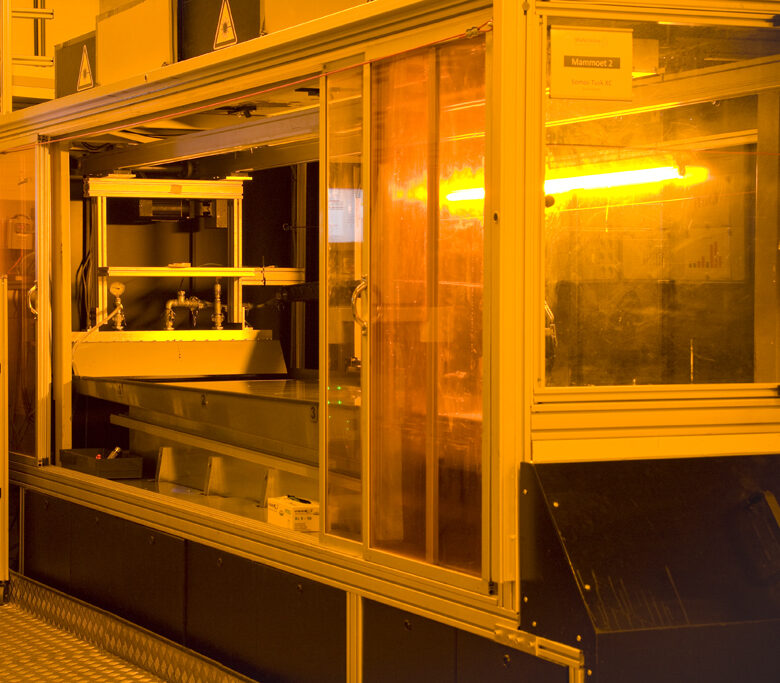
Medical White runs on Axtra3D's Lumia X1, a resin 3D printer built around what Axtra3D calls Hybrid PhotoSynthesis (HPS) — a process that combines laser and DLP imaging simultaneously in a single machine to push throughput well past what conventional single-laser or single-DLP SLA systems can manage, while Axtra3D's marketing frames the platform as aimed squarely at production shops rather than prototyping benches. Protolabs, a longtime contract manufacturer known for fast-turn CNC, injection molding, and additive services, has apparently bought into that pitch at scale: 3D Printing Industry's report notes the company now operates three Lumia X1 units in its production fleet.
That fleet didn't start with a medical resin. Axtra3D's original adoption announcement, cited above, documents Protolabs' initial Lumia X1 deployment running BASF's Ultracur3D RG 3280 material, aimed at injection mold inserts and electrical connectors that needed fine feature reproduction and dimensional accuracy under production volumes. At the time, Axtra3D described a broader materials ecosystem of more than 15 certified resin solutions available across North America, the EU, and Japan, sold through both its turnkey Axtra Solutions program and its more experimental Axtra OpenAccess track for customers qualifying their own materials. Medical White's arrival — reported separately, and later, by 3D Printing Industry — reads as the newest entry in that same expanding qualified-materials list rather than a standalone launch: a fleet that started with a mold-insert resin has grown into a lineup that now includes a biocompatible, patient-contact-rated material.
That's a notable detail on its own. Contract manufacturers don't triple down on a printer platform unless the throughput math and part quality are already working in production, not just in a demo cell. Medical White landing as the fifth qualified material on that same fleet — after whatever four materials preceded it — points to Protolabs treating the Lumia X1 line as a maturing, multi-material production platform rather than a single-application tool.
What It Means for Makers
Most hobbyist and prosumer resin printer owners will never load Medical White into their own machine — it's qualified specifically for Axtra3D's Lumia X1 running through Protolabs' service bureau, not sold as a bottle you can pour into a Saturn or a Form printer. So the direct takeaway for the maker who owns a desktop SLA rig is limited: this is a service offering, not a new SKU on your resin shelf.
The indirect takeaway is more useful. It's a data point in a trend worth tracking if you design parts for a living or side hustle: biocompatible, ISO-cleared resins are moving beyond specialty desktop-oriented materials and into industrial-scale, high-throughput platforms operated by contract manufacturers. That matters if you ever need to go from a garage-printed surgical guide prototype to an actual regulatory-cleared, production-run part — the on-ramp from "I designed this on my desktop printer" to "a service bureau can mass-produce this to an ISO standard" just got a little shorter, at least through Protolabs' door. It's also a reminder that ISO 10993 compliance is verifiable and specific: when evaluating any resin claiming "biocompatible" or "medical grade" status, ask which sub-standard it actually cleared, because -5 and -10 cover a very different risk profile than implant-grade certifications.
