
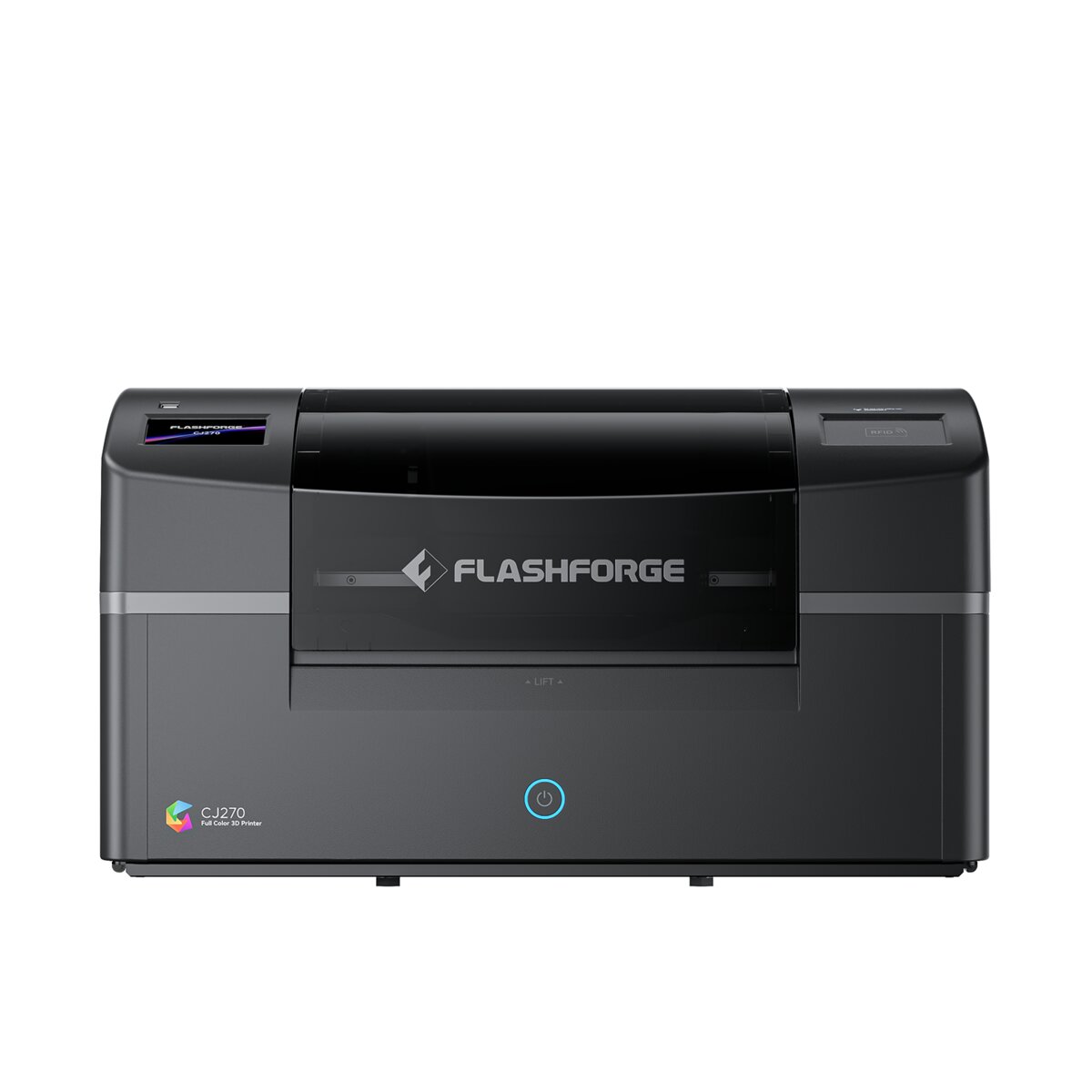
Flashforge has officially launched the CJ270, a desktop-class material-jetting printer the company says can reproduce more than 10 million colors — including transparency — for a launch price of $3,999, according to the company's own announcement. It's a notable number for a technology that, until now, has mostly lived in industrial machines that cost substantially more and take up far more floor space than anything marketed as a desktop peripheral.
The CJ270 was announced September 9, 2026, with the regular price set at $4,499. Flashforge is running an early-bird package for buyers who purchase during the launch period, bundling 1kg of full-color resin, a $100 consumables coupon, and three additional $50 coupons on top of the discounted launch price.
What Material Jetting Actually Does Differently
Most desktop 3D printing falls into one of two buckets: fused deposition modeling (FDM), which melts and extrudes filament layer by layer, or vat photopolymerization (resin/MSLA), which cures a liquid resin bath with light. Material jetting (MJP) is a different animal entirely — it works more like a 2D inkjet printer that happens to build in three dimensions. Print heads deposit tiny droplets of photopolymer resin directly onto the build area, and each layer is cured before the next is jetted on top. Because the deposition is droplet-based rather than filament- or vat-based, an MJP system can mix multiple resins on the fly, the same way a color inkjet printer mixes cyan, magenta, yellow, and black ink to produce a full-color image. The CJ270 uses that same CMYK logic, but in three dimensions: it jets cyan, magenta, yellow, and black resins alongside white and transparent formulations, blending them in real time to produce full-color parts with continuous gradients rather than the discrete color zones typical of multi-material FDM printing. A dissolvable, water-soluble support resin handles overhangs and internal cavities, which can then be washed away rather than mechanically snapped off.
The Numbers
According to Flashforge's specifications, the CJ270 has a build volume of 180 x 120 x 100mm — modest by desktop-printer standards, but not out of line for a machine aimed at figures, collectibles, and small-batch parts rather than large functional prints. Minimum layer thickness is rated at 7 micrometers, an order of magnitude finer than the layer heights typical of consumer FDM printers and fine enough to render smooth color gradients and small surface detail without visible banding. The printer itself measures 697 x 410 x 405mm, reflecting the fact that a jetting system needs room for multiple ink reservoirs, print heads, and a curing stage even when the build volume itself is small. Materials ship as proprietary resin pouches rather than open bottles or spools — CMYK, white, clear, and dissolvable support formulations — which locks buyers into Flashforge's consumables ecosystem, a tradeoff common to inkjet-style hardware of any kind. The machine integrates with Flashforge's own Flash Studio Desktop slicing software rather than third-party open-source slicers, which is typical for jetting hardware given how tightly the color-mixing pipeline needs to be tuned to specific resin chemistry. Flashforge describes Flash Studio Desktop as having evolved out of the company's existing Orca-Flashforge slicer base, adapted to manage the multi-resin jetting pipeline the CJ270 requires rather than the single-material toolpaths that software was originally built around.
A Price Below Where Jetting Usually Lives
The CJ270 isn't introducing full-color material jetting as a technology — droplet-based, CMYK-style color mixing already exists in industrial 3D printing hardware built for professional service bureaus and design studios. What's different here is the price and the footprint: Flashforge's $3,999 launch price and 697 x 410 x 405mm chassis put a version of that same MJP workflow within reach of a hobbyist's desk rather than a corporate prototyping lab, at a fraction of the size and cost of the industrial-grade equipment that technology has historically shipped in. That compression is arguably the more significant story here than any individual spec on the sheet. Pulling a capability out of expensive, service-bureau-only hardware and into desktop territory is the kind of shift the 3D printing market has already seen play out with SLA and SLS, but hasn't yet seen with full-color jetting — at least not until now.
What It Means for Makers
For hobbyists and small studios who currently paint or airbrush finished prints to get color and detail, the CJ270 offers a genuinely different workflow: color and geometry baked in from the same file, with gradients and transparency that hand-painting can't easily replicate. That makes it a natural fit for the categories Flashforge is explicitly targeting — figures, tabletop miniatures, character models, and short-run collectibles — where surface color fidelity matters as much as shape. It's worth tempering expectations on a few fronts, though. The 180 x 120 x 100mm build volume rules out large single-piece prints; this is a machine for small, detailed objects, not full-scale props or enclosures. The reliance on proprietary resin pouches means recurring material costs will likely run higher than filament or open-bottle resin, a familiar tradeoff for anyone who has owned an inkjet photo printer. And because material jetting is mechanically more complex than FDM or single-vat resin printing — multiple print heads, multiple resin lines, precision curing — long-term reliability and maintenance costs remain open questions that won't be answered until the printer has actually been in the field, in ordinary owners' hands, for a while. Still, the headline number is hard to ignore: a technology that has been effectively unreachable for individual makers and small studios is now priced alongside high-end desktop resin printers rather than industrial capital equipment. If Flashforge can keep the CJ270 running reliably once it's out of the early-bird batch and into ordinary hands, it could mark the point where full-color material jetting stops being a niche service-bureau technology and starts being something makers actually own.
Sources
- Meet the Flashforge CJ270: Full-Color 3D Printing Moves to the Desktop — Flashforge official announcement
- Flashforge's CJ270 Is Out, a 10-Million+ Color Desktop Material-Jetter for Less Than $5K — All3DP
