
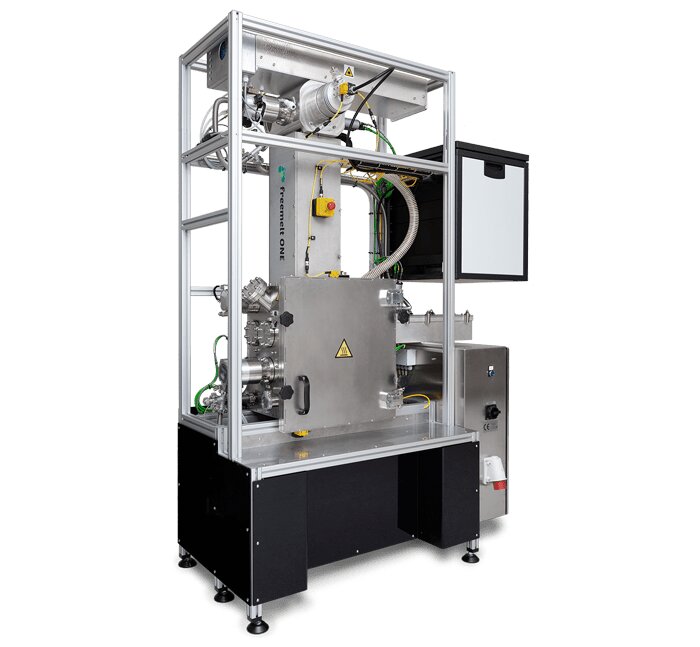
Freemelt, the Swedish electron-beam powder bed fusion (E-PBF) machine builder, announced on September 9 that it is splitting itself into two business units — one selling printers, the other selling finished metal parts — in what the company is calling a platform for "Europe's industrial platform for qualified advanced metal components." The reorganization formalizes a bet that's been building across the metal additive manufacturing (AM) sector for a few years now: hardware vendors are discovering that the real money, and the stickier customer relationships, sit downstream of the machine sale — in the parts themselves.
The new structure carves Freemelt into a Production Systems unit, which continues selling the company's E-PBF machines to labs, research institutes, and manufacturers who want to run their own metal printing operations, and a Manufacturing unit, which will sell qualified, production-ready metal components directly to customers who'd rather buy finished parts than operate a printer fleet themselves. It's a shift from "we sell you the tool" to "we sell you the tool, or we'll just make the thing for you" — and Freemelt is betting a lot of its near-term identity on that second half of the sentence.
Why Split the Business At All
Freemelt's own numbers make the logic behind the split explicit. As a pure production-systems vendor — selling printers and nothing else — the company sizes its addressable market at SEK 22–33 billion (roughly $2.3–$3.4 billion at current exchange rates). Once component manufacturing and subsystems are folded in, that figure jumps to SEK 450–560 billion, an expansion of roughly twenty times. That's the headline number driving the restructuring, and it says a lot about how Freemelt's leadership thinks about where the growth actually is: not in convincing more customers to buy an E-PBF machine, but in becoming the company that already owns the qualified process and can just print the part for you. CEO Daniel Gidlund framed the shift in market terms rather than product terms. "The market is changing," he said in the announcement. "Customers increasingly need access to qualified manufacturing capacity, materials expertise and reliable supply chains — not only advanced production systems." That's a notable reframe for a hardware company: Freemelt isn't just saying its printers are better than the alternatives, it's saying the printer itself is no longer the product a growing share of its customers actually want to buy.
The Numbers Behind the Pivot
Freemelt has an installed base of more than 45 systems, and the company reaffirmed a target of SEK 1 billion in annual order intake by 2030 — a goal it had already stated before this restructuring. What's new is a target of EBITDA positive by 2028, and an expectation that more than half of revenue will eventually come from recurring sources rather than one-off machine sales. That recurring-revenue framing is the real tell here: a manufacturing-services business that ships qualified parts on an ongoing basis produces steadier, more predictable revenue than a capital-equipment business that lives quarter to quarter on machine orders, which tend to be lumpy and hard to forecast. The clearest evidence that this isn't just strategic messaging is a contract Freemelt is already running through the new Manufacturing unit: an agreement with Fusion for Energy (F4E), the European organization responsible for Europe's contribution to ITER and other major fusion programs, for roughly 33,000 tungsten-based components destined for the JT-60SA fusion program. The base contract is valued at SEK 55 million, with options that could push it to SEK 84 million. Tungsten is a notoriously difficult material to process — extremely high melting point, brittle, and prone to cracking under thermal stress — which is precisely the kind of application where E-PBF's ability to build inside a heated, controlled vacuum chamber earns its keep over laser-based powder bed fusion. It's also exactly the kind of order a printer buyer couldn't easily replicate on their own equipment; it requires the qualified process, the materials expertise, and the supply-chain reliability Gidlund name-checked in his quote, not just access to a machine.
What E-PBF Brings to a Manufacturing Play
For readers less steeped in the metal-AM landscape, electron-beam powder bed fusion is the less common cousin of laser powder bed fusion, the more familiar approach behind most industrial metal 3D printing. Instead of a laser, E-PBF uses a focused electron beam to melt metal powder layer by layer, inside a vacuum chamber kept at high temperature throughout the build. That environment reduces residual stress in the finished part and tends to suit reactive or refractory metals — tungsten among them — that are difficult or risky to process with a laser in an open, lower-temperature build chamber. It's a smaller niche than laser PBF, with only a handful of vendors worldwide, but it plays especially well in aerospace, energy, and research applications — like fusion reactor components — where material properties matter more than build speed.
What It Means for Makers
This restructuring doesn't touch the hobbyist or prosumer end of 3D printing directly — E-PBF machines run well into six and seven figures, and Freemelt's customer base is research institutes, aerospace suppliers, and industrial manufacturers, not garage tinkerers. But it's a useful data point for anyone tracking where the broader additive manufacturing industry is heading. The pattern Freemelt is chasing — machine vendor becomes machine vendor plus parts supplier — has shown up before in desktop and prosumer FDM, where companies increasingly bundle materials, subscriptions, and cloud services around the hardware sale rather than relying on printer margins alone. Seeing the same logic play out at the high end of metal AM, backed by a twentyfold market-size claim and a real government-adjacent contract to point to, is a signal that "sell the object, not just the tool" is becoming the dominant strategy across the industry's price tiers, not just a desktop-market quirk. It's also a reminder that as metal AM matures, qualification and supply-chain trust — not raw machine capability — are becoming the actual product being sold.
