
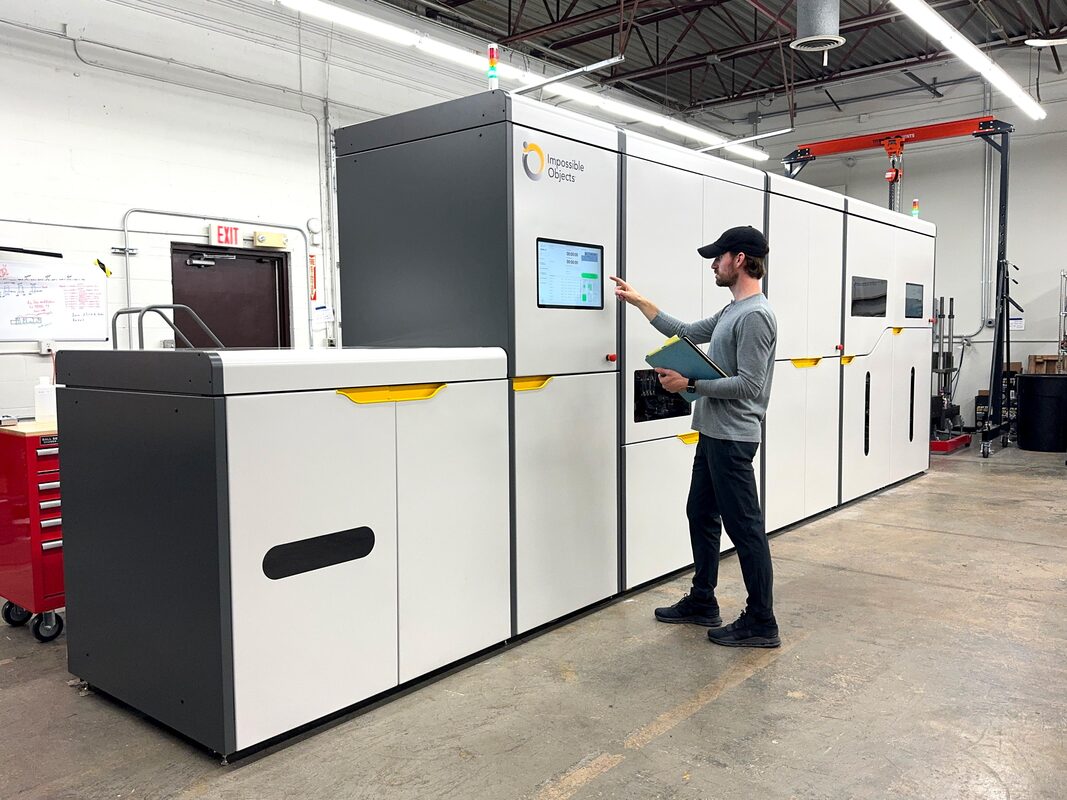
Impossible Objects, the Northbrook, Illinois-based additive manufacturing company behind Composite-Based Additive Manufacturing (CBAM) technology, has closed a $40 million Series B funding round to scale production of its flagship CBAM 25 system and meet growing customer demand. The round was reported by AOL on September 11, 2026, with Inflection Equity leading the raise and additional participation from Aaron Wealth Management, OCA Ventures, Impact Capital, and Excell Partners.
Founded in 2017, Impossible Objects operates out of facilities in Northbrook, Illinois, and Rochester, New York, and has spent recent years building out CBAM as an alternative to conventional layer-by-layer FDM and powder-bed printing for composite parts — a category where print speed and material strength have historically been at odds with each other.
What CBAM Actually Does Differently
Rather than extruding filament or fusing powder layer by layer, CBAM works by selectively depositing a fluid onto sheets of reinforcement material — carbon fiber or fiberglass — layer by layer, then fusing the stacked sheets under heat and pressure into a finished composite part. The approach lets Impossible Objects produce parts with continuous fiber reinforcement throughout, rather than the chopped or aligned fiber typical of most fiber-reinforced FDM filaments, which is part of why the company claims dramatically higher strength figures than competing processes.
The company's CBAM 25 system, according to the funding announcement, prints up to 25 layers per minute — a pace Impossible Objects says makes it 15 times faster than competing production-grade additive technologies. On the materials side, the company states its composite parts reach tensile strength up to 200 MPa, about four times the strength of parts produced by competing additive processes, with minimal shrinkage and warpage — a persistent headache in large composite and fiber-reinforced printing where uneven cooling can bend or crack a finished part.
Who's Actually Buying It
The funding announcement names a specific and notable customer list. The U.S. Air Force and the National Institute for Aviation Research are both using CBAM systems, alongside the Oregon Manufacturing Innovation Center and Rochester Institute of Technology. Perhaps the most concrete deployment cited is at the U.S. Army's Rock Island Arsenal, where a CBAM system is supporting production of up to 10,000 drone bodies per month — a volume figure that puts real weight behind Impossible Objects' pitch that CBAM has moved past prototyping and into genuine production-scale manufacturing.
That defense and aerospace-heavy customer list lines up with where composite additive manufacturing has found its clearest use case so far: parts that need to be both lightweight and strong, produced in volumes too high for hand-layup composite manufacturing but too low or too specialized to justify traditional injection molding tooling. Drone bodies in particular are a natural fit — production volumes are growing quickly as militaries and commercial operators scale up drone programs, and composite construction is standard for keeping airframes light without sacrificing structural strength.
The Money Behind the Technology
Alongside the new venture funding, Impossible Objects has previously received roughly $20 million in U.S. government contracts and awards, including Small Business Innovation Research (SBIR) Phase I and Phase II grants — a funding path common among hardware companies developing technology with clear defense and aerospace applications, where government R&D funding can de-risk early development before a company has to prove out a fully commercial customer base. The combination of that government backing and now $40 million in private venture capital suggests Impossible Objects is transitioning from an R&D-stage company proving out CBAM's technical claims to one focused squarely on scaling manufacturing capacity to meet order volume.
What It Means for the Broader Composite AM Market
Composite and continuous-fiber 3D printing has been one of the more active corners of the industrial AM market in recent years, with companies ranging from Markforged to smaller specialists all chasing the same basic value proposition: parts as strong as machined metal, at a fraction of the weight, printed rather than machined or molded. A $40 million raise for a company whose core differentiator is print speed — rather than material novelty alone — signals investor confidence that throughput, not just material strength, is becoming the deciding factor for composite AM adoption at real production volumes. Whether CBAM 25 can hold that speed advantage as competitors push their own systems faster will be the more interesting story to watch over the next funding cycle.
A Different Kind of 3D Printing Than Most Readers Know
It's worth being clear about how different CBAM is from the desktop FDM and resin printers most hobbyists and small shops use day to day. There's no spool of filament and no extruder moving over a build plate; the process more closely resembles an automated composite lay-up line crossed with a 2D printer, depositing fluid onto stacked reinforcement sheets rather than building an object up in filament beads or cured resin layers. That distinction is part of why CBAM can hit the throughput numbers it claims — the fundamental bottleneck in extrusion-based printing, where a nozzle has to physically trace out every layer's geometry, doesn't apply in the same way to a sheet-based deposition process.
It also explains why CBAM has found its footing in defense and aerospace production rather than in the hobbyist or even most industrial prototyping markets: the systems themselves are large, expensive, and purpose-built for high-volume composite part production rather than the flexible, low-volume prototyping that dominates desktop and small-shop 3D printing. For FilamentFeed's audience, Impossible Objects is less a company whose products you'll ever run on a benchtop and more a bellwether for where serious money is flowing in additive manufacturing — continuous-fiber composite production at genuine manufacturing volume, rather than one-off custom parts.
Sources
- AOL — Impossible Objects Raises $40 Million to Bring Industrial Scale to 3D Printing (September 11, 2026)
- Start Midwest — Midwest Startup Funding for the Week Ending September 11, 2026 (September 11, 2026)
