
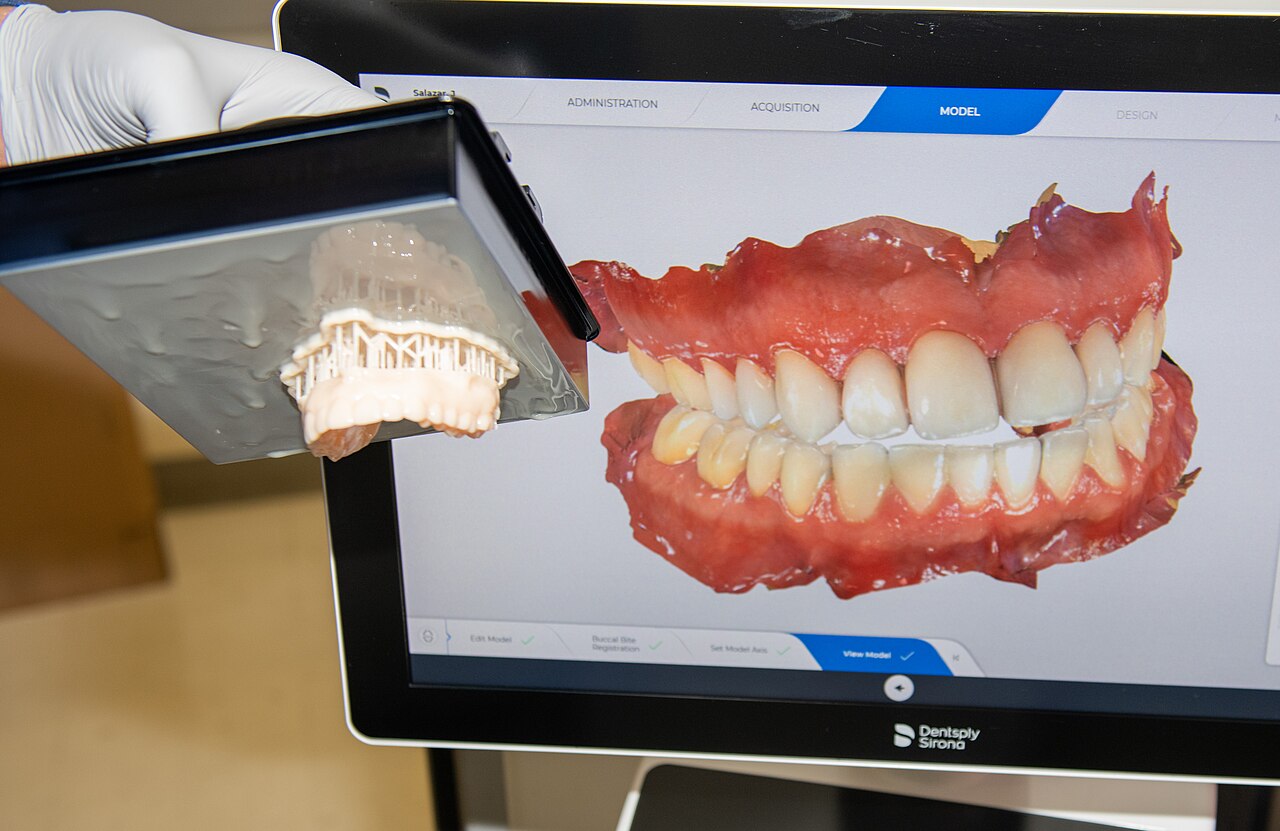
South Korean photopolymer developer Graphy has signed a supply contract worth about 2 billion won with MegaGen Implant, a Korean dental implant company. According to Finance Scope's report on Graphy's October 7 announcement, the deal covers more than a resin. MegaGen will receive Tera Harz E-Namel, Graphy's nano-ceramic-filled, light-curing resin for permanent crowns, together with 3D printers, a nitrogen curing unit and resin removal equipment. In other words, MegaGen is buying a complete production line for printed restorations, not just bottles of material.
VoxelMatters puts the value of the initial agreement at about $1.3 million. That is a modest sum by dental-industry standards. Still, the structure of the deal says a lot about where resin printing in dentistry is going, and about how material suppliers plan to make money from it.
A Material Sold as a System
The equipment list is the most telling part. A permanent-crown resin is only as good as the process wrapped around it. Print parameters, how thoroughly uncured resin is removed and how the part is post-cured all affect the final mechanical properties and biocompatibility of anything that ends up in a patient's mouth. Supplying the resin together with printers, a nitrogen curing unit and resin removal hardware lets the supplier control those variables, instead of hoping each lab copies the instructions for use correctly. Finance Scope describes the aim as an integrated material, printing and post-processing package so dental clinics and labs can start work immediately.
The nitrogen unit deserves particular attention. Anyone who has post-cured an SLA or MSLA print has run into oxygen inhibition: the thin tacky layer left on a surface when atmospheric oxygen interferes with free-radical polymerization. Curing in an inert atmosphere is a well-known fix. In a hobby part, a tacky skin is a cosmetic annoyance. In a crown, surface cure matters a great deal more. Neither source explains why the nitrogen unit is included, but its place in the package is consistent with a controlled atmosphere being part of the intended process for E-Namel rather than an optional extra.
This is the closed-ecosystem model that much of the professional resin market already follows: material, hardware and workflow supplied as one package. For a regulated product it makes commercial sense. Graphy's version is notable because it comes from a photopolymer developer, a company whose core business is chemistry, rather than from a printer maker.
Ceramic-Filled Resin Versus Zirconia
Tera Harz E-Namel belongs to a class of materials that tries to close the gap between printable polymers and milled ceramics. Finance Scope describes it as a resin with a high nano-ceramic content, designed for permanent crowns, and VoxelMatters calls it a resin for long-term dental crowns. That positioning matters. Printed temporaries are routine. Printed definitive restorations that have to survive years of chewing are a harder sell to clinicians.
MegaGen's chairman, Park Kwang Bum, offered some early evidence. VoxelMatters reports that he said roughly 50 clinical cases with the material showed shorter production times and lighter restorations compared with conventional zirconia workflows. Both points fit what you would expect. A printed crown avoids the milling, sintering and finishing steps a zirconia crown requires, and a polymer-ceramic composite is generally less dense than a fully dense ceramic.
Readers should treat those claims with appropriate caution. Fifty cases reported by the buyer of the material is a useful signal, not a controlled trial, and neither source gives follow-up periods, failure rates or wear data. Over the long run, the question for any composite crown resin is how it handles fracture, wear and discoloration over years rather than weeks. The answer will come from independent clinical literature, not from launch statements.
Regulatory Status
According to VoxelMatters, E-Namel has been cleared by South Korea's Ministry of Food and Drug Safety (MFDS). Graphy is pursuing US FDA clearance and CE marking for Europe, and the article does not report either as granted. For now, the only clearance reported is the Korean one. Both companies talk about global ambitions, so how those other regulatory processes go will shape how far the product travels.
The Ray Connection and the "K-Dental Workflow"
The MegaGen contract is part of a broader strategy. Finance Scope reports that the parties are in the final stage of negotiations on an annual supply arrangement for CBCT (cone-beam computed tomography) scanners from Ray, a digital diagnostics company. VoxelMatters adds that Graphy holds a 26.14% stake in Ray Co., Ltd., so this involves closely linked companies rather than strangers.
Taken together, the pieces outline what the companies call a "K-Dental Workflow": Ray's digital diagnostics, MegaGen's implant know-how and Graphy's 3D-printing materials working together. Graphy chairman Un-Seob Sim was quoted on the deal in the company's announcement, saying the first KRW 2 billion order is the start of the partnership and that the companies want to take the workflow to the world stage. The sources available do not provide a detailed technical description of how the workflow will be integrated. Read conservatively, it is a branded, vertically linked supply chain built around three Korean companies. Finance Scope says the CBCT agreement, if concluded, would complete the workflow.
That is a familiar strategy in dental technology, where scanner, software, mill and material vendors have long tried to lock clinics into a single digital pipeline. What stands out is that a resin chemistry company is helping to assemble the stack.
What It Means for Makers
Few FilamentFeed readers will be printing permanent crowns, and they should not try: dental restorations are regulated medical devices, and a validated process exists for good reason. But this deal is worth following for anyone who cares about where photopolymer technology is heading.
First, it shows that money and engineering effort in resin printing are increasingly concentrated in specialized, highly filled formulations. Ceramic-loaded resins are hard to print. Fillers raise viscosity, scatter light and make recoating and layer cure more sensitive. Work done to make them reliable for dentistry may well influence engineering and hobby materials later.
Second, it suggests that post-processing is part of the product. Washing and curing are not afterthoughts. Graphy is supplying dedicated resin removal and nitrogen curing hardware as part of the contract, which points to those steps mattering for the final properties of the part. Makers who struggle with tacky surfaces, brittle prints or inconsistent results from the same resin are dealing with the same physics on a smaller scale. A controlled cure environment is not exotic.
Third, the closed-system model is spreading. Material-plus-machine bundles make sense where regulators require a validated process. When the same approach shows up in less regulated markets, it usually means less freedom to mix vendors.
Bottom Line
A KRW 2 billion (about $1.3 million) initial contract will not reshape dentistry on its own. It does show a resin specialist turning a ceramic-filled crown material into a complete, vertically linked production package with a major implant company as the customer. Whether E-Namel becomes more than a Korean-cleared product depends on FDA and CE decisions and on independent long-term clinical data. Until then, it is a clear example of how high-end resin printing is being packaged and sold.
