
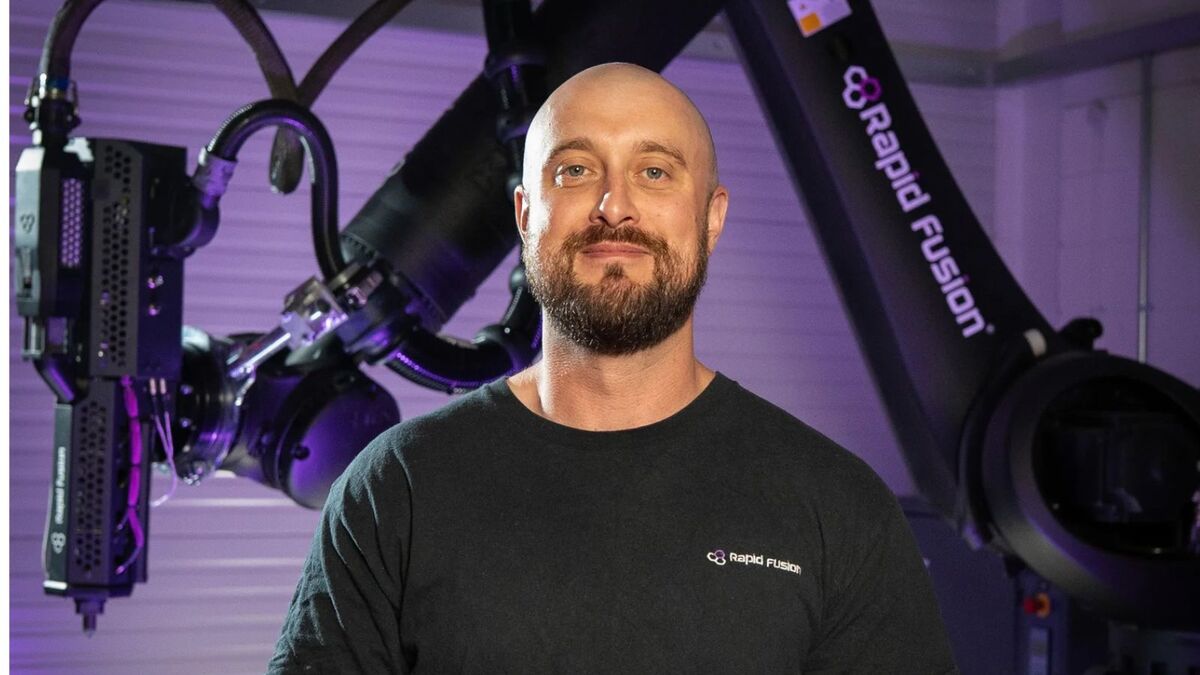
The weakest part of a large-format thermoplastic print is usually not the material. It is the seam between one layer and the next. Rapid Fusion, a large-format additive manufacturing company based in Exeter, UK, says its new robotic cell is built around that problem. The company used Formnext 2026 to unveil Prometheus, a hybrid additive and subtractive system developed with LEAM, a German specialist in layer-adhesion technology. Rapid Fusion says Prometheus is aimed at PEEK and PEI, two high-performance polymers. Its headline feature is localized heating at the layer interface, with built-in temperature sensing that adjusts the heat as the print runs. The full launch is planned for early 2027, and Rapid Fusion says customers have already signed up for the first deliveries.
This is a business story as much as a hardware one. According to VoxelMatters, Rapid Fusion expects Prometheus to bring in more than 2 million GBP (about $2.6 million) in collective revenue over two years. The company is targeting aerospace, maritime, and oil and gas customers, and the product page also lists clean mobility among its target sectors.
The Problem Prometheus Is Built to Solve
Anyone who has snapped a printed part along a layer line already understands the basic issue. Extrusion printing builds a part as a stack of beads, and each new bead has to fuse with material that has already started to cool. When that interface is too cold, the part ends up weaker in the build direction than in the plane of each layer. The gap gets wider with high-temperature engineering polymers, and it gets wider again as parts get bigger, because a large layer takes longer to complete and the material below has more time to cool before the nozzle returns.
LEAM's approach, as Rapid Fusion describes it, is to heat the exact spot where fresh material meets the layer underneath, not the whole part or the whole chamber. The adhesion nozzle delivers that heat locally. Built-in sensing reads the temperature and changes the heat input during the print. The goal is a layer interface that is hot enough to bond well, with the heat concentrated where the bond forms.
What Is Actually New Here
LEAM's technology is not new to Rapid Fusion's equipment. VoxelMatters reports that earlier versions of the LEAM system had been retrofitted onto existing Rapid Fusion cells. What changes with Prometheus is how deeply the two companies worked together. Rapid Fusion says Prometheus is the first system in which the nozzle, the sensors and the extruder were designed jointly by both firms from the start, so the layer-adhesion hardware is part of the design and not something bolted onto a finished machine.
That difference counts for more than it might seem to. A retrofit has to fit around an extruder, a mounting scheme and a control system that were never designed with it in mind. When the extruder and the adhesion nozzle are co-designed, heat delivery, sensor placement and material flow can be developed as one system. That should make the process easier to tune and repeat, although Rapid Fusion has not yet published performance figures that would let anyone measure the improvement.
Prometheus also combines additive and subtractive work in a single cell. According to the product page, the cell combines additive and subtractive work, and a print can be paused mid-build to add inserts or change the process before carrying on. For large parts made from expensive polymers, being able to machine surfaces and embed hardware partway through the build, without moving the part to another machine, is a practical advantage on its own.
Why PEEK and PEI, and Why Certification Matters
The choice of materials is where the business case becomes clearer. In remarks reported by VoxelMatters, LEAM CEO Dr Patrick Consul pointed out that PEEK and PEI are already certified across key industries. Customers who adopt Prometheus therefore would not need to pay for new material certification before using printed parts. In aerospace and oil and gas especially, qualifying a new material can take longer and cost more than buying the machine. Choosing polymers those sectors already accept removes one of the biggest obstacles to adoption.
The weak point is layer adhesion. A certified material only helps if the printed part has properties close to those the certification assumes, and parts that are weak between layers are hard to approve for structural use. By pairing well-qualified polymers with a process designed to strengthen the bond between layers, Rapid Fusion and LEAM are aiming at that gap. Whether the approach meets the requirements of a specific aerospace or offshore application will depend on testing data that has not been published yet.
A Partnership Model, Not Just a Product
Rapid Fusion managing director Jake Hand has described the LEAM agreement as a blueprint for future partnerships, VoxelMatters reports. That framing deserves attention. Large-format extrusion is a crowded field, and many companies can mount an extruder on an industrial robot arm. A cell maker that brings in specialist process technology from outside, and co-designs the hardware around it, has a way to stand out without building every subsystem itself. If the Prometheus arrangement works, more component-level partnerships of this kind seem likely, both from Rapid Fusion and from its competitors.
The revenue projection should be read as a forecast and not as booked sales. Signed customers for first deliveries are a good sign, but the more than 2 million GBP figure is Rapid Fusion's own estimate over two years, and the full reveal is still months away. For a cell aimed at heavily regulated industries, that number looks more like a measured opening market than a mass-market bet.
What It Means for Makers
Nobody will be putting a robotic PEEK cell in a garage. Even so, Prometheus is worth watching for people who print at smaller scale, because the problem it targets is the same one desktop and prosumer users deal with. Layer adhesion limits the strength of printed parts at every size, and the usual workarounds at the hobby level involve heating more of the print environment. Prometheus takes the opposite approach: heat only the bond line, measure it, and adjust in real time.
If closed-loop, interface-focused heating proves effective in industrial cells, the idea is one that could reasonably spread to smaller machines over time, although nothing announced so far points to that. The more immediate takeaway is strategic. Industrial additive manufacturing is increasingly competing on process control and material qualification, not only on build volume or deposition rate. For engineers who specify parts, or makers who send high-temperature work to service bureaus, that shift matters. Certified polymers combined with a process designed for stronger layers bring printed PEEK and PEI closer to the parts that regulated industries already buy.
The details that would settle the question are still missing, including interlayer strength figures, build envelope, pricing and delivery timing beyond early 2027. FilamentFeed will follow up when Rapid Fusion publishes them.
