
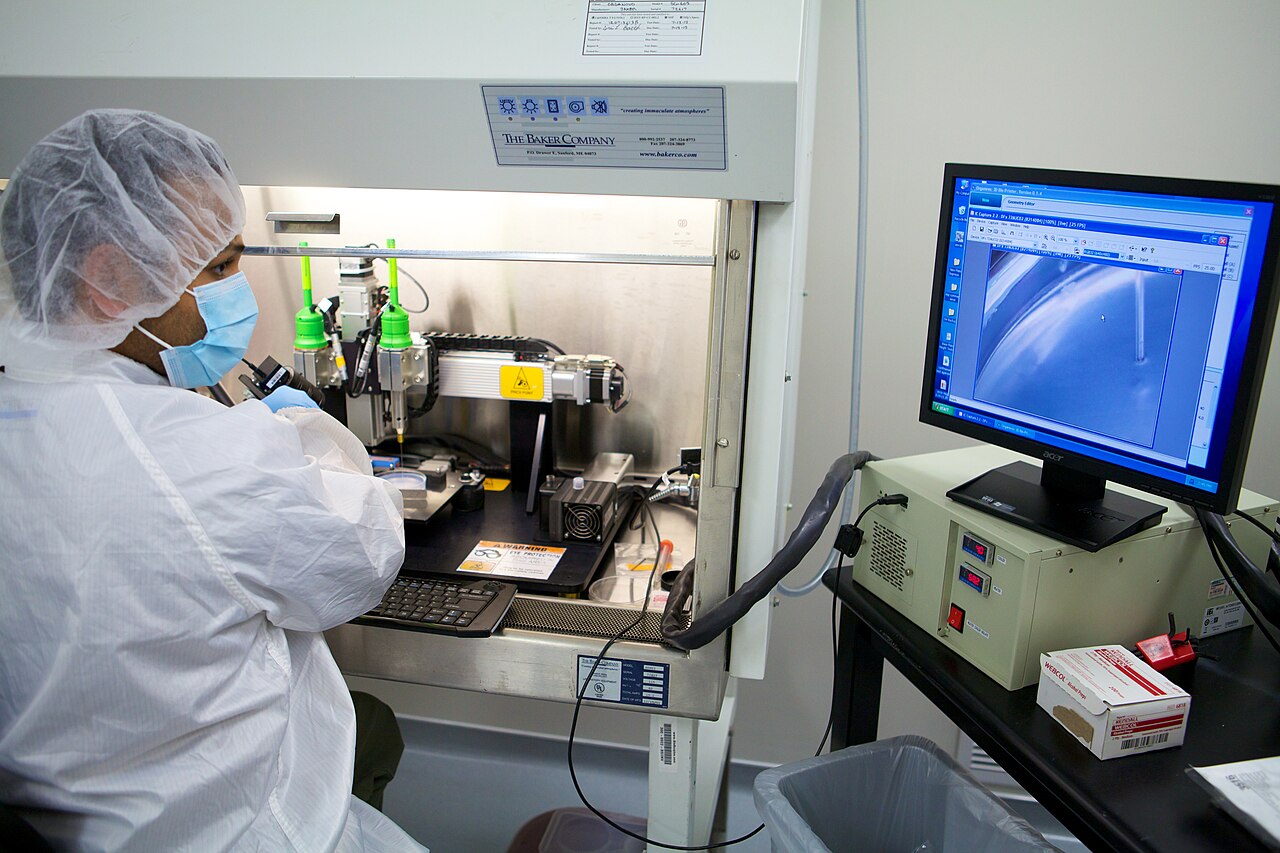
The 3D-Bioplotter has been on the market for more than 20 years and has changed hands several times along the way. Now it has a new owner. Boston biofabrication startup Linton Lifesciences has acquired the 3D-Bioplotter platform, technology and operations from EnvisionTEC GmbH, VoxelMatters reported on November 22, 2026. The report does not give a price or other terms. Linton says it will keep supporting the existing installed base while it invests in the next generation of the platform. That puts a long-lived research tool in the hands of a company that wants to use it in its own products, not just keep it alive as a legacy line.
The buyer is young. Linton launched in July 2025. The asset has been around for two decades, and its former parent group went through a bankruptcy only last year. To see why the deal makes sense, it helps to follow how the Bioplotter got here.
A Platform That Outlived Its Owners
EnvisionTEC developed the 3D-Bioplotter, and it came out of the German 3D printer manufacturer that Desktop Metal acquired in 2021. That ownership did not last. Desktop Metal filed for Chapter 11 in July 2025, and EnvisionTEC GmbH was one of the foreign subsidiaries sold to an affiliate of Anzu Partners, a US industrial technology investor.
VoxelMatters covered that step in August 2025, when a US court approved the Anzu affiliate's acquisition of EnvisionTec with no objections, and no appeals were expected. Anzu expressed a strong commitment to continuity across operations, and Managing Partner Whitney Haring-Smith said the priority was stability and honoring existing commitments to customers and suppliers. The coverage focused on EnvisionTec's polymer 3D printing systems for dental, professional and industrial use, not on bioprinting.
That gap is worth noticing. The August 2025 report describes a business built around mass-producing polymer parts, and the Bioplotter does not feature in it. A research platform used for biomaterials and regenerative medicine work sits some distance from that pitch, so it is not surprising that the Bioplotter has now moved to a buyer for whom biofabrication is the whole point rather than a side line.
Who Is Linton Lifesciences?
Linton is led by CEO Ricky Solorzano, who co-founded Allevi, a bioprinter company that 3D Systems acquired in 2021. Julio Aleman is CTO. That background matters. Solorzano has already built a bioprinting hardware company that was absorbed by one of the large AM groups, and VoxelMatters notes the deal puts him back in charge of a commercial bioprinting hardware line, this time inside a company whose main business is implant development.
The company's technical pitch is a hybrid workflow that combines advanced chemistry, robotics and 3D bioprinting, depositing synthetic polymers and human biomaterials in a single continuous build. Its first product target is specific: a biofabricated vascular graft for hemodialysis access. In April 2026 Linton introduced what it calls Biofabricated New Approach Methodologies, or bfNAMs, which are perfusable, tubular tissue models intended to replace static in vitro testing. Perfusable means fluid can be pushed through them, the way blood moves through a vessel.
Linton is part of the NextFab Ventures portfolio and was a semifinalist in Harvard Innovation Labs' 2026 President's Innovation Challenge. It now lists a site in Gladbeck, Germany, EnvisionTEC GmbH's historic home, alongside its Boston headquarters. Carlos Carvalho is Product Lead for the 3D-Bioplotter.
Why a Graft Company Wants a Printer Line
The obvious question is why a startup chasing a vascular graft would take on a hardware business with an existing customer base to support. The sources do not spell out all of Linton's reasoning, but they do offer some clues. VoxelMatters says the acquisition adds an established technology base, a global user community and deep technical expertise to Linton's biofabrication capabilities. It also says Linton can use the Bioplotter both as a revenue-generating research tool and as a production platform for its own graft and tissue-model programs.
That second role is the interesting one. A company whose main product is a printed tissue structure depends heavily on the machine that makes it. Owning the platform, its technology and the team that has run it would plausibly give Linton more control over the deposition process. A hybrid workflow that combines synthetic polymers with human biomaterials is also the kind of process that tends to benefit from tight integration between hardware, software and materials, though that is our reading rather than something Linton has said.
The installed base helps too. Existing Bioplotter users bring a support business and a community of researchers and product developers who already know the system. Linton's promise to keep supporting those users while investing in a successor suggests it sees that community as an asset rather than a liability. Whether a startup can fund both the support obligations and new platform development is a reasonable question. The deal terms, which the report does not give, would say a lot about how much room it has.
What It Means for Makers
Most FilamentFeed readers will never touch a 3D-Bioplotter. This is lab equipment, and Linton's stated first product target is a vascular graft, not a desktop product. The deal is still a useful case study in how 3D printing hardware survives consolidation, and that applies well beyond bioprinting.
- Platforms outlast owners. The Bioplotter has now gone from EnvisionTEC to Desktop Metal to an Anzu affiliate to Linton, and it is still on the market after more than 20 years. The machine kept going while the companies around it rose and fell. If you buy hardware, its long-term support depends on corporate decisions you cannot see from the spec sheet.
- Niche lines get carved out. When a broad AM portfolio breaks up, specialty products can end up with focused buyers. That can be good for users, because the new owner actually cares about the product. It can also be risky, because the new owner is smaller.
- "Continued support" is a promise, not a guarantee. Linton says it will support existing users. Anzu said something similar about continuity last year. Both are encouraging, but anyone running a Bioplotter in a lab should watch how parts, service and software updates actually get delivered from Gladbeck and Boston over the next year.
- Multi-material deposition keeps advancing. Linton's pitch of synthetic polymers and biological materials in one build is a demanding version of a problem makers know well: getting different materials to cooperate in a single print. Progress in the lab sometimes shows up in tooling and process knowledge further down the market eventually.
Bottom Line
Linton Lifesciences has bought a veteran platform that its previous owners had listed mainly as part of a polymer printing business. The startup gets an established technology base, a German operating base and an existing user community to build on as it works toward a hemodialysis graft. Bioplotter users get an owner that plans to use the platform in its own programs. The open questions are financial and practical: how much Linton paid, how it will fund support and new development at once, and what the next-generation system will look like. The VoxelMatters report does not answer any of them.
