
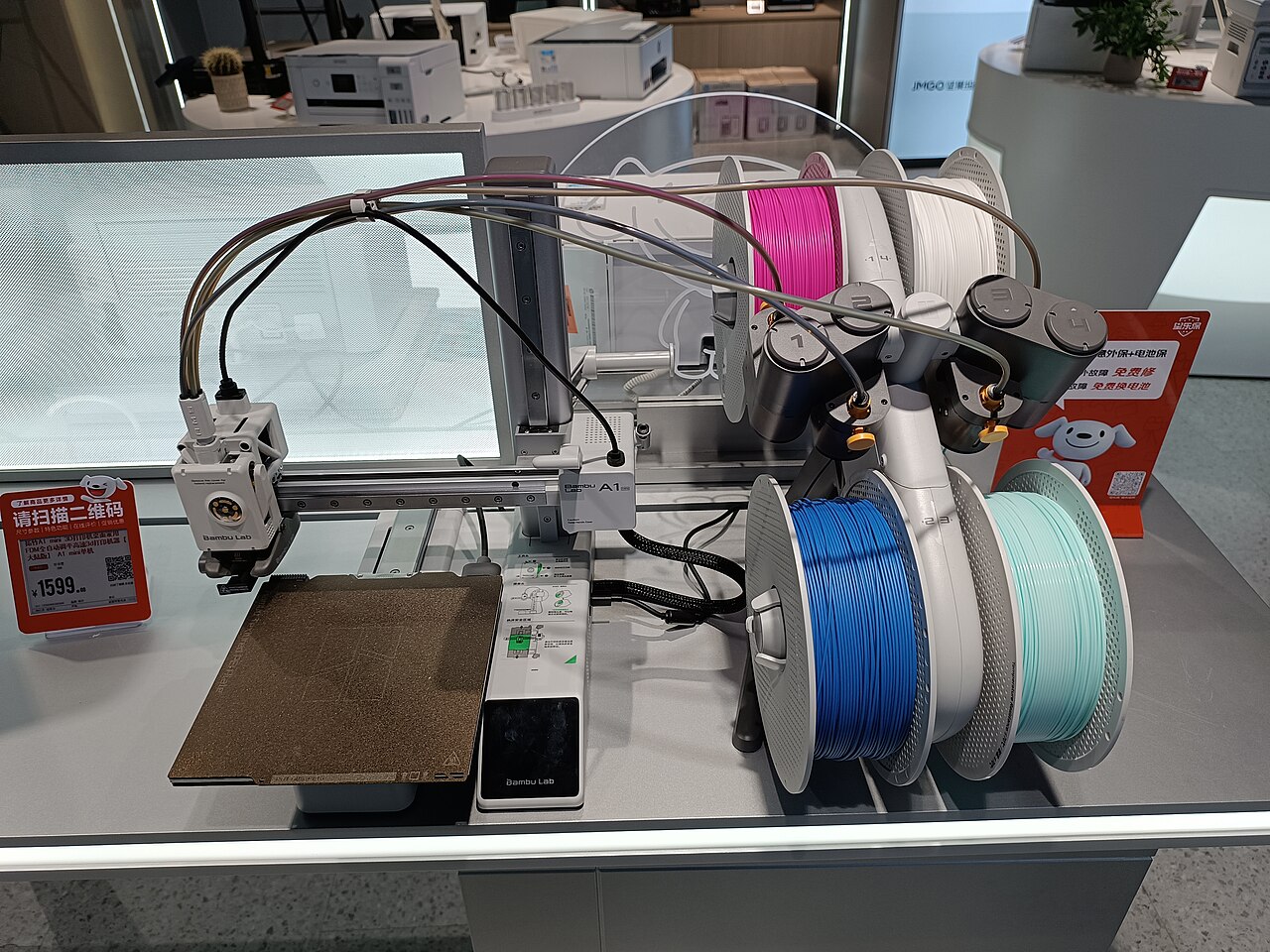
When 3D Printing Industry editor-in-chief Michael Petch toured a manufacturing facility in Shenzhen's Guangming district this past August, he wasn't looking at a prototyping shop or a hobbyist mega-garage. He was looking at a factory — one built almost entirely out of desktop FDM printers. His report on Huafast, published September 25, describes a company whose founder and CEO, known as Sven, has assembled roughly 15,000 printers across the parent company's sites in China, with 5,600 of them — all of them Bambu Lab machines, per Sven's account — concentrated at the Shenzhen location alone.
That number is worth sitting with. Most job shops that call themselves "print farms" operate in the dozens or low hundreds of machines. Huafast operates at a scale where individual printers are treated less like precision instruments and more like the injection-mold cavities or CNC spindles of a conventional factory: interchangeable units of capacity, deployed and redeployed by the thousand depending on what's selling this week.
A Factory Floor Made of Bambu Labs
The clearest illustration in Petch's report is a single order: more than 50,000 pieces of a toy product, completed in seven days. To hit that deadline, Huafast didn't queue the job on a handful of dedicated machines — it allocated somewhere between 1,000 and 2,000 printers to the run, splitting the workload across a slice of its fleet large enough that most manufacturers would recognize as an entire factory in its own right.
That kind of allocation only works if the underlying hardware is cheap, standardized, and disposable in the industrial sense — replaceable without ceremony when it wears out or when demand shifts to a different product. Desktop FDM printers, and Bambu Lab's line in particular, have become cheap and reliable enough in volume that a company can buy them by the thousand the way a garment factory buys sewing machines. Huafast's own homepage backs up the figures Petch reported firsthand, stating that the company has "deployed nearly ten thousand Bambu Lab 3D printers" and describing itself as operating a "10,000-unit scale 3D printing cluster" offering FDM OEM/ODM production, filament sales, and an upload-quote-order pipeline for customers.
Testing Demand Before Committing to Tooling
The toy order is the headline number, but the more telling detail in the report is how Huafast structures risk for its customers. Rather than committing straight to injection-mold tooling — the traditional path for any product expected to sell in volume, and one that can cost tens of thousands of dollars and take weeks to iterate — customers use the print farm to run small test batches first. According to the report, a typical test spans roughly 20 different designs, each produced in batches of 300 to 500 units, before anyone spends money on a mold. That's a fundamentally different value proposition than the one most people associate with desktop 3D printing. It's not "print instead of injection mold." It's "print to find out if injection molding is worth doing at all." The printers function as a market-research instrument as much as a production tool — cheap enough per-unit that a failed design costs a few hundred dollars in test parts rather than a five-figure tooling bill, but fast enough in aggregate that a company can still turn around tens of thousands of units if a design does take off.
Chasing Memes at Manufacturing Speed
Petch's report ties this model directly to a specific case: the Chinese animated film "Niu Lai" ("The Cow Is Coming"), whose merchandise-driving popularity spiked sharply on Google Trends, peaking around August 21, before falling off just as fast. That's the kind of viral curve that conventional toy manufacturing — with its mold lead times and shipping schedules — simply cannot respond to. By the time an injection-molded product line could be tooled up, the meme would already be dead. A print farm sized in the thousands of machines can respond inside that window. Design goes up, a batch runs, sell-through data comes back, and the farm either scales the allocation up toward the 1,000-to-2,000-printer range seen in the toy order, or drops the design and moves those machines to the next trend. It's a manufacturing model built around the half-life of internet virality rather than the multi-month planning horizons of traditional consumer goods.
What It Means for Makers
For anyone running a desktop printer at home or in a small shop, Huafast is a useful reality check on where the ceiling of "desktop FDM" actually sits. The individual hardware — largely stock Bambu Lab machines, per Sven's account to Petch — isn't exotic. What separates a hobbyist's single printer from Huafast's operation is entirely organizational: fleet management, allocation logic, and a business model willing to treat thousands of consumer-grade machines as expendable production capacity rather than precision assets to be babied. It's also a signal about where cheap, reliable desktop printers are pulling market share from. The 300-500-unit test batch described in the report is squarely in the range that used to go to short-run injection molders or overseas sampling houses. If a Shenzhen print farm can turn that work around cheaper and faster using off-the-shelf desktop hardware, it puts pressure on that entire tier of the manufacturing supply chain — not the big injection-molding runs, but the testing and validation step that comes before them. For competitors trying to build farms of their own, the more actionable number isn't 15,000 — it's 1,000 to 2,000. That's the size of allocation Huafast could stand up for a single rush order without disrupting its other work, and it suggests the real infrastructure challenge isn't buying printers, it's the software and logistics layer that can route a 50,000-piece job across that many machines and have it done in a week.
