
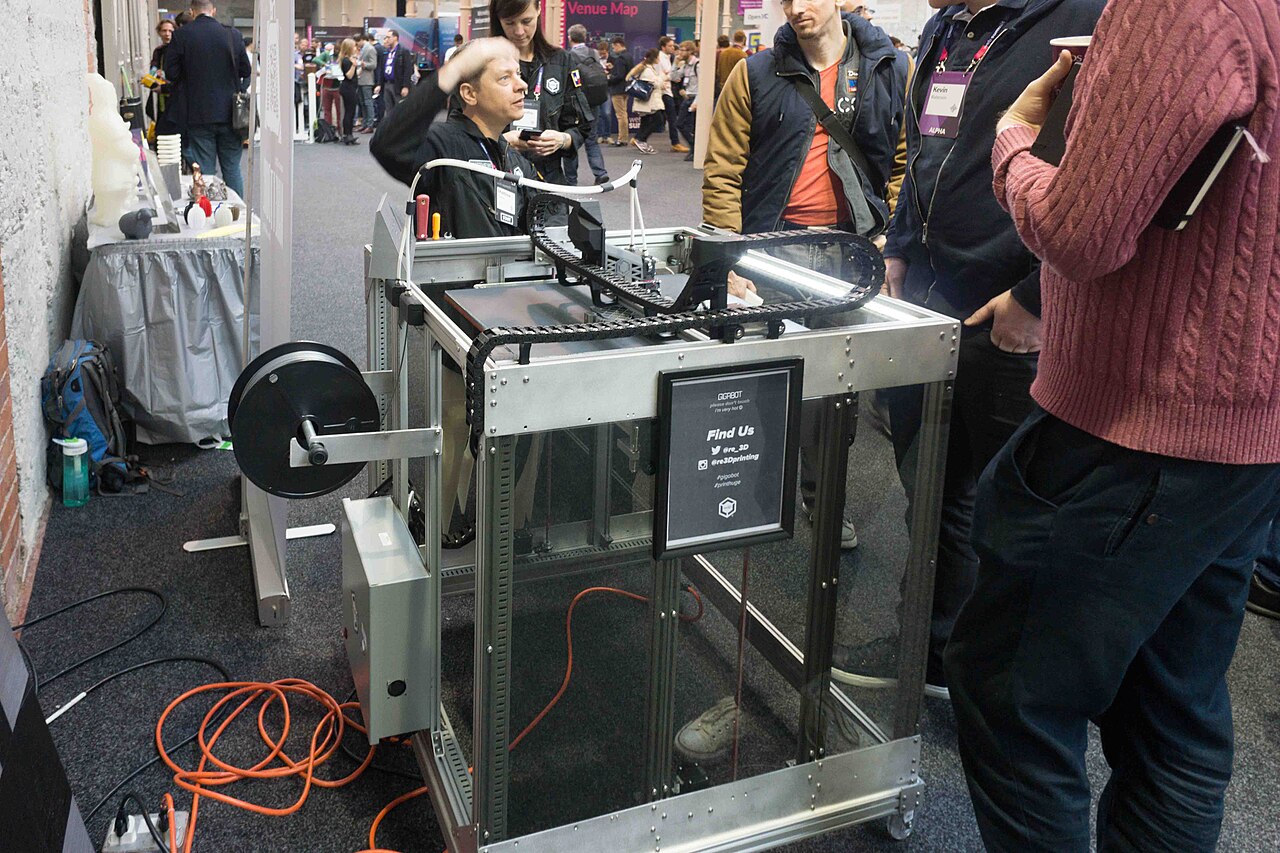
Massivit 3D, the Israeli additive manufacturing company known for its large-format Cast-in-Motion (CIM) printers, is bringing its RapidWings tooling-as-a-service platform to North America, according to a press release published Sept. 16 by the company. The move pairs Massivit with Artek, a manufacturing and design firm in Portland, Oregon, to open a service center that will print large-format molds, jigs, fixtures, and mandrels for aerospace and defense customers on demand.
If tooling doesn't sound like the most exciting corner of 3D printing, it's worth remembering how much of the industry's economics run through it. Composite parts — the carbon-fiber and fiberglass layups that make up wing sections, fairings, and structural panels on aircraft — are only as fast to produce as the molds they're laid up on. Those molds are traditionally machined from tooling board or cast in metal, a process that can eat months of lead time and tie up a facility's own CNC and pattern-making capacity before a single composite part gets made. Massivit's pitch with RapidWings is to compress that timeline into days by printing the tooling instead.
The Portland service center isn't limited to production tooling, either. Per Massivit's press release, the site is also set up to handle on-demand prototyping and demonstration work — meaning an aerospace or defense engineer can walk in with a design that needs validating on a physical mold or fixture well before it's locked in for production, rather than waiting on a full tooling order to see whether a part geometry actually works. That's a meaningfully different service offering than a traditional tooling vendor, which typically wants a finalized design before it will quote a job, because the mold itself represents a large chunk of the up-front cost.
What Cast-in-Motion actually does
CIM is Massivit's proprietary process, and it isn't quite like a standard FDM or resin print scaled up. The system deposits a dual-component material — developed in partnership with materials giant Sika — that cures as it's laid down, building large, hollow-shelled structures. According to Massivit, the resulting molds, masters, and mandrels are isotropic (meaning their mechanical properties are consistent in every direction, unlike many 3D-printed parts that are weaker across layer lines) and rated to survive hundreds of production cycles — enough for genuine short-to-medium-run manufacturing rather than a one-off prototype.
The company says the process cuts tooling lead times by 90 percent, turning what might be a months-long procurement and machining cycle into a matter of days. That number comes from Massivit's own materials, so it's a claim rather than an independently audited benchmark — but the underlying logic tracks with how additive tooling has generally performed elsewhere in the industry: printing a mold outright skips the raw-stock machining, hand-finishing, and pattern-shop scheduling that dominate conventional tooling timelines.
Why Artek, and why Portland
Rather than opening its own American facility from scratch, Massivit is licensing CIM into an existing certified Tier-2 composite manufacturer, which is the structure behind RapidWings generally. The company calls these partners its "Joint Manufacturing Alliance," and according to a report from 3D Printing Industry published Sept. 22, Massivit claims a five-day design-to-finished-part turnaround across that partner network. Artek, as the Portland node, becomes the first North American stop for a platform Massivit has already been running in other regions.
That licensing model matters for how quickly this can scale. Instead of asking every new market to build out CIM printing capability and qualify it from zero, Massivit drops its hardware and process into a facility that's already doing certified composite work — Artek's existing quality systems and customer relationships do a lot of the heavy lifting. Artek CEO Sam Reiser is quoted by 3D Printing Industry saying the deal will help U.S. manufacturers shorten tooling lead times, which is a modest way of describing what amounts to a new supply option for a sector that has historically had few fast ones.
Massivit CEO Yossi Azarzar framed the expansion in more geopolitical terms, telling 3D Printing Industry: "RapidWings is transforming Aerospace and Defense infrastructure across multiple regions, allowing both governments and industry to accomplish sovereign, autonomous production at the point of need." That "sovereign production" framing isn't incidental — defense primes and government buyers have spent the past several years pushing hard on domestic and allied manufacturing resilience, and a tooling process that can stand up locally on short notice fits squarely into that priority. The report also notes that Massivit's U.S. subsidiary already holds an active SAM.gov registration and CAGE code, the administrative prerequisites for bidding directly on federal contracts — a detail that signals this isn't purely a commercial-market play.
What It Means for Makers
For hobbyists and desktop-printer owners, RapidWings itself is not something you'll ever touch — Massivit's CIM systems are industrial equipment aimed at aerospace-grade tooling, priced and scaled well outside the maker market. But the underlying trend is worth watching. Large-format additive tooling has been creeping steadily downstream from aerospace primes toward smaller composite shops for several years, and every time a platform like this proves out a faster, cheaper way to make molds, some version of that capability eventually filters into the tooling supply chain that smaller manufacturers — including the composite-boat builders, custom fabricators, and prototyping shops that makers sometimes freelance for — depend on.
There's also a broader signal here about where 3D printing's most defensible business models are heading. Consumer and prosumer printer sales are a brutally competitive, thin-margin market. Service platforms that sell outcomes — a finished mold delivered in days, rather than a machine sold once — are proving to be where companies like Massivit can actually build recurring revenue. If you're a maker thinking about where the industry's money is flowing, tooling-as-a-service for regulated, high-value sectors like aerospace and defense is increasingly the answer, even if the printers doing the work never show up on a maker's bench.
Sources
- Massivit Expands RapidWings Platform, Delivering Services in North America — Massivit 3D press release, Sept. 16, 2026
- Massivit Brings RapidWings Composite Tooling Platform to North America — 3D Printing Industry, Sept. 22, 2026
