
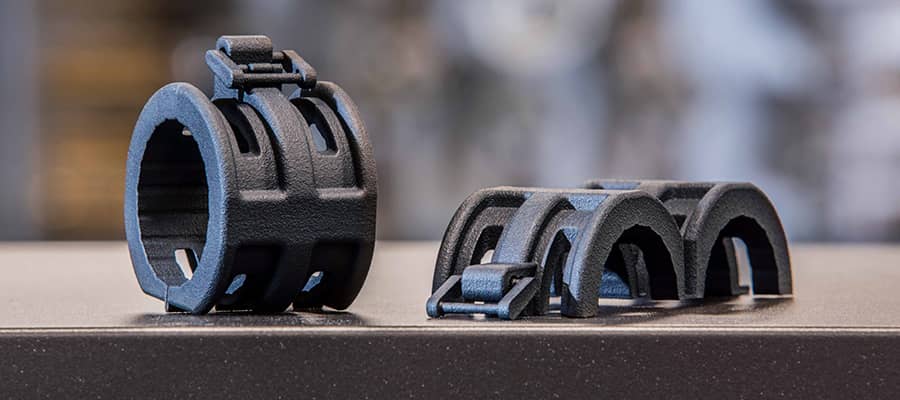
Protolabs, the digital manufacturing service that many engineers know as the place to get quick-turn parts, has increased its HP Jet Fusion 5600 series capacity by 50%. In a press release distributed on Business Wire on November 3 (read via mirror), the company gave a plain reason: drone makers want more parts. Protolabs (NYSE: PRLB) says Multi Jet Fusion revenue at its US factories grew more than 40% year over year through the third quarter of 2026, and drone customers account for part of that growth.
The numbers in the drone segment stand out even more. Protolabs says it now serves more than 100 drone manufacturers, and revenue from that segment has risen more than 90% since 2023. The company puts the compound annual growth rate at nearly 40%. Some service bureaus add machines because they expect demand. Here, Protolabs says demand is already growing, and the new machines follow it.
Why Drones, and Why MJF
It makes sense that drones and powder-bed nylon go together. Small and mid-size uncrewed aircraft go through design changes quickly. Airframes, mounts, enclosures and fairings change from one version to the next, and the first production runs are often small enough that injection-mold tooling is hard to justify. A process that turns out functional nylon parts in useful quantities, without tooling, fits that cycle well.
According to TCT Magazine's coverage of the expansion, lightweighting with MJF uses Nylon PA-12, which the company describes as an impact-resistant material with an exceptional strength-to-weight ratio, ideal for demanding drone applications. On a drone, weight affects everything else. Every gram saved in structure can go to battery, payload or flight time, so a material and process that allow optimized, low-mass geometry is worth a lot to these customers.
TCT also says Protolabs expects the HP 5600 series to enable higher build density, so more MJF parts can be printed at once. This is where service bureau economics are decided. In a powder-bed process, the build volume is the unit of production, and how tightly parts can be nested in that volume largely sets throughput and cost per part. Adding machines raises capacity in a straight line. Fitting more parts into each build multiplies that gain.
The Defense and Aerospace Angle
Protolabs presents the expansion as a response to aerospace, defense and drone demand together, and its compliance credentials point the same way. TCT reports that the parts are made at Protolabs' North Carolina factory, which is ITAR registered and holds AS9100D and ISO 9001:2015 certifications.
Each of those matters for a different reason. ITAR registration lets a US supplier handle defense-related technical data and articles under export controls. Many drone programs need that, especially those near military or government work. AS9100D is the aerospace quality management standard, and ISO 9001:2015 is the general quality baseline beneath it. For a drone startup trying to sell into defense, a supplier with these already in place removes a qualification step the startup would otherwise have to handle itself.
The release quotes CEO Suresh Krishna on the company's role in scaling drone and aerospace customers. The underlying business case is simple. A customer who prototypes with a service provider and then moves to small production runs at the same provider, under the same quality system, tends to stay.
Reading the Numbers Carefully
Readers should note what the figures cover and what they leave out. The 40%-plus growth figure applies to MJF revenue at Protolabs' US factories, not to the company's total revenue or its full 3D printing business. The release says the growth was driven "in part" by drone customers, so it does not say what share of MJF revenue comes from drones. The 90%-plus segment increase covers the period since 2023, and the nearly 40% CAGR is the company's figure for that same span.
Read together, the figures show strong growth in one process line, led by one fast-growing customer category, rather than a turnaround for the whole company. The 50% capacity increase applies specifically to the HP Jet Fusion 5600 series fleet. The release gives no machine counts, so it does not say how many printers that represents.
Even so, a company like Protolabs does not add half again its capacity in a process line on a hunch. The decision suggests the company expects drone and aerospace demand to keep growing, at least for the next few planning cycles.
What It Means for Makers
Most FilamentFeed readers do not run HP Jet Fusion 5600s in their garages, but the news is still relevant to them for a few reasons.
First, it supports nylon powder-bed fusion as a production process. Hobbyists often see MJF as the expensive upgrade from FDM prototypes. Protolabs' figures show it working as a manufacturing method for real flying hardware, sold to more than 100 drone makers. If you design drone frames, camera mounts or other weight-sensitive parts, PA-12 from a service bureau is a reasonable path to small production runs, and you don't need to wait until you can justify an injection mold.
Second, more capacity usually means shorter queues. When a large service provider adds 50% to a machine fleet, smaller orders tend to get through faster, at least until demand catches up. If you have been holding a run of nylon parts because of lead times, it may be worth requesting a new quote.
Third, designing for build density helps your costs. Bureaus profit when parts nest well. If you design parts that are compact, avoid unnecessary bulk and orient sensibly in a powder bed, you are working with the economics that drove this expansion. Lightweighting is good for flight time, and it is also usually good for your quote.
Finally, the drone sector looks like a growing customer for additive manufacturing. Customer segments that grow quickly tend to attract investment in materials, machines and software. Makers who build drones may see more material choices aimed at them, as large suppliers build capacity around that market.
Bottom Line
Protolabs' 50% Multi Jet Fusion expansion follows what it describes as clear demand: more than 40% growth in US MJF revenue and a drone segment up more than 90% since 2023. The PA-12 parts come from a North Carolina factory with ITAR registration and aerospace-grade certifications, which makes the offering credible for defense-adjacent work. For makers, the takeaway is practical. Nylon powder-bed fusion is a proven way to produce light, functional drone hardware, and service capacity for it is growing.
