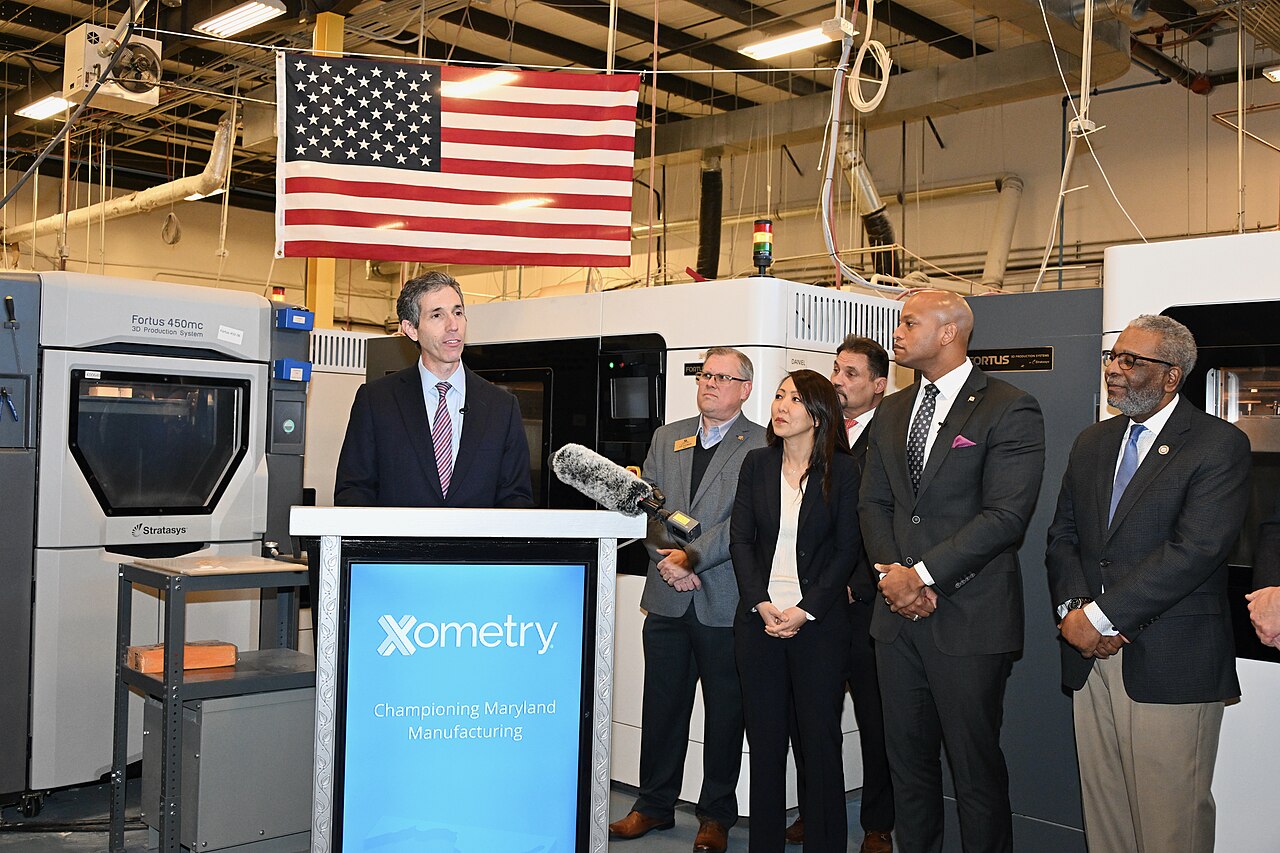
Xometry, the on-demand custom manufacturing marketplace that sits between engineering buyers and the shops that make their parts, reported the strongest quarter in its history on November 3. According to the company's third-quarter 2026 results release (via mirror), revenue rose 40% year over year to $252 million and marketplace revenue climbed 43% to $238 million. CEO Sanjeev Singh Sahni said the company has now passed a $1 billion revenue run rate. For anyone running a print farm, a small service bureau or a job shop that takes outsourced parts work, the numbers are worth reading closely. They say a lot about demand for custom parts bought online, and they also show how much of that demand now runs through one intermediary.
The Numbers
The headline figures are strong across the board. Per the release, gross profit grew 37% to $98.7 million, total gross margin was 39.1%, and marketplace gross margin hit a record 36.0%. Adjusted EBITDA reached $21.4 million, up $15.3 million from a year earlier. CFO James Miln pointed out that this is the second quarter in a row with growth around 40%. That matters because a single strong quarter can be a one-off order spike. Two in a row looks more like a trend.
VoxelMatters' breakdown of the results adds detail. Revenue for the quarter ended September 30 came to $252.4 million. Net income attributable to common stockholders was $1.9 million, compared with a net loss of $11.6 million a year earlier. It is a thin profit, but it is a profit, and it reverses a meaningful loss. Adjusted EBITDA margin was 8.5%, up 510 basis points. The company ended the quarter with $505 million in cash and marketable securities.
Not every segment is growing. Services revenue, which sits outside the core marketplace, rose just 2% to $14.4 million. Nearly all of Xometry's growth is coming from the marketplace, where buyers place orders and the parts get made.
Who Is Buying
Buyer metrics may matter more than the revenue line, because they show whether growth comes from more customers or from bigger ones. Here the answer is both. VoxelMatters reports that active buyers rose 20% to 93,812, with 4,255 net additions. Accounts that spent $50,000 or more over the prior 12 months grew faster still, up 26% to 2,172.
Large accounts growing faster than the overall buyer base is consistent with existing customers moving more of their procurement onto the platform. They are not just trying it once for a prototype. Customers that spend $50,000 a year on outsourced parts tend to be engineering organizations with recurring needs. Their growing presence suggests that online, quote-driven buying is becoming a normal procurement channel rather than a fallback for urgent jobs.
A Raised Outlook
Management expects the momentum to continue. VoxelMatters reports fourth-quarter revenue guidance of $254 million to $256 million, which would be 32% to 33% growth, with adjusted EBITDA of $22 million to $22.5 million. The company raised its full-year growth outlook to at least 37%, up from a previous 33% to 34%. It expects full-year adjusted EBITDA of $68 million to $68.5 million, compared with $18.5 million in 2025.
That jump in adjusted EBITDA, from about $18.5 million to about $68 million in one year, is the clearest sign of where the business is heading. Xometry is not just getting bigger. It is turning more of each dollar of revenue into adjusted operating profit. The release describes the company as an "AI-native marketplace." The release does not detail how that translates into margin, but automated quoting and order routing are plausible levers. Investors will want to see whether that framing holds up over time. The margin numbers suggest something is working for now.
What It Means for Makers
For small print shops and service bureaus, these results cut two ways.
The demand signal is real. Marketplace revenue up 43% and active buyers up 20% mean more companies are getting custom parts made by someone else and ordering them online. The release does not say how much of that is 3D printing, so treat it as a read on the wider market for outsourced custom parts rather than printing alone. If you have been wondering whether there is still room in contract manufacturing, a $238 million marketplace quarter suggests demand is growing, not shrinking. Faster growth among $50,000-plus accounts also hints at repeat, production-style work, not only one-off prototypes.
The platform is capturing more of the value. A record 36.0% marketplace gross margin means Xometry keeps more of each marketplace dollar as gross profit. That is good news for shareholders. For the shops that actually make the parts, it is worth thinking through. The release does not break out what happens to fulfillment pricing, and we won't guess. Still, the basic arithmetic of a marketplace applies: when the intermediary's margin goes up, the difference has to come from higher buyer prices, lower fulfillment costs, or both.
Independent channels still matter. The case for running your own storefront, quoting directly and building repeat relationships with local engineering firms doesn't get weaker when a marketplace grows. If anything it gets stronger. Large platforms train buyers to expect instant quotes and fast turnaround, and shops that match those expectations on their own terms can compete for the same customers without giving up a cut. Treat marketplace work as a way to fill spare capacity and keep your own customers as the core business.
Watch the guidance, not just the record. Fourth-quarter guidance implies growth slowing from about 40% to the low 30s. That is still fast, but it is worth tracking. If demand for outsourced parts is cooling at the margin, the platforms will feel it first, and the shops downstream of them will feel it soon after.
Bottom Line
Xometry's third quarter answers two questions at once. Demand for custom parts ordered online is growing quickly, among both new buyers and large repeat accounts. The company sitting between those buyers and the shops that make the parts is also getting better at turning that demand into profit. For makers who sell printed parts, the opportunity is getting bigger, and so is the platform taking a cut of it. Use the marketplace where it helps, and keep building customers of your own.