
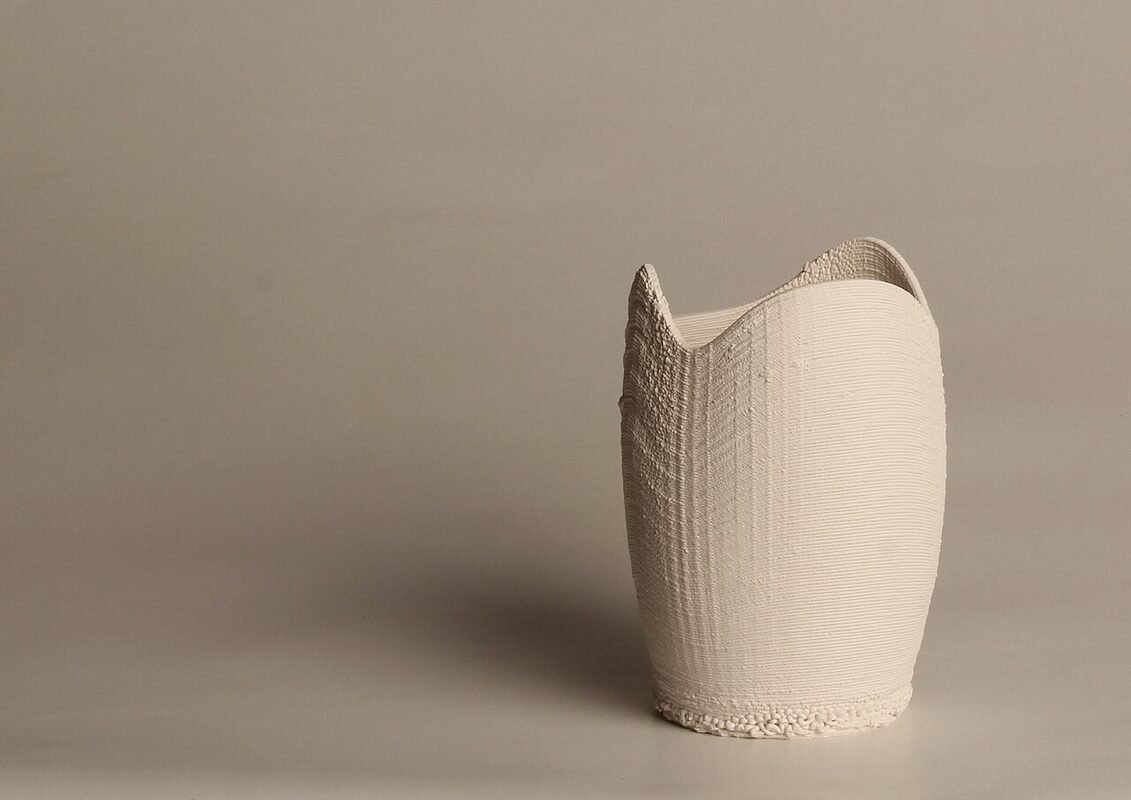
Paste-extrusion ceramic printing has always had an unforgiving failure mode. A void or a blob of excess material in layer forty stays in the part, survives debinding, and comes out of the kiln as a crack or a weak spot. Hydra Manufacturing, a spin-out from the University of Leeds, thinks the printer should catch those mistakes and fix them before the next layer covers them up. Its Ceramic Hybrid Additive Manufacturing Platform, or CHAMP, pairs a paste extruder with a milling spindle inside the same machine. Defect-detection software watches the build, and when it finds a problem the spindle cuts the bad material away and the printer lays the layer down again. In an interview with 3D Printing Industry published November 16, ahead of Formnext, CEO Louis Masters described what the approach has achieved so far and which parts are still being validated.
How the Repair Loop Works
What sets CHAMP apart is that the spindle is used to correct errors as they happen, not only to finish the part at the end. Masters said the idea came out of his doctorate, when he labelled thousands of images of printing defects by hand, boxing the places where the machine had deposited too much paste or too little, to teach the software to recognise them. Hydra's site says the AI-powered defect detection "autonomously fixes problems mid-print." According to the 3D Printing Industry interview, the machine deals with two kinds of error in different ways.
For voids and other under-deposition, the spindle cuts back to the previous layer, removing the flawed material, and the machine rewinds the print instructions and prints that layer again, adjusting extrusion pressure to reduce the chance of repeating the error. For over-deposition, where too much paste has piled up, the spindle skims the excess down to a reference height so the next layer starts on a flat, known surface. Masters said most 3D printers cannot do anything to repair a defect once it has happened, and the point of the spindle is to deal with the fault before the next pass buries it.
Hydra has published figures on how well this works. Tests published in the journal Additive Manufacturing used CT scans to show 68% less void content in reworked specimens than in unrepaired ones. The 68% figure applies specifically to void content in the test specimens. For ceramics, where voids are the kind of flaw that can turn into cracks, that is a meaningful result, but it is a laboratory result. Hydra's software enlarges the starting geometry to allow for sintering shrinkage, adds stock for the cutter and adjusts layer heights for shrinkage during drying, yet the company says it is still validating how closely the fired component keeps its intended tolerance across different geometries. That is the question production buyers will care about most.
The Economics Behind It
Hydra's case rests on two cost problems in technical ceramics. The first is machining. Masters estimates that grinding or machining can account for as much as 80% of the cost of a finished product in demanding cases involving wear-resistant materials such as silicon carbide. Before firing, the binder holds the ceramic particles together and the cutter meets a much weaker body, so the aim is to finish surfaces while less expensive tools still do the job and leave as little grinding as possible after the furnace. A second reason for the spindle is access: CHAMP can deposit and dry part of a component, cut a surface while it is exposed, then resume building around it.
The second is time. Masters described a typical sequence with Hydra's lower-binder feedstocks: after printing, the component dries overnight, and binder removal and sintering then take place in one furnace cycle of about 18 hours, or around 24 including cooldown. He compared that with some photopolymer-based ceramic builds, which he said can require five days for binder removal alone to limit cracking. He also granted light-based processes the advantage on very fine features and intricate geometries. That is the basis for the claim on Hydra's website that it can deliver production-quality parts "in days, not weeks."
Materials and Market
The company says CHAMP works with "an expanding range of ceramic pastes." At Formnext, Hydra plans to show samples in alumina, tungsten carbide and hydroxyapatite. Silicon carbide, which matters most to the machining-cost argument and which Masters sees as particularly promising, was still in the final stages of qualification at the time of the interview.
Hydra initially expected aerospace, medical and energy customers to lead demand, but Masters said much of its work so far has come from defence and electronics. The company sold its first machine to Lucideon, a materials development company, about seven days after Hydra registered, though the discussions had begun well before incorporation. A prospective customer can also submit its own material for printing trials, after which Hydra reports on how the formulation behaves and makes test coupons with features from the customer's component.
The research goes back several years. A University of Leeds project record lists a CHAMP project running from 1 June 2021 to 31 May 2027, worth £300,000. Professor Robert Kay is primary investigator and Matthew Shuttleworth is co-investigator, and Louis Masters is listed among the postgraduate students alongside Daniel Davie and Conor Farrel-John. The project's stated targets are ceramics for energy, chemical processing, aerospace and electronics, all fields where complex ceramic shapes are valuable and expensive to machine.
Visitors to Formnext can hear the company in person: Hydra is giving a talk with FastCast Ceramics on Tuesday, November 17, at 14:00 CET in Hall 12.0, Stand F139.
What It Means for Makers
CHAMP is an industrial research platform, not a desktop machine. Hydra has not published pricing, and its work so far has come from Lucideon, defence and electronics projects. Still, the idea behind it will be familiar to anyone who has tuned a printer at home.
Hobby printers increasingly use cameras and sensors to detect failures, and most of that detection ends in pausing a print or stopping it. Masters' point is that few machines can do anything once a defect has happened. A tool that cuts out a bad layer and redoes it turns a print from something you commit to layer by layer into something that can be edited during the build. That only works with materials that are machinable while green, as ceramic paste is, but it shows where in-process repair could go.
Makers already doing clay or ceramic paste extrusion, using ram or auger extruders on modified delta or Cartesian frames, will find the figures useful. Voids are a familiar failure in that work, and the 68% reduction shows how much a repair pass can cut void content in lab specimens. The firing times are worth noting too: Hydra's single furnace cycle of about 18 hours is far shorter than the five days Masters cited for binder removal in some resin-based processes.
Some caution is warranted. The void reduction is a published lab result, tolerance retention after firing is still being validated, and silicon carbide is not yet qualified. The repair loop and the economic argument for it make sense. Whether the parts hold their dimensions through the kiln is the evidence still to come.
