
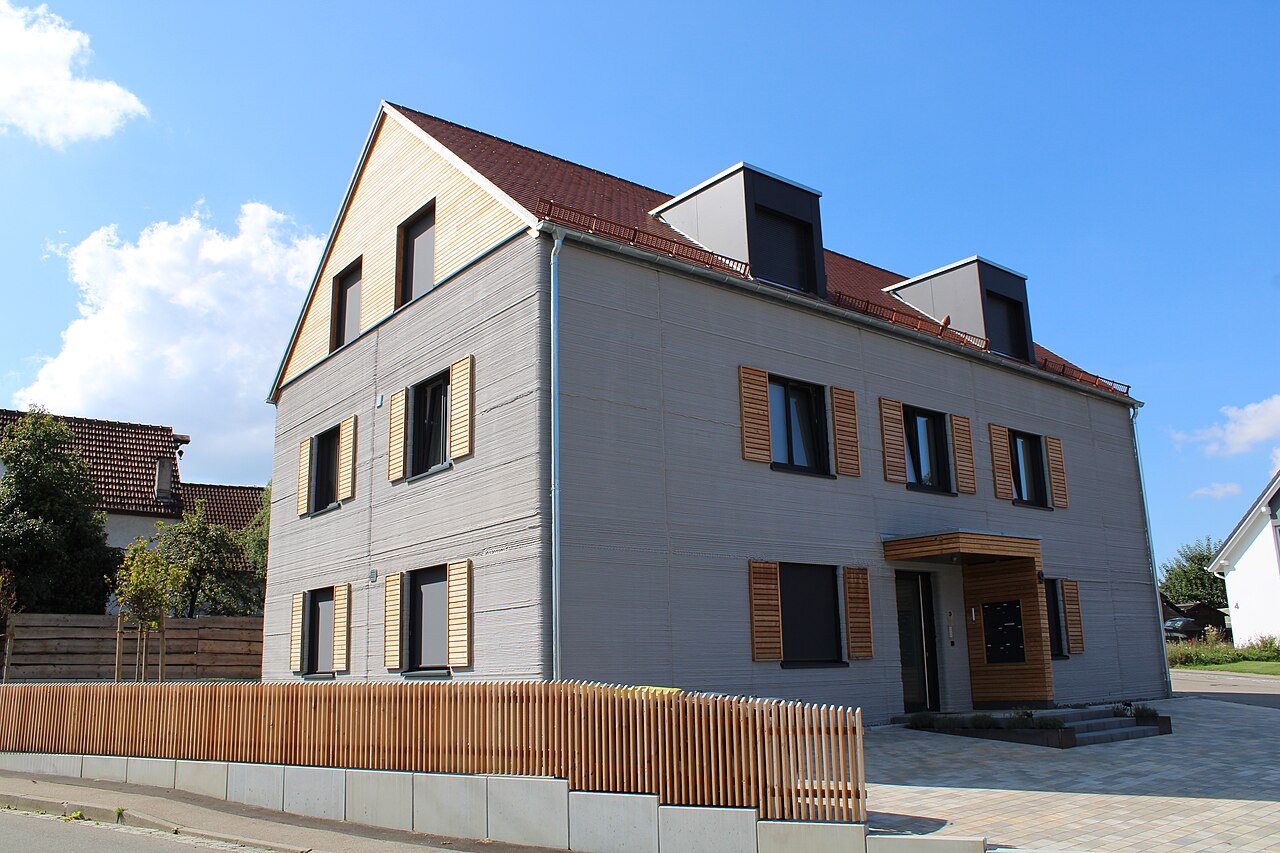
ICON, the Austin-based company that prints buildings, has raised $200 million in a Series D round. In an announcement on its newsroom dated October 13, 2026, ICON said Baillie Gifford and funds managed by BlackRock co-led the round. Capital Factory, CAZ Investments, Moderne Ventures, Moonshots Capital, Norwest, Overmatch, The Syndicate and Tiger Global also took part, among others. The company says the money will pay for manufacturing and deploying its robotic construction systems, building a large research and development facility in Austin, and expanding into new markets. ICON also says it is on pace for 4x revenue growth in 2026 and has now built more than 270 homes and structures.
Most readers of this site work with extruders that fit on a desk. Still, the two kinds of printing share more than people tend to admit. ICON's main bet is large-format extrusion: laying down building material bead by bead under machine control. The questions this round raises are familiar ones: can the machines be built in volume, does the business keep growing, and will anyone pay for the output at scale? The desktop market has faced the same questions.
Where the Money Is Going
ICON's announcement names several priorities. The first is manufacturing and deploying its robotic systems, and the company highlights the first commercial rollout of its Titan Print System as one of its milestones. The second is a large new R&D facility in Austin, where ICON is already based. The announcement also names both Titan and Olympus as technologies the money will help advance. TCT Magazine's report on the round repeats the geographic picture: expansion across Texas, Florida and Washington, D.C., along with new US markets.
The order of those priorities is worth noticing. A company that leads with "manufacture and deploy" is signaling that its bottleneck is now production capacity and field operations, not proving that the technology works. That is a different stage from simply showing that a printed structure can be built. Passing 270 homes and structures does not by itself prove the economics. It does mean ICON has a meaningful operating history behind its pitch to investors.
The investor list also says something about how ICON is positioned. Baillie Gifford and BlackRock are large institutional investors, and Baillie Gifford's Luke Ward describes his firm as a long-term investor. The other participants add venture and growth investors to that institutional core. A syndicate this wide suggests ICON is being pitched as a construction-industry company that happens to use printing, rather than as a 3D-printing company looking for a market.
The Case ICON Is Making
ICON's announcement leans heavily on macro numbers. It describes construction as a $16 trillion global industry. It cites a shortfall of roughly 4 million homes in the US. It points to a workforce problem: just 10 percent of US construction workers are under 25, and 41 percent of the current workforce is expected to retire by 2031.
The labor figures are the core of the argument. If the trades cannot replace retiring workers fast enough, automation becomes a way to keep building at all, not just a way to cut costs. A printer that extrudes wall assemblies does not remove the need for electricians, plumbers or roofers. It does take on a structurally significant, labor-heavy part of the job. Read this way, ICON's growth target is a bet that demographics will push builders toward machines whether or not they are enthusiastic about them.
The announcement includes statements from CEO Jason Ballard and from Luke Ward of Baillie Gifford about the company's direction and the investment thesis. As expected in a funding release, the message is ambition: Ballard says the round puts "that reality in builders' hands" and speaks of ending the global housing crisis in his lifetime, not of winning a niche.
Reading the Growth Claim Carefully
Two of ICON's figures deserve a skeptical reading. "On pace for 4x revenue growth in 2026" is a projection for a year that is not over, and the announcement does not give a base revenue figure. A fourfold increase on a small number and a fourfold increase on a large one are very different stories, and the announcement does not say which this is. The 270 count is cumulative and covers "homes and structures" across five states and two countries, so it mixes project types. It is a useful sign of operating experience, but it is not a production rate.
That is not a criticism unique to ICON. Late-stage private companies rarely disclose absolute revenue, and growth multiples are the standard currency of funding announcements. Readers should simply treat them as directional until more detail is available.
What It Means for Makers
For people who run printers at home or in a small shop, ICON's round matters in a few concrete ways.
Extrusion is going mainstream at the largest scale. The same basic process that runs a desktop FDM machine, a toolpath turned into stacked beads, is now attracting institutional capital to build houses. That brings attention, and eventually talent and tooling, to problems makers already know well: layer adhesion, material rheology, toolpath planning and how a part's strength depends on direction.
Manufacturing the machines is the real story. The first use of funds ICON lists is building and deploying its robotic systems, and the announcement says the round will initiate production and manufacturing of Titan at its Austin factory. Anyone who has watched a desktop printer company scale knows the hard part is rarely the first good print. It is making the five-hundredth machine behave like the first, then supporting it in the field. If the Titan rollout goes well, it will be because ICON solved that problem for much larger hardware.
Career paths are shifting. ICON's own figures describe an aging construction workforce. A growing printed-construction sector will need people who understand slicers, G-code, machine maintenance and material behavior. That is a skill set many hobbyists already have, and it is likely to be in demand on job sites, not just in prototyping labs.
Watch the expansion markets. TCT reports expansion in Texas, Florida and Washington, D.C. Makers in those areas may soon have printed buildings nearby, and with them a chance to see large-format extrusion in person.
Bottom Line
A $200 million Series D co-led by Baillie Gifford and BlackRock-managed funds shows that serious capital sees 3D-printed construction as a scaling business, not an experiment. ICON is spending the money where a maturing hardware company should: on manufacturing, R&D and new markets, with Titan's commercial rollout as the test case. The headline growth number needs context the announcement does not give. Even so, with more than 270 homes and structures built, the company has moved well past the demo stage.
Sources
- ICON Raises $200M Series D To Transform How The World Builds (ICON newsroom, Oct 13, 2026)
- ICON raises $200m to fuel deployment of robotic construction systems (TCT Magazine, Oct 14, 2026)
