
Researchers from Germany's Saarland University and Madrid's IMDEA Materials Institute have 3D printed an iron-based metallic glass that measures a coercivity of just 44 A/m — a figure the team describes as at least an order of magnitude lower than any prior phosphorus-, cobalt-, and rare-earth-free iron-based metallic glass produced by laser powder bed fusion (LPBF). The material is a soft-magnetic alloy aimed squarely at one of the more stubborn inefficiencies in electric motor design, and the work is detailed in a new paper published in Acta Materialia.
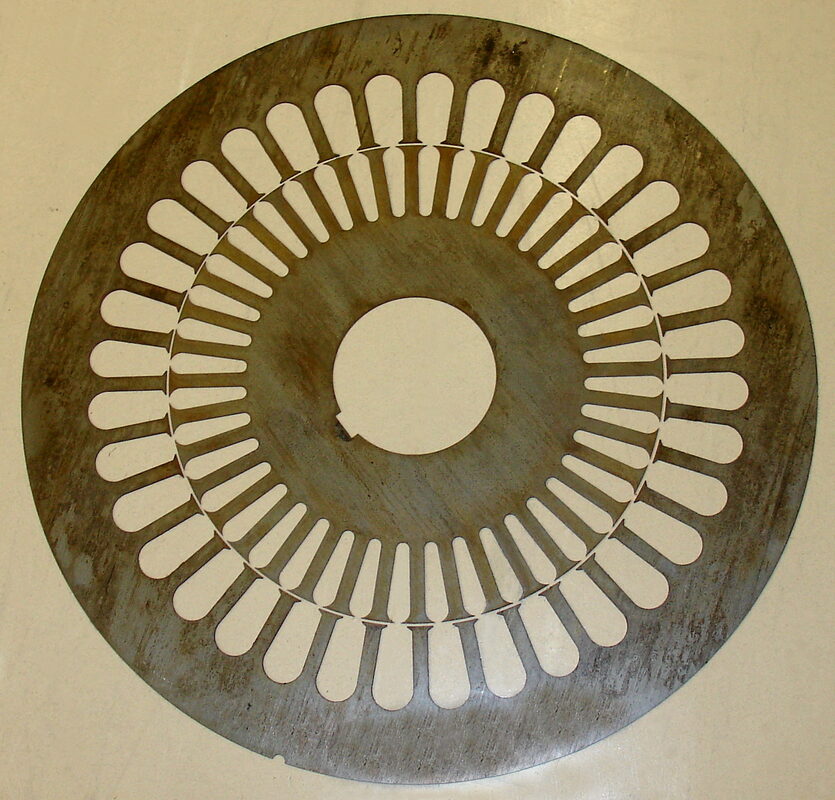
For readers who don't spend their weekends thinking about magnetic hysteresis, coercivity is the measure of how much magnetic field it takes to demagnetize a material once it's been magnetized. In a soft-magnetic component — the stator or rotor core inside a motor, for instance — you want that number as low as possible. Every time the magnetic field flips direction, which happens constantly as a motor spins, some energy gets lost as heat in the core material. Lower coercivity means a narrower hysteresis loop, which means less wasted energy, less heat to manage, and ultimately a more efficient motor. Shaving losses at this level compounds: electric motors already consume a huge share of global electricity, so even small percentage gains in core efficiency scale into meaningful savings across millions of units.
Why Metallic Glass, and Why Print It
Metallic glasses — alloys cooled so fast that their atoms never arrange into the ordered crystal lattice typical of metals — are prized for magnetics because that disordered atomic structure removes many of the crystallographic defects that pin magnetic domain walls in place and raise coercivity. The catch has always been manufacturing. Traditional metallic glass production relies on rapid cooling from the melt, which limits parts to thin ribbons or small castings — nothing close to the complex, application-specific geometries a motor designer might actually want for a stator core or flux-guiding component.
LPBF offers a workaround, in principle: melt powder with a laser, one thin layer at a time, and the tiny melt pools cool fast enough to freeze the alloy in its amorphous state, layer after layer, in whatever shape the design calls for. In practice, getting that cooling rate right across an entire printed part — without triggering partial crystallization that would wreck the magnetic properties — has proven difficult, especially for alloys that don't already contain cobalt or rare-earth elements to help stabilize the glassy phase.
The Alloy and the Process
The alloy at the center of this work, designated Fe-Si-B-Nb-Ni, was designed at Saarland University with a critical casting thickness of roughly 1mm — a rough proxy for how "printable" a glass-forming composition is likely to be, since a thicker critical casting thickness generally means the alloy resists crystallization over a wider process window. IMDEA Materials Institute then took on the job of translating that composition into a working LPBF parameter set on a Renishaw RenAM500Q Flex system, an industrial LPBF machine built for exactly this kind of high-value metal work. Rather than relying on laser power and scan speed alone, the IMDEA team leaned on remelting passes and controlled laser-off delays between layers — deliberately timed pauses that let the alloy cool through the temperature range where crystallization would otherwise creep in, before the next layer gets fused on top. That process tuning is where the coercivity improvement appears to come from: a combination of a favorable alloy chemistry and thermal management precise enough to keep the printed structure amorphous, or close enough to it, layer after layer.
The 44 A/m coercivity result is notable less for setting an outright record than for how it was reached: without phosphorus, cobalt, or rare-earth elements in the alloy, and using an LPBF process that can, in principle, produce net-shape parts directly rather than the thin ribbons or small castings that conventional metallic-glass production is limited to. Cobalt and rare earths carry cost, supply-chain, and sourcing baggage that motor manufacturers would rather avoid if a phosphorus-free, cobalt-free, rare-earth-free alternative can get close on performance while adding geometric freedom traditional casting can't offer.
What It Means for Makers
This is not a material or process makers will be loading into a desktop LPBF machine — assuming most readers don't have one — anytime soon, and it isn't aimed at the desktop or even prosumer market at all. The RenAM500Q Flex is an industrial LPBF system, and the parameter development described here (remelting, tuned laser-off delays for a specific alloy chemistry) is the kind of process engineering that takes a specialized research consortium and a dedicated EU grant to work out, not something portable to a hobbyist printer profile. Where this matters for the broader metal-AM-curious crowd is as a data point on how far LPBF process control can push material properties that were previously locked behind conventional casting. The same principles — layer-by-layer thermal management substituting for bulk rapid quenching — are the throughline connecting this work to other advanced LPBF metallurgy efforts, and they're a reminder that the "print settings" conversation in metal AM is not just about density and porosity, but increasingly about controlling microstructure at a physics level that changes what a part can actually do. If you follow metal 3D printing because you're interested in where the technology is heading rather than what you can print this weekend, this is squarely in that lane: motor cores, transformers, and inductors built with geometries impossible to cast, using an amorphous alloy that loses less energy every time it flips polarity.
The Bigger Picture
The research sits inside AM2SoftMag, an EU Horizon Europe Pathfinder-Open project (grant agreement No. 101046870) coordinated across a consortium that also includes Italy's INRIM and TU Berlin, alongside Saarland University and IMDEA. According to the project's own stated goal, the aim is to "make 3D printing the standard for producing high-performance amorphous soft-magnetic components" for electric motor applications — a considerably longer-horizon ambition than any single alloy result. The project's published output so far also includes work characterizing the Fe-Si-B eutectic composition and the mechanical behavior of additively manufactured iron-based glass-forming alloys, suggesting this coercivity result is one node in a broader, ongoing effort to make amorphous magnetic materials printable at all, rather than a one-off demonstration.
Whether any of this reaches production motors depends on scaling beyond lab-scale samples, validating long-term magnetic stability, and proving the economics against both conventional laminated silicon-steel cores and existing amorphous ribbon technology. But as a proof that LPBF process engineering — not just alloy chemistry — can meaningfully move the needle on rare-earth-free soft-magnetic performance, this result gives the metal-AM research community a concrete benchmark to beat.
