
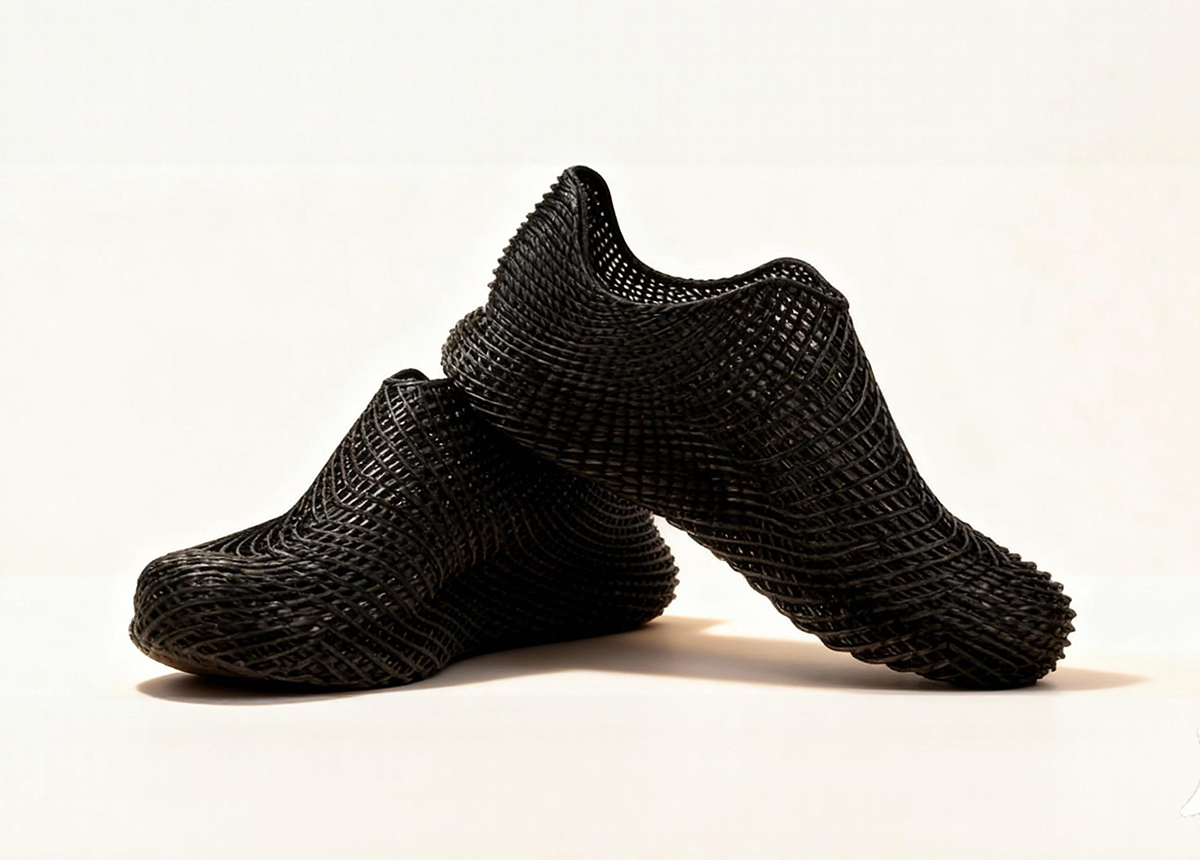
iSUN3D, a division of Chinese materials manufacturer eSUN — a name most FilamentFeed readers will recognize from spools of PLA and PETG rather than footwear — is bringing 3D printed shoes to MICAM Milano, one of the world's largest footwear trade shows, running September 13–15 at Fiera Milano Rho. The company will occupy Hall 5, Booth P09, according to VoxelMatters' coverage of the show, showing off both its footwear line and the resin system behind it as it looks to line up design, development, and production partnerships across the footwear industry.
The technology at the center of the pitch is FlexOne, a single-component elastic resin iSUN3D launched in November 2025 specifically to remove one of the biggest practical headaches in resin-printed footwear: pre-mixing.
Why Single-Component Resin Actually Matters
Most elastic resins used for flexible 3D printed parts — midsoles, uppers, lattice structures — are two-component systems that need to be mixed in a precise ratio before printing, similar in spirit to two-part epoxy. Get the ratio wrong, let the components sit too long after mixing, or fail to mix thoroughly, and the resulting prints can suffer from inconsistent cure, weak layer adhesion, or outright failed parts. At the volume a footwear manufacturer would need to hit for real production runs, rather than one-off prototypes, that mixing step becomes a genuine bottleneck and a source of scrapped material.
FlexOne is pitched as solving that by shipping ready to pour directly into the printer, no mixing required. According to All3DP's reporting on the launch, the resin posts tear strength above 50 kN/m — roughly double a standard elastic resin — tensile strength above 20 MPa, about three times an ordinary elastic resin, and elongation at break above 250%. For durability, iSUN3D cites more than one million Ross Flex cycles, a standard industry fatigue test that simulates repeated bending of footwear materials to check how long a sole or upper holds up before cracking. The company also states the resin is certified non-irritating, non-toxic, and free of heavy metals — relevant given that footwear sits in direct, prolonged contact with skin in a way most 3D printed parts don't.
The Hardware Side
FlexOne runs on iSUN3D's own HSL 100 and HSL 100MAX printers, which use 14- and 16-inch build platforms with a 40 cm build height. The company states these systems print at 100 mm/hour and can produce two pairs of shoes in roughly three hours, with post-processing limited to centrifugal and ultrasonic cleaning rather than a more involved manual finishing process. That combination — fast cycle time, minimal post-processing, no resin mixing — is squarely aimed at footwear brands evaluating whether resin 3D printing can move beyond limited-run sneaker drops and design showcases into genuine production volume.
iSUN3D's Track Record Before Footwear
This isn't iSUN3D's first foray into resin-printed products worn on the body. The company has produced more than 3,000 customized orthotic insoles per month since 2017 through a network of over 150 retail partners, according to VoxelMatters' reporting — a business that's built directly on the same core competency footwear demands: printing flexible, durable parts that fit an individual foot precisely and hold up to repeated mechanical stress. The MICAM Milano showing represents an explicit expansion from that orthotics business into full footwear production, leveraging years of manufacturing experience with flexible resin at meaningful volume rather than starting from a blank slate.
Where This Fits in 3D Printed Footwear
3D printed footwear has been a recurring showcase technology for over a decade, with brands like Adidas and Nike periodically releasing limited runs of printed midsoles and lattice structures, but broad commercial adoption has remained limited by exactly the kind of production bottlenecks FlexOne is aimed at — material cost, mixing complexity, cycle time, and post-processing labor. MICAM Milano's own coverage notes other recent 3D-printed footwear efforts on display in past editions, including Servati's modular sneakers with interlocking component systems and Syntilay's AI-generated custom-fit designs, suggesting the show has become something of a proving ground for competing approaches to solving footwear's mass-customization problem.
Whether FlexOne actually moves the needle on volume production will depend on factors outside the resin chemistry itself — pricing per pair, how footwear brands view the material's feel and durability against traditional foam and rubber, and whether iSUN3D can convert trade-show interest into real manufacturing partnerships. But for a filament company known to hobbyists mostly for budget PLA, the move into footwear-grade resin production is a notable expansion of what eSUN means as a materials brand.
What This Means for Filament and Resin Buyers
For hobbyists and small shops who know eSUN primarily as a budget-friendly filament brand sold alongside names like Sunlu and Overture, the footwear push is a reminder that many of the companies supplying the desktop 3D printing market also run substantial industrial and B2B materials businesses well outside what shows up on a retailer's shelf. eSUN's resin division has apparently been quietly building volume manufacturing capability in orthotics for close to a decade before this footwear announcement, which suggests FlexOne itself was likely developed and refined against real production constraints rather than as a lab curiosity aimed purely at trade-show demos.
That lineage matters for how seriously to take the footwear pitch. Plenty of 3D printed shoe concepts shown at trade fairs over the years have been one-off design exercises never intended for real manufacturing scale, and it can be hard from the outside to tell a genuine production system apart from a flashy prototype. A resin formulated by a company that already ships thousands of flexible, foot-contact parts a month through an established retail network carries a different kind of credibility than a startup's first attempt at a printed sneaker.
