
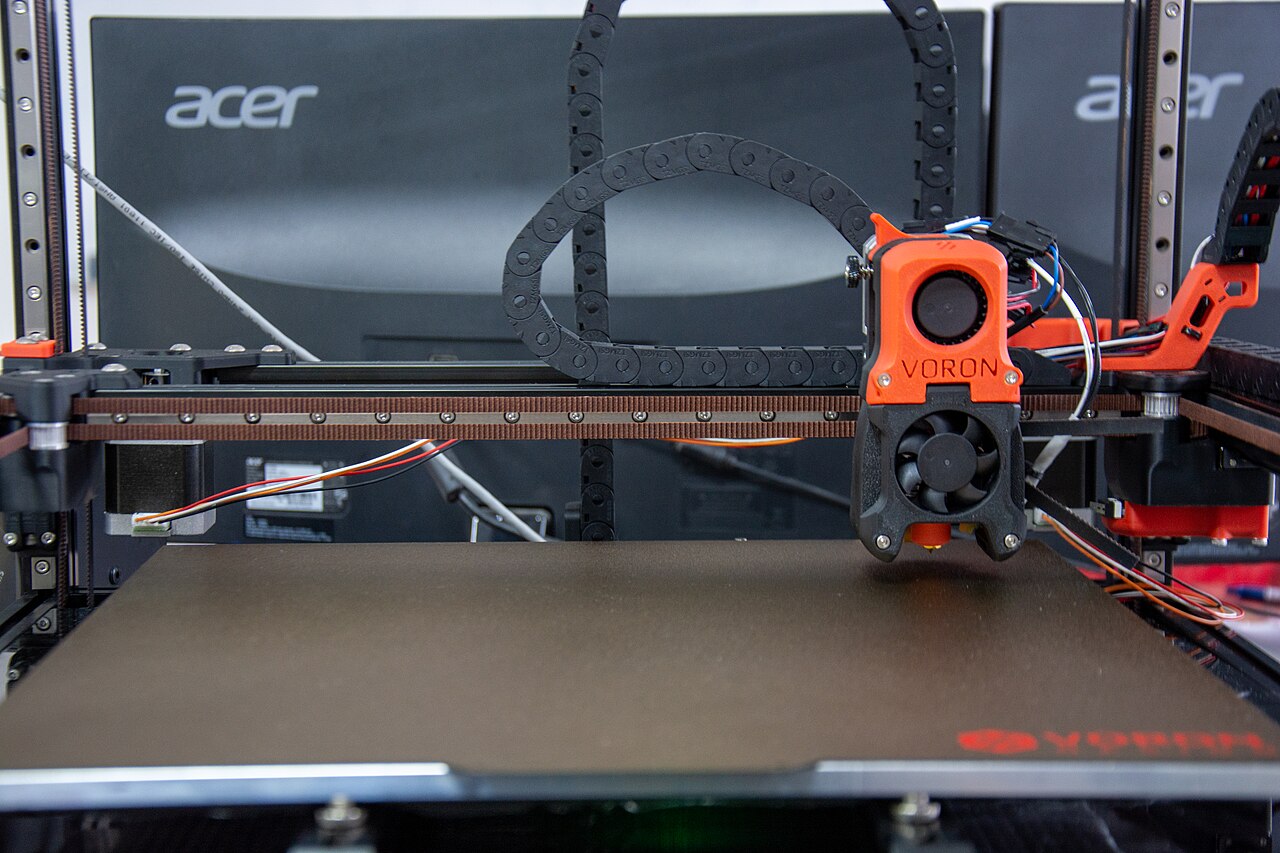
Klipper has a new major release. According to the project's official release history in the Klipper repository, version 0.14.0 became available on November 20, 2026, and the changelog is long. It adds native nozzle and bed tap probing using eddy-current and load-cell sensors. It also brings a new kinematics module that lets users describe unusual machines with their own motion formulas, moves step generation onto multiple host CPU cores, and adds a broad set of microcontroller improvements. Some of these changes are visible on day one. Others reach deep into how the firmware plans and times motion, and those are the ones worth reading closely before you update.
This piece goes through the release by subsystem rather than repeating the changelog in order. The aim is to explain what each change does and what it is likely to mean on a real printer.
Probing: Tap Arrives, and Z Homing Changes Underneath You
The headline feature is tap probing, where the nozzle itself, or the bed, works as the sensing element. The release notes describe new nozzle/bed tap probing that supports both eddy-current and load-cell sensors.
Load cells are the more interesting half of this. Klipper's load cell documentation notes that these sensors can read force data and weigh things like filament, and that a calibrated force sensor is an important part of a load-cell probe. The docs also describe a diagnostic command, LOAD_CELL_DIAGNOSTIC, which collects 10 seconds of data and reports the number of samples collected, the measured samples per second, the count of saturated samples and the number of unique values. The documentation says saturated samples should be 0, and a unique-value count of one suggests a wiring problem. That is a useful first check for anyone wiring up a load cell. The same page covers calibration and taring.
The release adds supporting hardware modules too. There is support for two load-cell ADCs, the ads131m0x and the cs1237. Together with the probing code, this gives load-cell setups built-in support in the release.
One related change needs attention from every user, whether or not they ever touch a load cell. The release notes state that homing a Z axis with a bed probe now internally uses the probing code instead of the endstop code. If your printer homes Z with a probe, the code path behind that move has changed. Plan to re-check your first layer and Z offset after updating, even if your configuration looks the same.
Motion: More Axes, Shorter Lookahead, Your Own Kinematics
Several changes affect the motion system directly. The motion planner now tries to stay one second ahead of the hardware, down from two seconds. That figure is how far the host schedules motion ahead of the moment it runs, and halving it tightens the gap between a command and its effect.
The standard G1 command can now move more than four axes at once. Extra axes are defined at run time by mapping manual_stepper objects to g-code identifiers. For tool changers, rotary attachments, filament-handling mechanisms and other machines with more motors than a plain XYZE printer, this could allow coordinated multi-axis moves through ordinary g-code. Homing for manual_stepper is also more responsive in this release, since it no longer waits for the full movement time before processing future moves.
The most ambitious addition is a new general_cartesian kinematics module, which supports a wide range of printer hardware through motion formulas the user provides. A formula-driven module may open the door to experimental frames and nonstandard linkages without writing a kinematics implementation from scratch, though the release notes say little about its limits, so expect the community to need time to learn them.
The Host: Step Generation Goes Multi-Core
Klipper splits the work between a host computer, which plans motion and generates step timing, and one or more microcontrollers, which carry it out. In 0.14.0, step generation on the host is enhanced to better use multiple CPU cores. The release notes list a thread per stepper motor, improved fine-grained locking, exported OS-visible thread names, and background threads for file reading.
This should matter most for machines with many steppers, or for hosts running on modest single-board computers where one busy core could become the bottleneck. OS-visible thread names are a small but welcome detail. When something stalls, a tool like top or htop can in principle show which Klipper thread is busy, which makes diagnosing performance problems much less of a guessing game.
Microcontrollers: Faster Clocks, CAN on LPC, Fewer Shutdowns
The MCU changes span a wide range of hardware:
- Higher STM32H7 clocks. The stm32h723 now runs at 520 MHz and the stm32h750 at 480 MHz. The release also mentions optimized GPIO code for higher output rates and step-on-both-edges at higher speeds.
- CANbus on lpc176x. Boards built on the older LPC176x family gain CANbus support.
- Small-flash options. Microcontrollers with small flash sizes get more code-size options during
make menuconfig. - PWM accuracy. Hardware PWM is more accurate on stm32 and rp2xxx parts.
- Gentler i2c error handling. i2c errors detected by the microcontroller are now forwarded to the host and no longer directly cause a shutdown.
- New chips. Support has been added for the rp2350b and the lgt8f328p.
The i2c change deserves a closer look. Treating a bus error as information for the host, and not as an automatic emergency stop, changes how a single glitch on a sensor bus affects a print in progress. New modules round out the hardware list: the bmi160 accelerometer, the tmc5262 and a static_pwm_clock module.
What It Means for Makers
For most people with a working Klipper printer, 0.14.0 is a worthwhile update that calls for a careful afternoon, not a quick click. The single most important item is the Z-homing change. If you home Z with a probe, re-verify your Z offset and first layer before you trust the machine with a long job. The shorter planner lookahead and the threaded step generation work underneath your configuration, but any change to motion timing is a good reason to watch the first few prints closely.
If you have been waiting for official nozzle-contact probing, this is the release to try it on. Eddy-current and load-cell tap probing are now part of mainline Klipper, with dedicated ADC modules and a documented diagnostic for checking your wiring. Builders of multi-axis or unconventional machines get the most new capability: G1 moves beyond four axes and a general_cartesian module driven by user-supplied formulas. Owners of stm32h723 and stm32h750 boards get higher clock speeds.
Back up your configuration, read the release notes for the subsystems you actually use, and take the update in stages.
