
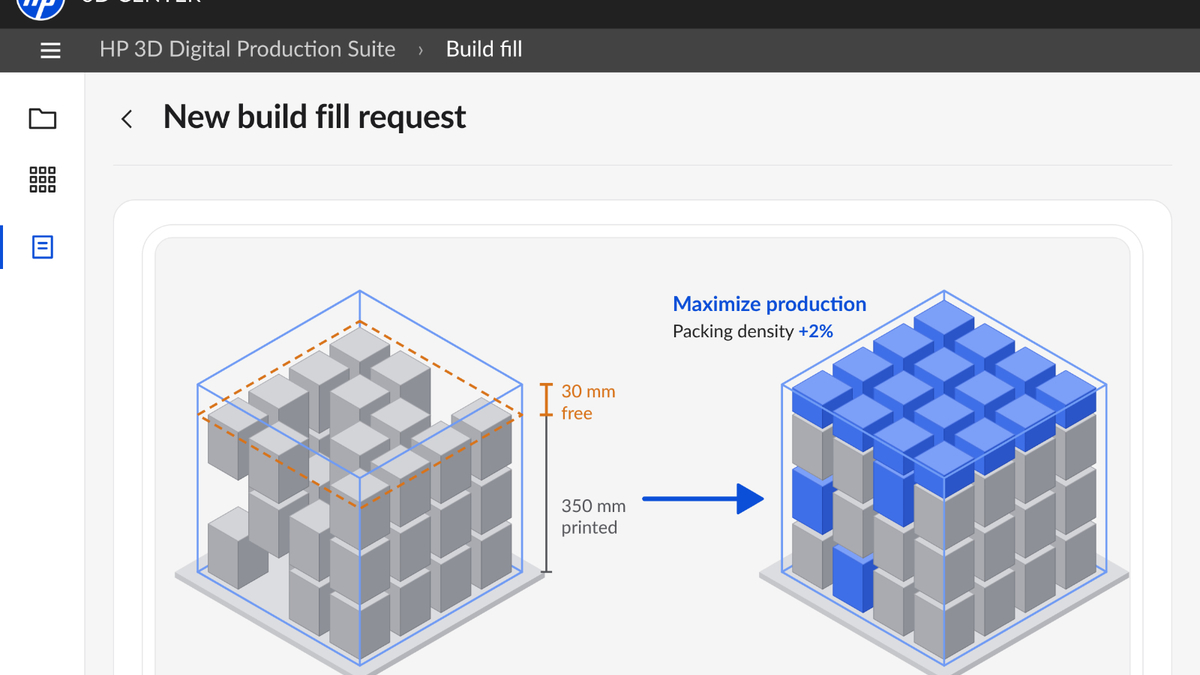
Anyone who has run a powder-bed machine knows the quiet arithmetic behind every build: the chamber gets heated, the powder gets spread and the job runs for hours whether the build volume is packed tight or half empty. At Formnext, Xometry announced a collaboration with HP that goes straight at that empty space. According to Xometry's November 17 press release (via mirror), HP's Multi Jet Fusion build-planning software will be integrated with Xometry Workcenter, Xometry's job management platform, so manufacturers running HP MJF systems can fill unused room in their builds with Xometry jobs.
The feature is expected in the United States in early 2027, with Europe to follow. It will be available only to manufacturers in the Xometry Partner Network who run HP MJF equipment. Xometry says that network has more than 5,000 vetted manufacturers, though the release does not say how many of them operate MJF machines.
How the Integration Works
The workflow in the announcement has two halves. On the HP side, the build-planning software does what it already does for MJF operators: it lays out parts in the build volume and optimizes the arrangement. The new piece is that the software also identifies the free space left over once a shop's own parts are placed. That information then reaches Xometry Workcenter, where the partner can see Xometry jobs that would fit into the gaps and accept the ones that make sense.
The order of operations matters. As described, the partner plans the build first, and the software then identifies the free space left in that layout. The partner still decides what to accept: the release says the partner matches jobs in Workcenter and accepts the ones that fit the space. The process as described starts with an empty spot in an existing build plan rather than with a dispatched order.
The integration extends an existing relationship. Xometry already sells HP MJF parts through its Instant Quoting Engine, the route through which MJF parts are offered to customers. The new link joins the demand side of that business, customers quoting MJF parts, to the supply side, partners with half-filled build chambers.
Why Empty Build Space Is a Real Cost
On a filament printer, an unused corner of the bed costs almost nothing. A powder-bed fusion system works differently. A build is a batch process: the whole volume gets processed and cooled as a unit, and machine time, energy and handling are spent per build, not per part. A build that is only partly full spreads those fixed costs over fewer billable parts.
That is the problem both companies describe. Xometry frames the integration as a way to raise build yield and cut wasted material. In VoxelMatters' coverage, Alex Monino, HP's SVP and general manager of Additive Manufacturing Solutions, makes the same argument from HP's side: get more use out of each build and reduce material waste. The release also quotes Xometry CEO Sanjeev Singh Sahni on the collaboration, which it presents as bringing Xometry intelligence into HP Multi Jet Fusion parts.
The promised benefits run in two directions. For partners, the pitch is higher utilization and more revenue per build, since a build that would have run partly empty now carries paid work. For Xometry's customers, the companies claim faster turnaround and more competitive pricing. The reasoning is plausible: if a part can ride along in a build that was going to run anyway, it may not need to wait for a dedicated build, and the marginal cost of producing it could be lower.
Open Questions
The announcement is a statement of direction, and several practical details are not addressed in either source.
- Pricing mechanics. The release does not explain how jobs placed into free space are priced to the partner, or whether that differs from Xometry's ordinary job pricing.
- Material and process matching. A part can only go into a build that uses the right powder and meets its requirements. The sources do not say how Workcenter handles that matching beyond describing jobs that fit the available space.
- Scope of eligible machines. The feature is described as being for partners running HP MJF systems. Which models and software versions qualify is not specified in either source.
- Timing. "Early 2027" for the US and an unspecified later date for Europe leaves room for the schedule to move, as is common with announcements made at trade shows.
None of these gaps is unusual for a Formnext announcement, but they will decide whether the integration turns into a routine part of how MJF bureaus plan their days or stays a niche option.
What It Means for Makers
Most FilamentFeed readers do not own an MJF system, and this integration is not aimed at hobbyists running a single printer. It still matters to two groups.
The first is anyone who orders MJF parts, whether nylon brackets for a robot or short-run enclosures for a hardware project. The claims of faster turnaround and better pricing depend on a simple idea: parts slotted into builds that were going to run anyway. If that works at scale, small orders, which are often the hardest to schedule economically on a large powder-bed machine, are the ones that stand to gain. Whether those savings actually reach buyers is something to watch once the feature ships.
The second group is small shops and print farms that have grown into industrial equipment, or are thinking about it. Utilization is the number that makes or breaks a powder-bed business case. A shop that can reliably fill leftover build volume with outside work faces a different calculation than one that must find enough of its own jobs to justify every run. The catch is that the benefit depends on membership in Xometry's Partner Network, which brings the dependency on a single platform that comes with any marketplace.
More broadly, the announcement shows where industrial additive manufacturing software is going: build-planning tools are starting to talk directly to order flow. Nesting parts efficiently used to be a matter of geometry inside a single shop. HP and Xometry are betting it can become a market problem as well, matching empty volume in one build with demand from across a network.
Bottom Line
Xometry and HP are connecting MJF build planning to Xometry Workcenter so Partner Network manufacturers can see their unused build space and fill it with Xometry jobs, with a US launch expected in early 2027 and Europe after. The aim, higher yield and less wasted material, addresses a real cost of powder-bed production. How much of that efficiency shows up in partner revenue and customer pricing will only be clear once shops start using it.
