
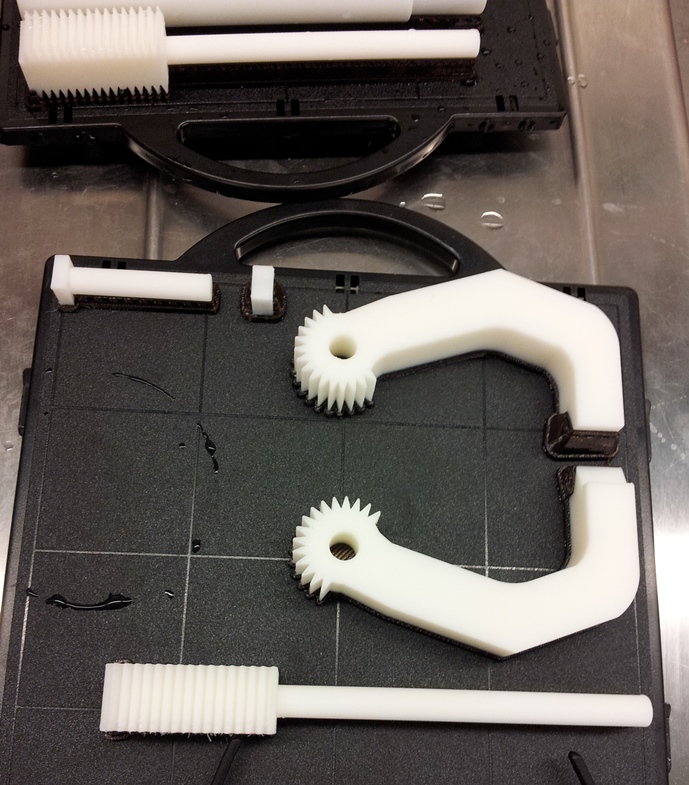
Most of the AI talk in additive manufacturing so far has been about one tool at a time: a generative-design module here, a print-failure detector there. Siemens is making a bigger claim. In a press release on its Industrial AI digital thread for additive manufacturing, the company says this is the first time it has connected agentic, prompt-based engineering with an adaptive production environment. The showcase, which Siemens says it will present at Formnext 2026 in Frankfurt, is a gripper for a humanoid robot, demonstrated together with AGIBOT, a humanoid robot developer. It starts as a plain description of an object and a task and ends as data ready for a printer.
The release is dated 16 November 2026. Trade coverage, including a VoxelMatters report dated November 22, followed days later. Strip away the marketing language and the announcement has three parts: an AI agent that drives CAD and simulation software for you, a physical production cell meant to receive what that agent produces, and an advisory tool for companies trying to work out where AI fits at all.
How the Prompt-to-Part Workflow Works
According to VoxelMatters, the user describes the object to be handled and the task the robot has to do. The agentic workflow then takes over a chain of steps a design engineer would normally do by hand. It picks a suitable gripper type, adapts the geometry in Siemens' Designcenter, simulates it, validates the robot interface and handling, and prepares the data for additive manufacturing.
None of those steps is new. Engineers already select gripper architectures, tweak parametric models, run analyses and export build files. What changes is who moves the work from one tool to the next. Siemens' release, as republished by Automation World, frames the main benefit as less need to interact with each engineering tool separately. The agent sits on top of the toolchain and calls each piece in turn.
The part doing that work is the Model Context Protocol (MCP) integration. VoxelMatters reports that MCP lets the agent call software functions directly. In practice, this suggests the AI is not producing a picture of a gripper from nowhere. It operates Siemens' engineering software through function calls, so the work stays inside a real engineering environment, though the sources do not detail what a person can inspect along the way.
That difference matters. An agent that drives engineering software and its simulation tools is a different kind of thing from a text-to-3D mesh generator. Its result is only as good as the models and checks it calls, which is why the validation steps in Siemens' description matter.
The Factory Side: An Adaptive Cell in Erlangen
Siemens' other half of the "digital thread" is physical. The company says it is creating an adaptive production cell at its Electronics Factory in Erlangen, Germany, working with EOS, the industrial powder-bed fusion manufacturer, and AM Solutions, the post-processing brand of the Rösler group. The release calls it a planned cell, so it is not yet a working line, and nothing in the sources gives a commissioning date.
Putting a post-processing specialist in the cell from the start is a telling choice. Post-processing is built into the cell from the start, and AM Solutions says the industrialization of additive manufacturing does not end with the printing process. A cell that connects design data to printing and post-processing, in a real electronics factory instead of a demo hall, is the more ambitious and more meaningful half of this announcement, even though it is the half that does not exist yet.
VoxelMatters quotes Karsten Heuser, Siemens' vice president of additive manufacturing; Marie Niehaus-Langer, CEO of EOS; and David Soldan of AM Solutions on the collaboration. Taken together, the three companies cover software and automation, printing hardware, and finishing, which is roughly the full span of an industrial AM process chain.
AM I Navigator: AI Triage for the Front Office
The third piece is less flashy. Siemens is offering an AI-enhanced version of its AM I Navigator, which the company says helps firms identify and prioritise AI applications in additive manufacturing and define pilot projects. Siemens says the results let companies define specific pilot projects and a roadmap for scaling Industrial AI. Put simply, it is a planning tool rather than a design feature.
For scale, Siemens reported fiscal 2026 revenue of 83.4 billion euros. Nobody should mistake this for a startup's pitch. If a company that size builds MCP connections into its engineering software, other CAD and PLM vendors may feel pressure to follow, though that is our inference.
What It Means for Makers
Nobody in a garage shop is going to run Designcenter-driven agents feeding an EOS cell in Erlangen. The pattern still matters a lot to smaller users, for a few reasons.
The interface is moving from clicks to intent. The hard part of designing a functional printed part is rarely drawing the geometry. It is knowing which features matter, which constraints apply, and which checks to run. An agent that turns "grip this object for this task" into a chain of tool calls takes some of that orchestration off the user. For a small shop that designs fixtures, end-of-arm tooling or replacement parts, that could shrink the gap between having an idea and having a validated file.
MCP is the detail worth watching. Siemens' approach depends on its software exposing functions an agent can call. If that becomes normal across CAD, simulation and slicing tools, the same kind of workflow could in principle reach the desktop toolchain makers already use. That is an inference, not something Siemens has announced, but the design choice points in that direction.
Validation is still the whole game. The workflow described here includes simulation and a robot-interface check before anything goes to the printer. That is the right instinct. An AI that confidently produces an unvalidated bracket is a liability. An AI that runs the analysis you would have skipped is an asset. Makers testing AI-assisted design tools should hold them to the same standard and ask what the tool checked, not just what it drew.
Keep expectations in proportion. The demo is one part family, robot grippers, shown at a trade show. The production cell is still being created. The sources give no performance numbers, timelines or pricing. Treat this as a clear statement of direction from a major vendor, not proof that prompt-to-part manufacturing works at scale.
Bottom Line
Siemens has put together a coherent version of an idea the industry has been circling: let an AI agent operate real engineering software through a protocol like MCP, keep validation in the loop, and pass the result to an automated print-and-finish cell. The software half is set to be shown at Formnext. The factory half is still being created. If both hold up, the skill that matters most in AM design will shift from operating each tool to stating the problem precisely, and that skill applies just as well on a desktop printer as in an industrial cell.
