
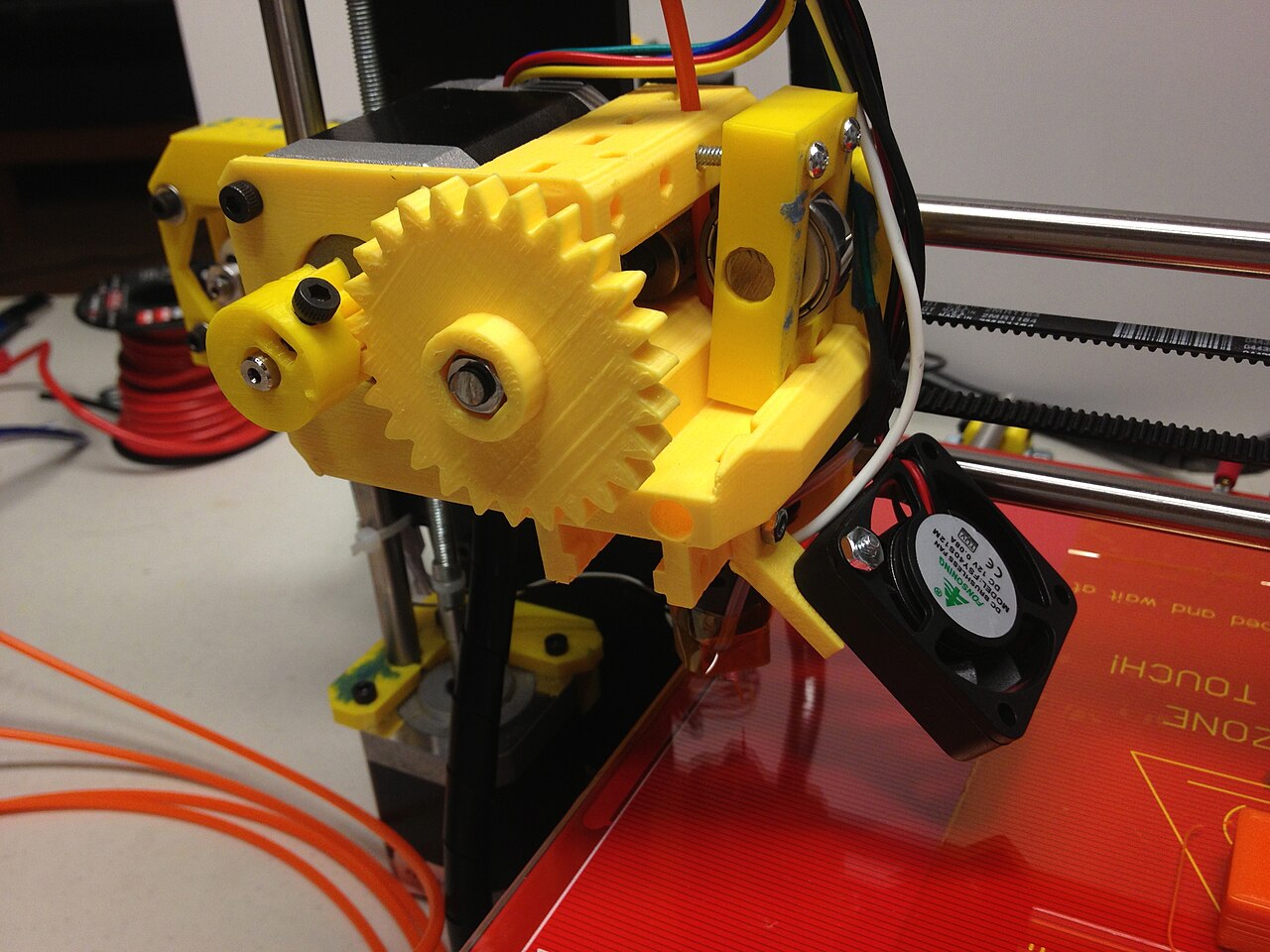
Vapor smoothing has always come with an asterisk: acetone fumes for ABS, harsher solvents for other materials, and a nontrivial explosion risk if you're heating that vapor in an enclosed chamber. A maker who goes by 'I Changed a Thing' has been chasing a chemical-free alternative, and his latest build bolts two diode lasers directly to an FDM printer's X-axis, using them to selectively remelt the outer skin of a print as it comes off the nozzle. According to Hackaday's write-up published August 29, the approach gets top surfaces close to vapor-smoothed quality with none of the fumes.
The concept is a natural extension of a project the same builder ran previously, in which laser energy was used not for cosmetics but for structural improvement — remelting between layers to fuse them more thoroughly than thermal contact alone achieves during normal FDM deposition. That earlier work, also covered by 3Druck.com, reportedly pushed Z-direction fracture strength up to 94% of the part's strength in other axes, with Hackaday describing the gains for both ABS and PLA as "big double-digit increases" — numbers that matter because Z-axis weakness (the tendency of FDM parts to delaminate between layers under load) is one of the process's oldest and most persistent limitations. That earlier strength work is the baseline the newer surface-finishing experiments build on, and it's why a second laser application aimed at cosmetics rather than strength was worth trying in the first place.
How Laser Remelting Differs From Vapor Smoothing
Chemical vapor smoothing works by dissolving a thin layer of plastic uniformly across every exposed surface at once, letting surface tension pull the softened material into a glossy, pore-free finish. It's effective and largely material-agnostic within a chemical family, but it treats the whole part indiscriminately — you can't easily target one face and leave another alone, and the part has to tolerate solvent exposure at all, which rules out some engineering plastics and any print with embedded electronics or fasteners.
A laser mounted on the toolhead flips that model. Instead of a bath or a chamber, the beam follows the machine's own motion system, remelting material immediately after the nozzle lays it down, layer by layer. That gives the operator direct control over which surfaces get treated and how much energy each one receives — a top surface, a specific wall, even a small cosmetic feature could in principle be dialed in independently. The tradeoff is that the laser has to actually reach the plastic at a useful angle, and geometry doesn't always cooperate.
Why Top Surfaces Are Easy and Walls Are Not
Hackaday's coverage is specific on this point: laser remelting smooths top surfaces far more readily than it smooths vertical walls. A top surface is presented to the laser essentially face-on — the beam strikes it close to perpendicular, delivering energy efficiently and evenly across the plane. A vertical wall, by contrast, can only be hit obliquely from a toolhead-mounted laser, since the beam has to angle down or sideways to graze a surface that's parallel to the direction of travel rather than facing up toward the optics.
That oblique incidence cuts against the physics of the whole technique in two ways. First, less energy per unit area actually couples into the plastic at a shallow angle, so getting enough heat to remelt the surface without either underdoing it (no cosmetic improvement) or overdoing it (sagging, warping, or scorching) is a narrower target to hit. Second, an oblique beam is far more sensitive to the printer's own surface irregularities — the very ridges and bumps a smoothing pass is trying to erase — because those features cast their own shadows and create inconsistent exposure across a wall that a face-on beam wouldn't have to contend with. Hackaday's builder reports the outcome depends heavily on the size and geometry of the object being printed, and describes the whole technique as "as much art as science right now" — which tracks with why the project's most convincing results are, so far, on horizontal top surfaces rather than the vertical walls that dominate most prints' visible area.
What It Means for Makers
For hobbyists who've avoided vapor smoothing because of ventilation requirements, chemical storage, or the flat-out danger of heating solvent vapor in a sealed box, a toolhead-mounted laser is an appealing alternative in principle: no fumes, no explosion risk, and — because it's integrated into the print itself rather than a separate post-processing step — potentially no extra handling time once the hardware and firmware are dialed in. The strength data from the earlier layer-adhesion project is also relevant here, since it suggests the same hardware could do double duty: improving Z-axis strength during the print and improving surface finish where geometry allows, without switching setups.
That said, this remains a DIY retrofit documented by one builder, not a shipping product or a peer-reviewed process. The wall-smoothing limitation is a real gap, not a rounding error — walls are where most functional and cosmetic surface area lives on a typical print, from enclosures to figurines to mechanical parts with vertical faces that see load or friction. Anyone trying to replicate the top-surface results should expect the toolhead mounting, laser selection, power tuning, and motion-control integration to take real iteration, and should treat "close to vapor-smoothed" as a qualitative impression from the builder's own results rather than a measured surface-roughness comparison. There's also the more mundane safety note that swapping chemical hazards for a class of laser mounted inches from your hands and eyes is not automatically the safer trade — proper enclosure and interlocks matter here just as they do with any laser diode retrofit.
Still, the direction is a sensible one: FDM's two biggest cosmetic and mechanical weaknesses — visible layer lines and weak interlayer bonding — both stem from the same root cause, incomplete fusion between adjacent layers of plastic. A toolhead laser that can selectively add heat exactly where and when it's needed addresses that root cause directly, rather than papering over it with a solvent bath after the fact. Getting walls to work as well as top surfaces do now looks like the next real milestone for this line of experimentation, and it's one worth watching given how much of a typical print's surface is vertical.
