
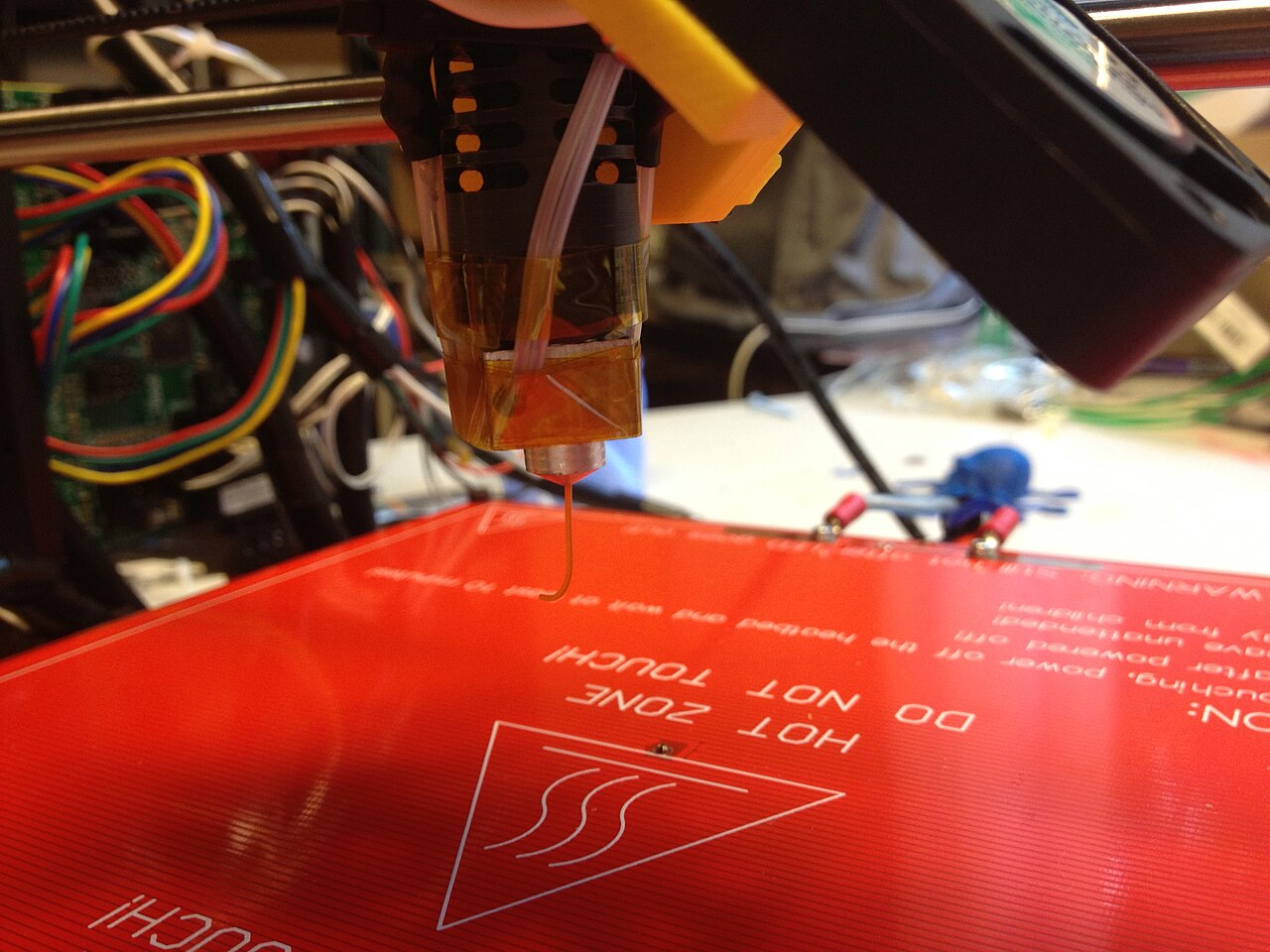
A Prusa i3 with a dead hot end is usually headed for the parts bin. A maker identified as Riley turned one into something more interesting: a liquid-dispensing rig for embedded 3D printing, built around the open-source Allstruder syringe extruder from the Shiwarski Lab and a Caribou Duet 3 control board. As Hackaday reported on October 9, the conversion progressed from a cream cheese test to a failed attempt with two-part epoxy and, finally, an imperfect but recognizable print in Sylgard 184 silicone deposited inside a bath of ordinary hair gel.
The project is small, but it makes a technique that mostly lives in research labs look reachable for anyone with a retired printer frame and some patience. It is also a useful illustration of where the hard problems in that technique actually sit.
What Embedded Printing Is
Conventional extrusion printing, whether with thermoplastic filament or paste, deposits material into open air. Each layer has to support itself and whatever comes after it, which is why soft or runny materials slump, spread or collapse before they set. A 2026 mini review in Frontiers in Materials, from authors affiliated with institutions in China and Malaysia, describes the alternative: embedded 3D printing deposits ink inside a supporting medium rather than air. Surrounded by that medium, the technique reduces gravitational collapse.
That support changes the geometry rules as well. Because the bath holds the deposited strand where the nozzle left it, the toolpath no longer has to build strictly bottom-up on a flat bed. The review notes that the technique allows freeform toolpaths and enables structures that are difficult to obtain by conventional additive manufacturing, particularly from soft and flowable materials.
The review's title, "beyond formability," signals its main argument. Getting a material to hold a shape in the bath is only the first hurdle. The authors approach embedded printing from the perspective of process-window design and application reliability, with particular attention to rheological matching, interfacial instability, structural suspension and the removal of sacrificial material. Interfacial fidelity, in plain terms, is about the quality of the boundary between the printed material and the bath around it. Those concerns map closely onto what Riley ran into on the workbench.
The Hardware: A Syringe Where the Hot End Was
Riley's build replaced the Prusa's blown-out hot end with a syringe system. The motion system of an FDM printer is already well suited to this kind of work: it is a three-axis gantry that can trace precise paths. What it lacks for liquids is a way to push controlled volumes of material out of a needle, and that is the job the Allstruder does.
The Allstruder is an open-source syringe extruder developed and documented by the Shiwarski Lab. According to the lab's project page, it has been tested across a distributed network of labs on more than twelve printers and bioprinters, which matters for anyone hoping to adapt it to a machine its designers never saw. The page reports that the drive mechanism deflects a maximum of 20 micrometers at 30 PSI, a measure of how rigidly it holds position under the back-pressure that builds when pushing viscous material through a fine needle.
The lab's published example also gives a sense of what the extruder can do when the whole system is tuned. In one complete configuration, it printed 23 mg/mL collagen filaments at 141.8 micrometers from a 150-micrometer needle, with spacing errors under 4 percent. Those are lab results with a lab material, not a promise of what a converted hobby printer will achieve, but the page states that print fidelity is limited by the syringe and printer rather than the extruder.
On the control side, Riley replaced the Prusa's stock electronics with a Caribou Duet 3 board, alongside the Allstruder syringe pump.
Cream Cheese, Epoxy and Silicone
The test sequence is the most instructive part of the project. Riley started with cream cheese, which Hackaday describes as an apparently ideal test material, and which is cheap, safe to waste and easy to clean up: a sensible way to check the mechanics of extrusion and motion before committing expensive or messy materials.
The next candidate, two-part epoxy, did not work in the hair gel support; as Hackaday puts it, hair gel and epoxy are not friends. Epoxy also brings a practical constraint that any embedded process has to plan around: once mixed, it has only about forty minutes before it hardens, which caps how long a batch remains usable in the syringe.
For the final print, Riley switched to Sylgard 184 silicone. The result was not perfect, though Hackaday found it striking to watch a trifold torus take shape in what appeared to be a void. The hair gel proved imperfect too: some of its additives apparently inhibit the silicone from curing, and by Riley's own comment on the video the print was still goopy after a few days. Hackaday also notes a broader difficulty, citing a 2025 paper: Newtonian fluids such as silicone oil pose problems for reliable printing. The lesson is that matching the ink to the bath covers more than whether the strand holds its shape. It also covers whether the two materials interact chemically, which is the kind of interfacial issue the Frontiers review highlights.
What It Means for Makers
The appeal here is not that a hair-gel bath rivals a purpose-built bioprinter. It is that the barrier to experimenting with embedded printing turns out to be lower than it looks. The motion platform is a printer many makers already own or can find secondhand. The extruder is open source, and the lab lists about $50 in off-the-shelf components for it. The support medium, at least for initial experiments, can be an everyday consumer product.
Hackaday points to flexible and soft robotics, printing biological tissues and microfluidics as application areas for the technique. Of those, soft robotics is arguably the most natural fit for a home workshop, since printing silicone into freeform shapes is the kind of capability that makes compliant actuators and grippers interesting. Microfluidics is another plausible target for makers comfortable with silicone casting who want to experiment with channels that would be awkward to mold.
Anyone attempting a similar build should treat Riley's sequence as a template. Validate the mechanics with a forgiving, disposable material first. Check pot life and cure behavior before mixing a reactive resin. And expect the real work to sit in matching the ink to the bath, not in the gantry. Riley's results show that epoxy and silicone behave very differently in the same support, and that a bath can interfere with curing, so a working combination for one material says little about the next.
Bottom Line
A bricked Prusa, an open-source syringe pump and a Duet 3 board were enough to put a research technique on a hobby bench. The research literature makes clear that reliable embedded printing depends on careful process design, and Riley's failed epoxy run and slow-curing silicone both show why. But a recognizable silicone print from a converted printer shows the entry point is real, and inexpensive enough to justify finding a use for that dead printer.
