
LightForce Orthodontics, the Boston company that prints custom ceramic and metal brackets one patient's teeth at a time, has a new chief executive. On July 16, 2026, the company announced that Erica Rogers would take over as CEO "as the company enters its next phase of commercial growth," with founder Dr. Alfred Griffin stepping into a dual role as Chairman and Chief Product Officer. It is the kind of leadership handoff that tends to arrive when a technically ambitious company decides the harder problem is no longer making the thing, but selling it at scale.
Rogers is not a printing person by background. She is a medtech operator with more than 30 years in the industry, and her signature credential is Silk Road Medical, the vascular-device company she ran through its 2019 IPO and its subsequent acquisition by Boston Scientific. That is a specific kind of resume: someone who has taken a clinically differentiated product from private company to public markets to strategic exit. She has also spent the last two years on LightForce's board, per trade coverage from VoxelMatters, so this is an insider being elevated rather than an outsider parachuting in. Her appointment is effective July 17, one day after the announcement.
What LightForce Actually Makes
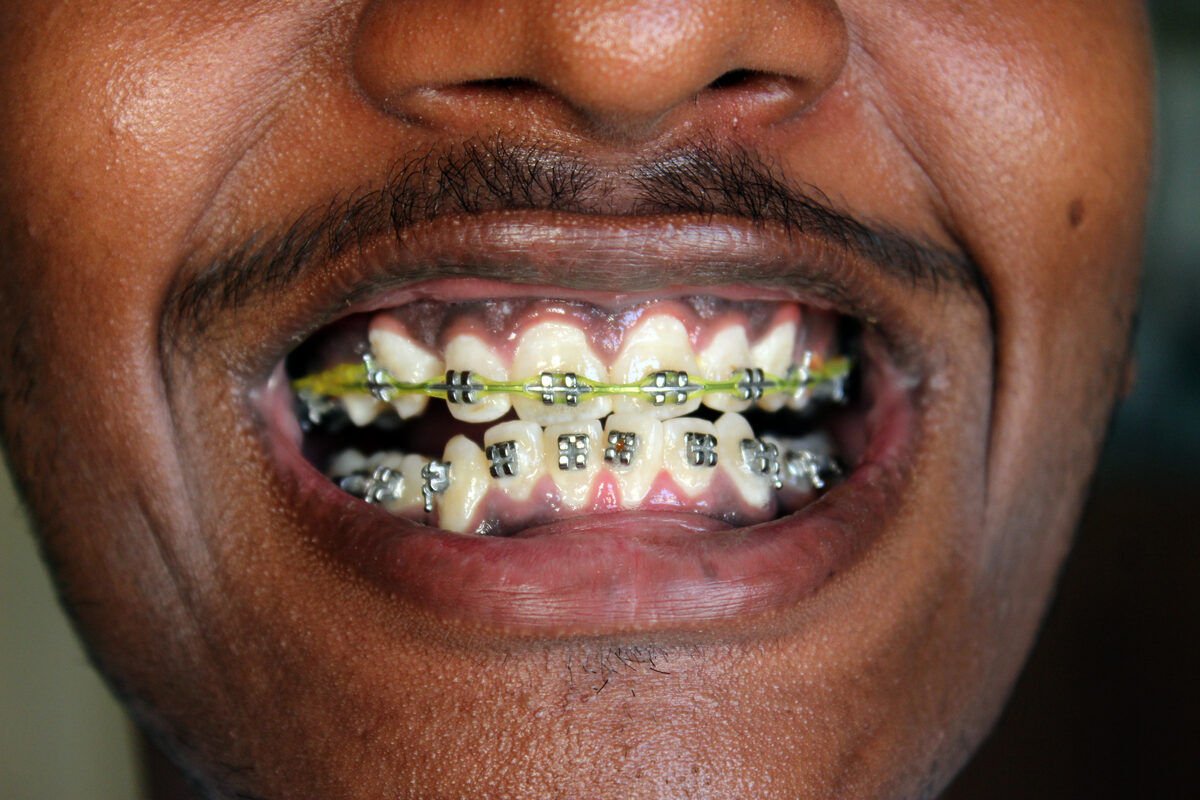
For readers who know 3D printing but not orthodontics, the product is worth unpacking, because it is a genuinely different application of additive manufacturing than the aligner boom most people associate with digital dentistry. LightForce does not make clear plastic trays. It makes fixed brackets — the small anchors that get bonded to individual teeth and threaded with an archwire — except each bracket is designed and printed to match the specific anatomy of the specific tooth it will sit on. The company markets this under the LightForce Generative Braces system, offering both ceramic and metal patient-specific brackets. Instead of an orthodontist adapting a patient's mouth to a tray of off-the-shelf, one-size brackets, the brackets are generated to fit the patient.
That is a meaningful distinction for anyone who cares about the manufacturing side. Mass-customization at the level of the individual tooth is exactly the sort of workload additive is supposed to be good at and traditional tooling is not: there is no economical way to injection-mold a bracket geometry that will only ever be used once, on one molar, in one person's mouth. Printing removes the tooling problem entirely, which is the whole reason a patient-specific bracket business can exist at all.
The scale claim attached to the announcement is the number that makes it a business story rather than a technology demo. According to VoxelMatters, LightForce has now treated more than 200,000 patients with its Generative Braces. For a device that has to be individually designed, printed, and clinically bonded, six figures of completed cases is the point at which "interesting technology" becomes "a manufacturing operation with real throughput."
Why Bring in a Closer Now
The strategic logic of the appointment reads clearly off the company's own framing. LightForce's press release cites an "estimated $10 billion global orthodontics market" and says Rogers will "lead the expansion of the LightForce Generative Braces system." Griffin, meanwhile, is not leaving — he is consolidating into product and chairmanship, which is the classic founder move when a company decides the technical vision is proven and the next mountain is distribution.
The market context sharpens the thesis. Despite years of noise about clear aligners, fixed brackets still account for roughly 75 percent of North American orthodontic case starts, per VoxelMatters. That statistic cuts against the assumption that traditional braces are a legacy category being eaten alive by trays. Three out of four cases on this continent still begin with brackets and wires — and LightForce's entire pitch is that it can make that dominant, unglamorous, high-volume category better by making every bracket bespoke. Hiring an executive whose track record is specifically about scaling a differentiated medical device and delivering a financial outcome — IPO, acquisition — is a coherent way to attack a market that is both enormous and already the default.
The board is signaling the same intent. The announcement carries a quote from Kevin Reilly of Ally Bridge Group, a healthcare-focused investor, which situates the change inside an investor narrative about commercial expansion rather than a course correction. Nothing in the verified material suggests distress; the language throughout is about a "next phase" and scaling, the vocabulary of a company graduating from proving the concept to pressing the advantage.
What It Means for Makers
If you build things additively, LightForce is a useful data point for where high-value, regulated, mass-personalized printing is actually heading — and it is not toward hobby desktops. This is production additive manufacturing operating under medical-device constraints, where every printed part is a one-off that still has to be clinically safe, dimensionally exact, and bonded inside a human mouth. The 200,000-patient figure is the tell: the hard part of this business was never printing a single clever bracket, it was building the digital design pipeline and the manufacturing throughput to do it hundreds of thousands of times without the per-unit economics or the quality falling apart.
The leadership change underscores a pattern worth internalizing. In additive, the technology-to-market gap is frequently the real chokepoint, not the technology itself. LightForce has evidently decided that the printing is solved enough that the founder can move to product and chairman, while a commercialization specialist runs the company. For anyone watching additive mature out of prototyping and into genuine end-use production, that ordering — invent it, prove it at volume, then hire the person who has scaled and exited a medical device before — is the arc that turns a printing story into an industry.
The one thing worth flagging honestly is scope. The verified material is a leadership announcement plus trade coverage, not an operational deep-dive. There are no new details here on print technology, materials chemistry, per-case cost, or clinical outcomes beyond the treated-patient count. What we have is a clear read on intent: a patient-specific 3D-printing company with a proven volume base is betting that the next constraint is commercial reach, and it has hired accordingly.
