
Additive manufacturing has spent a decade producing press releases about capacity — square footage added, printers installed, "production-ready" platforms launched — and comparatively few about money coming in the door. So the notable thing about SWISSto12's announcement this week is not really the $70 million. It's the paragraph underneath it. In closing a US$70 million (€61 million) Series C, the Swiss company disclosed 2025 revenue of $140 million (€121 million), more than $500 million in total contracted orders, a 110% compound annual growth rate since 2022, and positive EBITDA expected in 2026. That is an unusually concrete set of figures for a company whose core manufacturing method is printing, and it lands in a sector where "we are scaling" has long been an acceptable substitute for "we are profitable."
What Was Actually Announced
SWISSto12, founded in 2011 and headquartered in Renens, Switzerland, builds satellite payloads and antennas using what its release describes as "patented 3D printing manufacturing technologies." The Series C money is earmarked for scaling manufacturing and integration capacity — not R&D, not a pivot, not a new product line. That distinction matters when reading the rest of the numbers.
Two product lines carry the business. HummingSat is a compact geostationary platform — SpaceNews describes it as washing-machine-sized, which is a useful mental image for anyone used to thinking of GEO birds as bus-sized. It has seven contracts with global operators including SES and Viasat, and is backed by $84.8 million (€73 million) in ESA ARTES support. HummingLink is the multi-orbit payload and antenna side of the house, with more than 2,000 units already deployed in orbit.
The contract book, per SpaceNews, is specific enough to check against a calendar: SES's Intelsat-45 (Ku-band FSS and BSS media) in 2027; four Inmarsat-8 satellites for Viasat (L-band safety communications and SBAS navigation) in 2028; Astrium Mobile's Neastar-1 (L-band direct-to-device broadcast) in 2028; and Space Compass's SC-A commercial optical data relay in 2029. Those are the seven HummingSats. The ESA ARTES award — that same $84.8 million — was made in January 2026, per SpaceNews.
What the company did not say is equally worth noting. The release names no investors, and no post-money valuation was disclosed. For context, the 2019 Series B was $18.44 million, led by Swisscom Ventures and Swisscanto Invest. A jump from $18.44M in 2019 to $70M in 2026, with the later round's valuation withheld, is a data point with a hole in the middle of it. Treat the funding number as real and the implied company value as unknown.
Why RF Geometry Turned Out to Be the Killer App
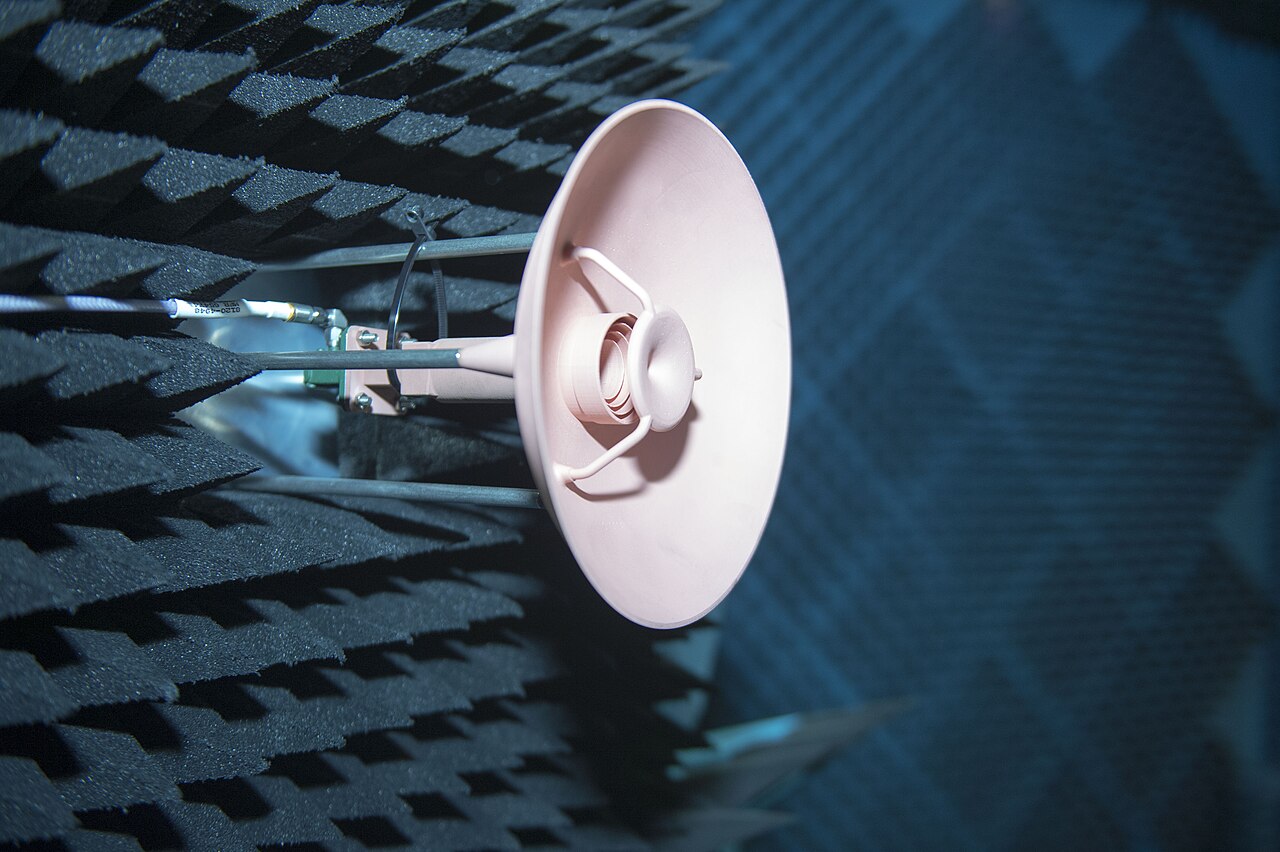
Here is the part that should interest anyone thinking about design for additive rather than subtractive. SWISSto12's business is radio-frequency hardware: waveguides, horn antennas, feed structures. These are shapes defined by their internal voids — smooth, curved, continuous channels whose geometry is the function. Get the internal surface wrong and the RF performance degrades.
Machining that geometry conventionally means splitting the part into halves or sections, cutting each one, and then joining them — with every joint a potential source of loss, leakage, mass, and assembly labor.
Printing inverts that. A curved internal channel is no harder to print than a straight one; a monolithic feed assembly costs roughly what a segmented one costs. SpaceNews summarizes the payoff plainly: 3D printing reduces the size, cost, and production time of HummingSat. Every maker who has printed a part specifically because it was unmachinable — internal lattices, conformal channels, geometry with no tool access — recognizes the logic. SWISSto12 found an industry where that advantage is not a novelty but the entire value proposition, and where the customers are institutional buyers signing multi-year contracts.
The Business Case, Read Skeptically
A 110% CAGR since 2022 and $140M in 2025 revenue is a genuinely strong trajectory. But the composition deserves attention. The $84.8 million (€73 million) in ESA ARTES support underpins HummingSat. Institutional space funding is a legitimate revenue channel — it is how essentially every European space company gets built — but it is not the same as unsubsidized commercial demand, and the disclosures don't let us separate the two.
Against that, the $500M+ contracted order book is the harder number. Orders are commitments from named operators — SES, Viasat, Astrium Mobile, Space Compass — with delivery dates from 2027 through 2029. It is the difference between a pipeline and a forecast. The stated reason for raising is to scale manufacturing and integration capacity, which is what you do when your problem is delivering the backlog rather than finding one.
CEO and founder Emile de Rijk framed the round around demand: "Space is increasingly recognized as essential infrastructure for the global economy." CFO and Strategy Officer Fredrik Gustavsson was blunter about the financials, calling the disclosed numbers "the signals of an agile business, deploying capital efficiently, and operating at scale." The market thesis is de Rijk's, quoted by SpaceNews: "Small GEO is increasingly viewed as a solution for multi-orbit, disaggregated constellations" — operators want smaller, cheaper GEO assets that slot alongside LEO fleets rather than monolithic satellites that must justify themselves alone.
What It Means for Makers
The transferable lesson is not "3D printing is finally profitable." It's narrower and more useful: SWISSto12 is approaching profitability by finding an application where printing isn't a cheaper way to make an existing part but the only sane way to make a better one. The company didn't win by printing brackets faster than a mill. It won because RF waveguides are geometry-limited, and geometry is exactly what additive is good at.
That is the filter worth applying to your own work. When printing merely substitutes for another process, you're competing on cost per gram and losing to injection molding at volume. When printing enables a part that couldn't otherwise exist — monolithic where the alternative is assembled, curved where the alternative is faceted, hollow where the alternative is solid — the economics stop being a comparison and start being a moat. SWISSto12 spent fifteen years finding one such niche and industrializing it. It now reports $140M a year and expects positive EBITDA. Whether the sector produces more companies like it depends on whether anyone else is willing to be that specific.
One caution for the record: 2025 revenue, order book, CAGR, and EBITDA all come from the company's own release and have not been independently audited in public. The EBITDA figure is a 2026 expectation, not a closed result. The investor list and valuation remain undisclosed. The numbers are more concrete than most AM announcements. That is not the same as verified.
