
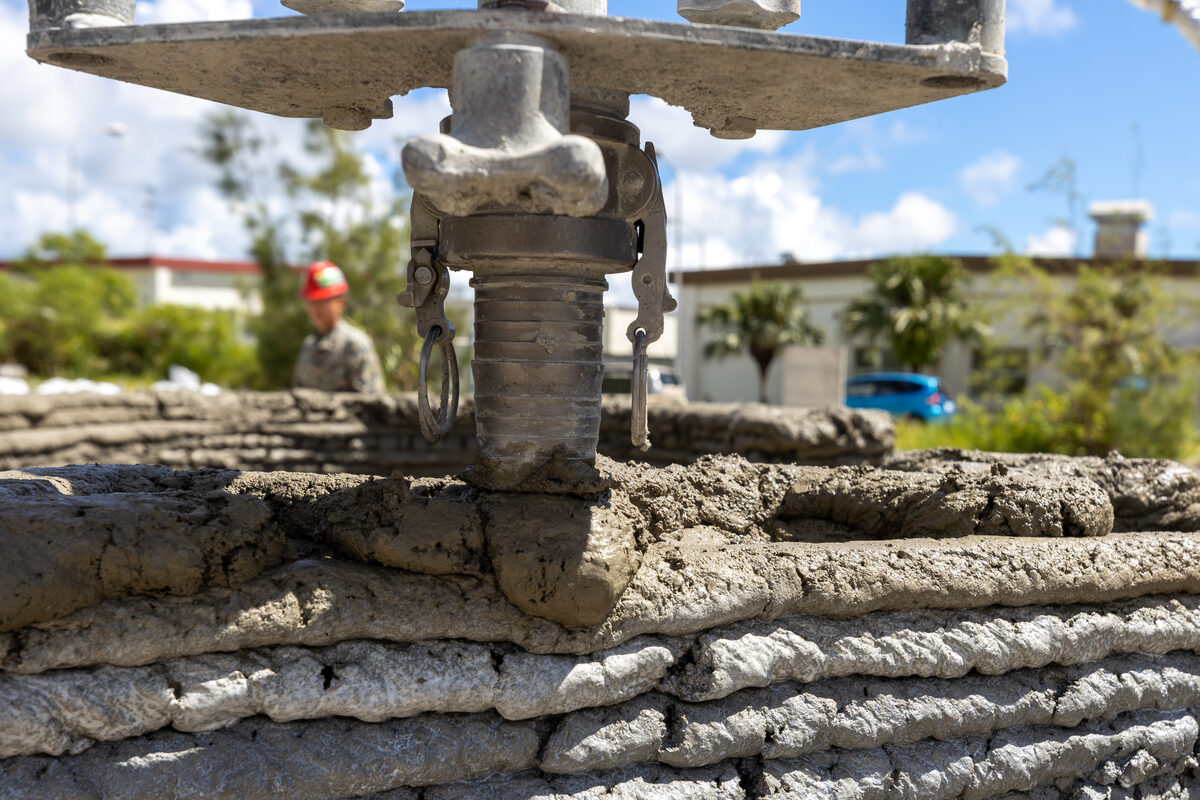
Melbourne-based construction-printing company Luyten has opened early reservations for the ASCEND A27, a US$849,000 system that mounts robotic concrete-printing hardware onto a standard tower crane, turning familiar high-rise construction equipment into a machine capable of printing structures up to 100 meters tall. It's a category shift for a company that, until now, has been best known for smaller gantry-style printers aimed at single-story houses and low-rise builds.
The pitch is straightforward: instead of engineering a purpose-built printing rig that has to be trucked to a site, assembled, and eventually scaled up floor by floor, Luyten is putting the printing payload on a piece of infrastructure that contractors already know how to erect, operate, and tear down — a tower crane. According to Luyten's product page, the ASCEND A27 is aimed squarely at multi-storey buildings, high-rise developments, large-scale infrastructure, and what the company calls "advanced construction automation" — a considerably bigger swing than the single- and double-story homes that have dominated construction 3D printing headlines to date.
How a Crane Becomes a Printer
Construction 3D printers have mostly come in two flavors: gantry systems that ride on rails bracketing the print area, and robotic arms mounted on a fixed or mobile base. Both approaches top out in height relatively quickly — gantries need taller and taller rail structures as a build rises, and arms are limited by reach. A tower crane sidesteps that problem entirely. Its jib already extends dozens of meters into the air and rotates through a wide arc, which is exactly the kind of coverage a large-scale printer needs.
Luyten's own product materials describe the ASCEND A27 as the "world's first tower crane 3D construction printer," converting existing tower cranes into computer-controlled concrete additive-manufacturing systems capable of operating at heights of up to 100 meters. Neither Luyten's product page nor VoxelMatters' coverage discloses a specific working radius, extrusion rate, or crane-erection timeline for the system, so those figures remain unconfirmed pending more detailed technical documentation from the company. What is clear from both sources is the underlying logic: rather than building a dedicated rail or arm structure to carry the print head, the system rides on hardware — the crane's trolley and hoist — that contractors already know how to raise and anchor, which sidesteps a lot of the site-logistics engineering that custom-built gantry printers require at large scale.
What's Actually in the Box
The US$849,000 price, listed on Luyten's official product page, isn't just for the print head and control electronics. It bundles a three-year warranty, operator training, first-year technical support, and the integrated pumping system needed to move concrete from a mixer or silo up to the print head at height. Luyten describes the system as running "AI-driven construction workflows," though the company hasn't published specifics on what that entails — likely some combination of path planning, layer-height correction, and quality monitoring, based on how competitors in the construction-printing space have described similar systems.
Notably, the ASCEND A27 isn't a from-scratch design. VoxelMatters reports that its control systems were developed and tested first on Luyten's existing Platypus X12 platform, the company's smaller, gantry-based printer. That's a meaningful detail for anyone trying to gauge how real this product is: rather than debuting brand-new print-head and material-handling logic simultaneously with a brand-new mechanical platform, Luyten is porting proven control software onto new hardware. It's the same de-risking logic you'd want to see from any manufacturer scaling up a machine by an order of magnitude in build height.
Reservations, Not Orders — Yet
Luyten isn't taking firm orders right now. According to VoxelMatters, the reservation window — open through October 25 — gives developers, contractors, government agencies, and infrastructure providers "priority access to its first production allocation," essentially a place in line for a still-limited production run. That's a familiar playbook from high-ticket industrial equipment launches: gauge demand, lock in early adopters, and avoid building inventory for a machine that costs the better part of a million dollars before anyone has committed to buying one. Neither Luyten's product page nor VoxelMatters' report specifies whether reservation deposits are refundable or credited toward a future purchase, so that detail should not be assumed.
Ahmed Mahil, Luyten's founder and Global President, framed the launch in characteristically ambitious terms. "ASCEND A27 is more than a new machine," he said, according to VoxelMatters' coverage. "It represents a new era of intelligent construction, empowering our customers to build faster, smarter and at unprecedented scale." Whether that holds up will depend on execution: concrete printing at 100-meter scale introduces engineering challenges — wind loading on an extruder hanging from a crane jib, material curing consistency across dozens of stories, structural code compliance at high-rise scale — that Luyten's marketing materials don't yet address in public detail.
What It Means for Makers
The ASCEND A27 isn't a machine that's going to show up in a maker's garage, and at nearly $850,000 it's well outside hobbyist or even most small-shop budgets. But it matters to the broader 3D printing community for a couple of reasons. First, it's a signal of where the construction-printing segment is headed: from single-story demo houses toward genuine multi-story buildings, which is the threshold the industry needs to cross to be taken seriously as an alternative to conventional construction at scale. Second, the underlying idea — repurposing existing heavy equipment as a printer chassis rather than engineering a bespoke rig from the ground up — is a pattern worth watching. It's the same instinct that leads hobbyists to convert CNC routers into pellet extruders or laser cutters into pick-and-place machines: use the expensive, well-understood platform you already have, and put your engineering effort into the print head and controls instead of reinventing the whole machine. If Luyten's crane-based approach proves out at 100 meters, expect other construction-printing companies to follow the same logic rather than keep building taller and taller custom gantries.
