
High-performance polymer printing has always had an awkward middle: too expensive to run on a desktop filament printer at real volume, too niche for most job shops to bother stocking. A German startup thinks it has found the gap. As reported by Joris Peels at 3DPrint.com, Malping GmbH, based in Neuhausen auf den Fildern near Stuttgart, is building a business around printing PEEK, PEKK, PPS-GF20 and ULTEM 9085 for electronics and medical customers — and it wants to sell not just the parts, but the capability to make them.
The pitch has two halves. The first is a conventional-sounding manufacturing service: send Malping a design, get back a finished PEEK or ULTEM part, prototype or short-run production. The second, branded the "PEEK Turnkey System," is less conventional — it's an offer to help a customer stand up in-house PEEK printing of their own, rather than staying dependent on an outside bureau indefinitely. That combination, service now and independence later, is the part worth paying attention to.
Granules, Not Filament
The technical lever behind Malping's cost claims is granule-fed printing — often called FGF (fused granulate fabrication) or pellet extrusion — rather than the spooled filament most desktop and even industrial FDM/FFF machines rely on. According to the report, Malping's granule-based systems run at 500 grams per hour and cut material cost by more than 40 percent compared to filament. That gap exists because filament itself is a manufactured, value-added product: raw polymer has to be extruded, sized to tight diameter tolerance, spooled and packaged before it ever reaches a printer nozzle. Feeding pellets or granulate directly into a hopper skips that entire conversion step, which matters enormously with a material like PEEK, where raw resin already commands a premium price and every processing markup compounds it.
For high-performance engineering plastics — PEEK's crystalline structure alone makes it resistant to chemicals, radiation and continuous service temperatures north of 250°C, which is why it shows up in surgical implants, semiconductor tooling and downhole oil-field components — that 40-plus percent swing is not a rounding error. It can be the difference between a part being viable to print at all versus needing to be machined from billet or injection molded, both of which carry their own tooling or setup costs that don't pencil out below certain volumes.
The Hardware Behind the Claim
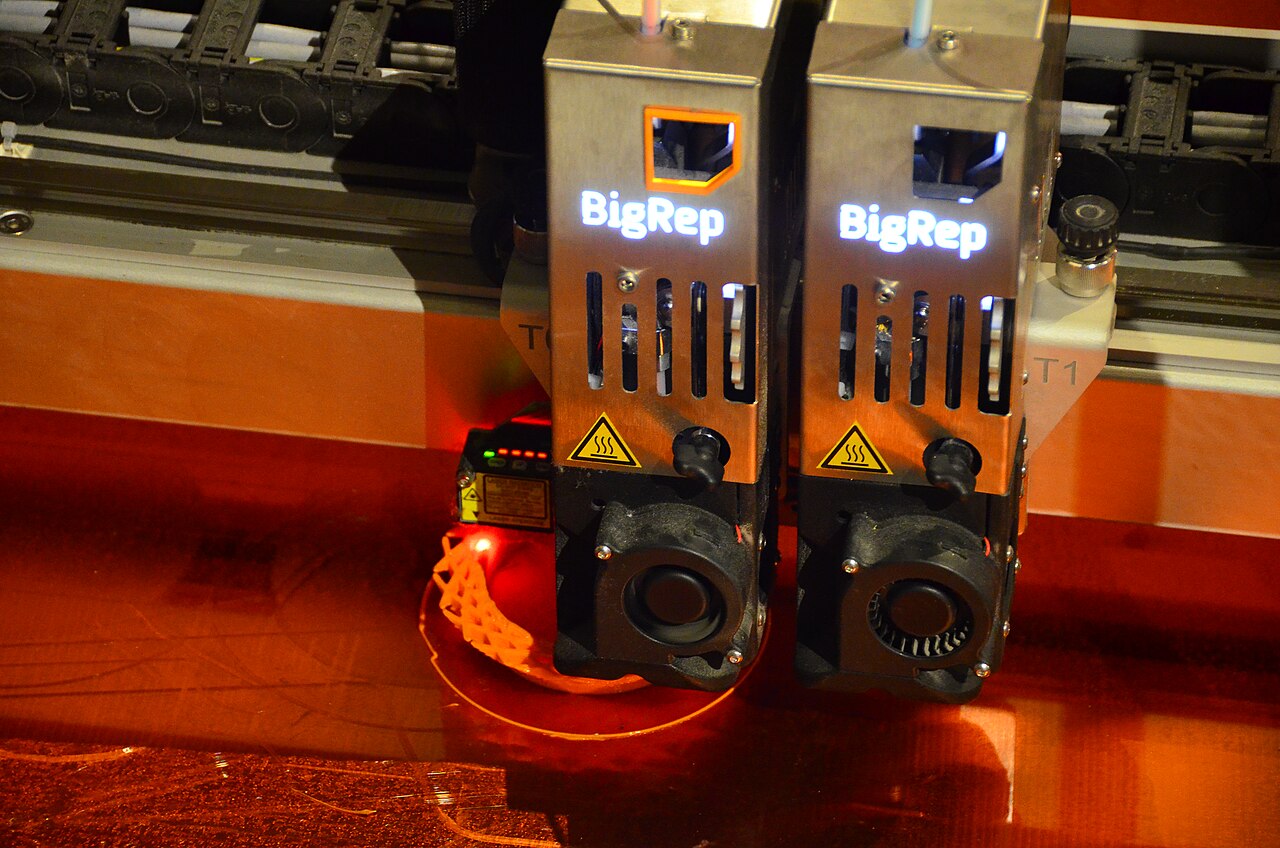
Malping isn't running a single machine. Per the report, the company operates an AIM3D ExAM 510 — a pellet-fed system with a 510 x 510 x 410 mm build volume — reserved for parts larger than 1,000 cm³, alongside a fleet of 22 IDEX Vision Miner filament extruders for smaller or lower-volume work. The ExAM 510 can also run MIM (metal injection molding) pellets, according to the report, which widens the range of feedstock Malping can source beyond print-specific granulate — notable given how thin the supplier base for high-performance printing pellets still is. That's a deliberate two-tier setup: granule-fed capacity for big parts where the per-kilogram savings matter most, and a bank of conventional filament machines for jobs where flexibility or part size doesn't justify pellet tooling. Malping also partners with outside CNC shops for finishing work, which suggests the company is positioning itself as a coordinator of a full high-performance-parts workflow — print, then machine to tolerance — rather than a pure printing vendor.
The material list itself signals the target customer. PEEK and PEKK are the marquee performance polymers; PPS-GF20 (glass-fiber-reinforced polyphenylene sulfide) is prized for dimensional stability and chemical resistance in process and chemical-industry hardware; ULTEM 9085 is a Boeing-and-Airbus-vetted, flame-retardant PEI used heavily in aerospace interiors and certified medical-device housings. Malping's own site additionally lists PPA-CF and PPA-GF (carbon- and glass-filled polyphthalamide) among its process materials, and names machinery, chemical/process, medical technology and defense as its target industries — a lineup that reads less like a maker-space bureau and more like a specialized industrial subcontractor. Malping's site also describes its primary market as the DACH region — Germany, Austria and Switzerland — while noting it serves customers worldwide, another data point suggesting the company is scaling a regional service model rather than chasing a single flagship account.
Founder Bastian Gaedike framed the company's value proposition around outcome rather than material choice: "Our customers do not buy a material, they buy a function. Sometimes the right answer is PEEK, sometimes a well chosen polyamide is enough." That's a notable stance for a company whose name is practically synonymous with PEEK in this story — it suggests Malping is trying to sell engineering judgment and process fit as much as it's selling exotic polymer capability, presumably as a way to build trust with buyers who might otherwise assume every quote defaults to the most expensive material on the shelf.
What It Means for Makers
Almost nobody reading this owns a granule-fed printer capable of running PEEK, and that's exactly the point — Malping's turnkey offering is aimed at companies that have decided the economics of in-house high-performance printing finally work, but don't want to build that expertise from zero. If you're a small shop or engineering team that has been quoting PEEK parts out to bureaus and eating long lead times or high per-part markups, a service built specifically around granule-fed PEEK, with a stated cost advantage over filament-based competitors, is worth getting a quote from — especially for parts too large or too high-volume for a desktop-scale FDM PEEK printer to make sense.
The more interesting signal for the broader market is what a viable "PEEK Turnkey System" business implies: that granule-fed high-performance printing has matured enough that a startup can package it as a repeatable, sellable system rather than a one-off engineering project. If that's true, expect the gap between "PEEK printing is a boutique service" and "PEEK printing is an equipment category you buy" to keep narrowing — good news for medical device, defense and process-industry buyers who need small batches of chemically resistant, high-temperature parts without committing to injection-mold tooling. For now, though, Malping's claims — the 500 g/hour throughput, the 40-plus percent material savings, the turnkey buildout — come from the company and its own reporting rather than independent third-party benchmarking, so treat the cost figures as a starting point for your own quote rather than a guaranteed number.
