
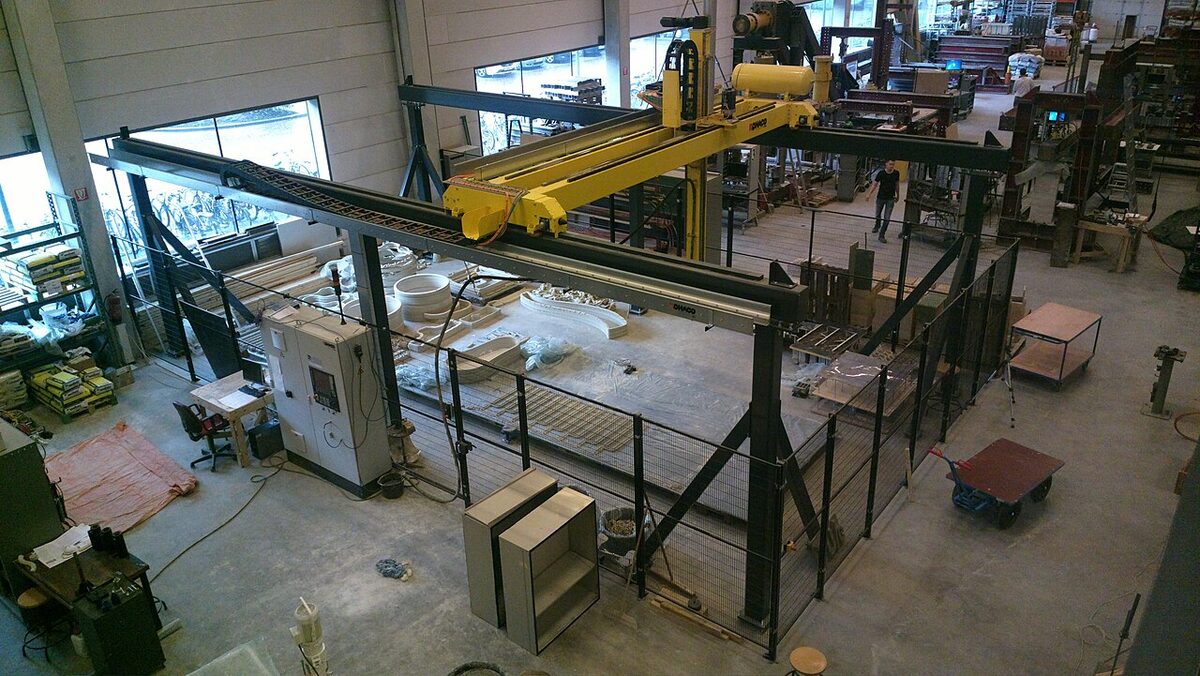
Anyone who has pushed a stiff paste through a nozzle knows the problem in miniature: too thick and it will not extrude, too thin and it slumps before the next layer lands. Construction-scale 3D printing lives with that tradeoff every day, and a new study in the Journal of Applied Physics, summarized by AIP Publishing's SciLights on October 2, 2026, tries to explain it from the atoms up. The team of Subhadeep Pal, Shady Gomaa, Gianluca Cusatis and Sinan Keten used multiple models, linked across scales, to examine how the water-to-cement ratio of freshly mixed paste relates to how easily it flows, and found that the simulated trends matched the key qualitative trends seen in experiments with wet cement.
The paper, titled "Molecular investigation of freshly made cement-paste rheology for 3D-printing application," does not hand printer operators a new mix recipe. What it offers is something the field has arguably lacked: a physical account of why fresh cement paste behaves the way it does under flow, built from simulation rather than inferred purely from trial batches.
The Gap Being Filled
As VoxelMatters reported on October 1, citing the AIP summary, construction in disaster-struck areas, military applications and other extreme environments is often difficult or unsafe for workers. Printing cement offsite and transporting the finished pieces to the location is described as an alternative. Yet, as both outlets note, there is a gap in understanding what controls the flow of wet, freshly mixed cement, and that gap limits the ability to optimize building performance.
That is the problem the study goes after. A model that connects composition to flow at a mechanistic level is the kind of tool that could eventually make the tuning of printable mixes less of a guessing game, though the authors do not claim to have reached that point.
How the Model Is Built
The study's core idea is to bridge scales. At the bottom are calculations of how water affects the interaction between cement surfaces at the atomic scale. Those calculations capture how water behaves where cement surfaces meet, which is the level at which the water-to-cement ratio ultimately does its work.
The results from that atomic-scale layer are then used to construct an effective interaction for a much larger particle-based model, which represents the paste as a collection of interacting particles rather than as individual atoms. In the AIP summary, Pal is quoted: "We first calculated how water affected the interaction between cement surfaces at the atomic scale and then used that information to construct an effective interaction for a much larger particle-based model." The larger-scale simulation therefore inherits behavior grounded in molecular interactions. The SciLights piece adds that the researchers used multiple models in the work, rather than a single simulation technique.
Pal also compared the multiscale approach to using a microscope to look at cement at different levels. Linking the levels lets each one contribute what it can: the atomic scale supplies the physics of water between surfaces, and the particle scale shows what the material does when it flows.
What the Simulations Showed
The headline result is intuitive to anyone who has mixed concrete by hand: the work identified a reduced viscosity with an increased water-to-cement ratio. More water, easier flow. What is new is that the effect emerges from a model built up from molecular interactions, rather than being assumed.
Just as important, the team compared the simulations against experiments using wet cement, and the AIP summary reports that the two showed the same key qualitative trends. That is a meaningful check. It does not mean the model predicts exact viscosity values for a given mix, and the summary frames the agreement as qualitative. But it does suggest the model is capturing the right physics in the right direction.
The Shear-Thinning Question
The more interesting contribution may be the proposed explanation for shear thinning, the drop in viscosity as a material is sheared faster. According to SciLights, the authors looked beyond the viscosity curve and focused on what the cement particles were doing during flow, and from that they could propose a microscopic mechanism for the observed shear thinning.
Readers who want the full details of that mechanism should go to the paper itself, published in the Journal of Applied Physics under DOI 10.1063/5.0332157. Still, having a candidate mechanism matters: if you know why a material thins under shear, you have a better idea of which knobs might change that behavior and which will not. In the quote AIP carries, Pal says he hopes the work provides "a useful framework for connecting molecular-scale cement science with the particle-scale behavior that ultimately controls processing."
Limits Worth Keeping in Mind
The model is simplified, and the summary says so plainly: cement is a complex material with irregular particles, and the team's simplified model was a starting point used to identify isolated relationships between water content, particle interactions, shear and viscosity. Per the AIP summary, future work will add more elements to the models to better understand cement flow and its use in 3D printing.
That framing is worth taking at face value. This is a starting point for a mechanistic understanding of fresh-paste rheology, not a calculator that tells a print crew what water ratio to dial in on a given day. The qualitative match with experiments is encouraging, but qualitative agreement is a long way from a validated design tool.
What It Means for Makers
Most FilamentFeed readers are not running gantry printers that lay down walls. But plenty of makers experiment with paste extrusion, whether clay, ceramic slurries or small-scale cementitious mixes on converted desktop machines, and they run into the same basic tension between flowability and shape retention. The lesson from this study is not a new number to adopt; it is a reminder that the water ratio is acting at a very fundamental level, and that shear-thinning behavior has physical causes that researchers are now trying to pin down.
For anyone following construction printing more broadly, the work points toward a future where mix design could lean more on simulation and less on repeated test pours. That future is not here yet. The model in this paper is a deliberately simplified starting point, and its comparison with experiments so far is qualitative. But building a bridge from atomic-scale interactions to the flow behavior of wet cement is the kind of foundational step that later, more practical tools tend to rest on.
The bottom line: more water lowers viscosity, the simulation agrees with experiments on the trend, and there is now a proposed microscopic explanation for shear thinning in fresh paste. Expect the refinements, not this first version, to be the ones that eventually matter on a job site.
