
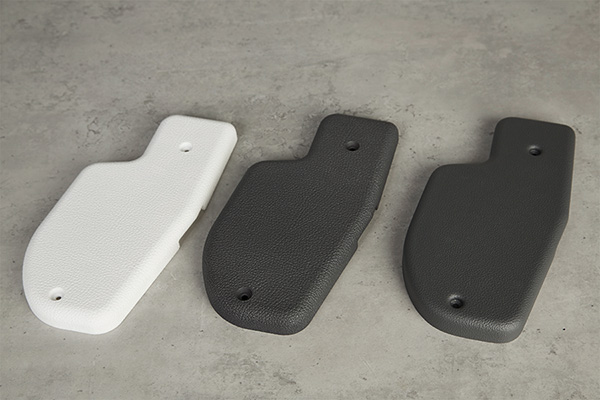
DyeMansion has opened orders for the Powershot Go, a compact blasting cabinet aimed at the shops that have never had room or budget for the company's industrial post-processing line. According to DyeMansion's launch announcement for Formnext 2026, the machine was co-developed with HP and validated as an HP Qualified Solution for the HP MJF 1200, though the company says it works with all powder bed technologies. The price is under 14,000 EUR or 17,000 USD, plus tax and shipping, and the first systems are scheduled to ship in the first quarter of 2027.
The Powershot Go was first announced in April 2026. The November launch turns it into an orderable product, and the timing is deliberate: TCT Magazine reported that the system would be showcased at Formnext, which DyeMansion's release places on November 17 to 20.
The Problem It Is Built to Solve
Anyone who has pulled parts out of a powder bed printer knows that the print is only half the job. Selective laser sintering and Multi Jet Fusion parts come out of the build unit caked in unfused powder, and that powder has to come off before a part is usable, let alone presentable. In a large service bureau, that work goes to dedicated depowdering stations, bead blasters and, for higher-end finishes, further surfacing steps. In a small lab, it often comes down to a brush, compressed air and a lot of patience.
DyeMansion's existing Powershot machines address the industrial end of that spectrum. The Powershot DUAL Performance, with a 55 L basket, is built for automated serial production. The Powershot X sits below it. What the company has not had until now is a machine sized for the compact printers that have opened powder bed fusion to smaller operations, and the HP MJF 1200 is the obvious anchor for that segment.
The pitch, per the press release, is that the Powershot Go delivers the same cleaning and blasting results as the Powershot X on a fraction of the floor space. That is a strong claim, and the real test will come when shops start running production batches through the first units in 2027. On paper, though, the trade-off is clearly stated: you give up capacity, not finish quality.
Capacity, in Numbers
The capacity figures need a careful read. The Powershot Go product page lists a basket volume of 57 L, but an effective usable volume of 15 L. The second number is the one that matters for planning throughput. The press release gives the Powershot X a usable basket volume of 26 L, nearly double the Go.
For an MJF 1200 owner, the more useful benchmark is the one TCT Magazine reported: one full HP MJF 1200 build fits in a single Powershot Go run. That pairing is the whole design brief. The machine is sized so that a printer and its post-processing cabinet move in step, one build in and one batch out, without parts piling up between the two.
The product page also points to low compressed air and power requirements. DyeMansion does not put figures on these in the material reviewed here, but the emphasis makes sense for the intended buyer. A small workshop is far more likely to be limited by its air compressor and electrical service than by floor space alone, and a machine that needs facility upgrades before it can be plugged in isn't really compact in any practical sense.
Glass or Plastic: Two Jobs in One Cabinet
The Powershot Go ships with both PolyShot Cleaning and PolyShot Surfacing as standard, and it supports either plastic or glass blasting media. The choice of media is what separates the two jobs.
According to TCT Magazine, glass media produces clean, depowdered parts. Plastic media goes a step further, adding a semi-glossy, scratch-resistant surface. In practice, that means one cabinet can handle both the basic cleanup every powder bed part needs and a cosmetic surfacing step that would otherwise call for a second process or a second machine. For a small shop, folding those into a single footprint is arguably more significant than the price.
The machine also uses a cyclone separator, which the product page says returns usable media to the process. Media is a consumable, and separating spent media and stripped powder from material that can still be used is part of keeping running costs predictable. It also matters for housekeeping: a blasting system that recirculates media efficiently is easier to live with in a room that also holds printers.
Who This Is Actually For
DyeMansion's own example user is telling. The press release names small-batch pediatric orthotics and prosthetics workshops as a use case. O&P is a field where parts are custom by definition, volumes per patient are low, and the finished device has to be clean and comfortable against skin.
The same logic extends to university and research labs, product development teams, and small contract shops that bought a compact MJF or SLS machine and then found that post-processing became the bottleneck. These are operations where a single build is often a mixed batch of different parts, where nobody is running three shifts, and where a cabinet that matches the printer one-to-one is easier to justify than an industrial line.
The Powershot Go is also positioned as half of what DyeMansion calls its Compact Industrial Line, alongside the VX1 vapor smoothing system. That pairing suggests a clear path for shops that start with blasting and later want sealed, smoothed surfaces: buy the compact cleaner now, add vapor smoothing when the work calls for it.
What It Means for Makers
For hobbyists printing on filament machines, the Powershot Go is not relevant hardware. For the growing group of makers and small businesses who have moved into powder bed fusion, it is a meaningful development, because it puts an industrial-vendor blasting system at a price and size that fits alongside a compact printer.
Under 17,000 USD before tax and shipping is not impulse money, and it should be weighed against the 15 L usable volume. A shop that expects to outgrow one MJF 1200 may find the Powershot X's larger basket the better long-term buy. But for a lab or workshop running a single compact machine, the combination of HP validation, a matched build-to-batch capacity, and a choice between glass cleaning and plastic surfacing covers most of what post-processing has to do.
The open questions are the ones only field use can answer: cycle times, media consumption, and whether the finish genuinely matches the larger machines across different part geometries. With orders open now and first deliveries due in Q1 2027, those answers should arrive by spring.
