
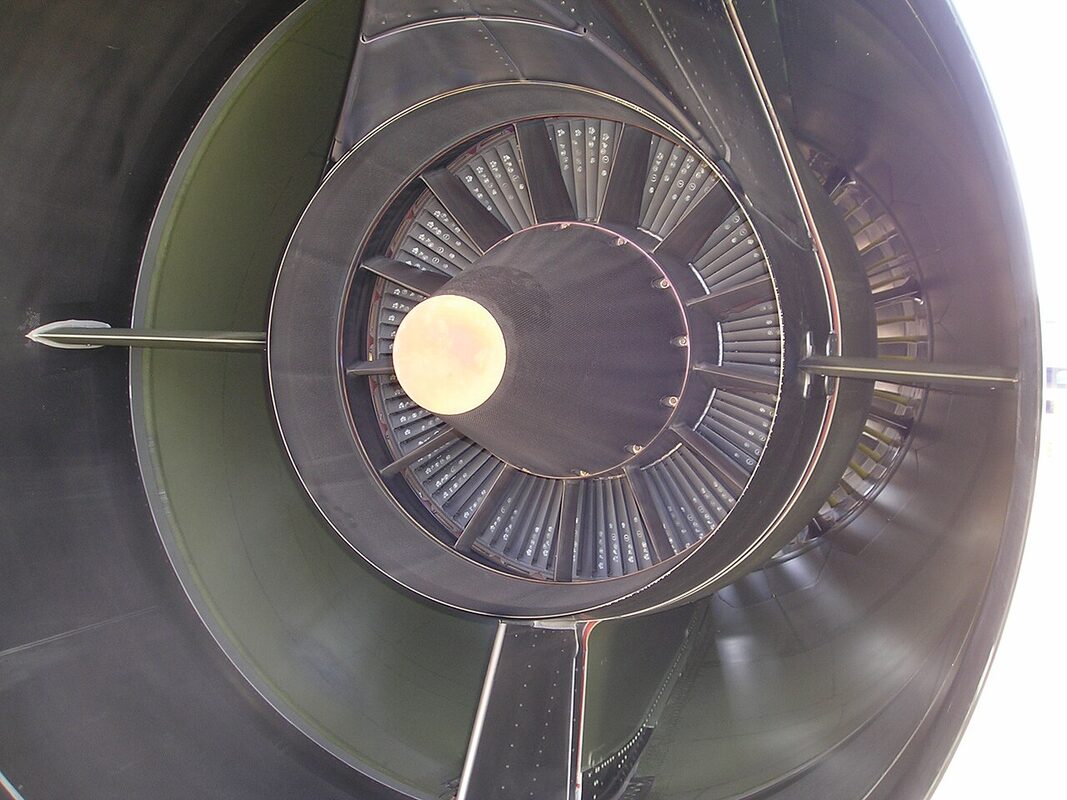
Boom Supersonic has ordered three CeraFab S65 industrial ceramic printers from Austrian specialist Lithoz, and it is not buying them to make airliner trim. According to Lithoz's announcement of the order, the Colorado company will use the machines to print ceramic casting cores, the sacrificial internal forms around which single-crystal turbine blades are cast, for its Superpower industrial gas turbine. It is a small order by machine count. What it says about where Boom intends to make its most demanding parts is a bigger story.
Two products, one hot section
Boom is best known for Overture, the supersonic airliner it is developing and for which, per Lithoz, it holds an order book of 130 aircraft. Its second product is Superpower, an industrial gas turbine aimed at power generation. Lithoz describes Superpower as an aeroderivative machine, meaning one derived from aircraft engine design, and that lineage matters here: the blades in its hot section have to survive what the press release calls the "extreme turbine inlet temperatures" of that kind of turbine.
The answer the industry settled on long ago is the single-crystal blade, cast from a superalloy so that the finished part has no grain boundaries for heat and stress to exploit. Those blades are also hollow. Their interiors carry networks of cooling passages, and the shape of those passages is defined by a ceramic core placed inside the mold before the metal is poured. Once the casting has solidified, the core is removed, leaving the passages behind. Whatever detail the core has, the blade inherits.
That is the job Boom wants the CeraFab S65 to do. Lithoz says its process, Lithography-based Ceramic Manufacturing (LCM), was identified as a key technology to "create, build and industrially scale" cores with the complex channels and branched cavities single-crystal blades require. TCT Magazine's report on the order, published November 16, confirms the same application: three printers, casting cores, and Superpower blades.
Why print a core at all?
Branched cavities are the operative phrase. A core with internal branches, intersecting channels, or passages that fold back on themselves is exactly the kind of geometry that is difficult or impossible to pull from a conventional two-part tool. Additive manufacturing removes that constraint in the usual way: if the printer can resolve the feature layer by layer, the designer is free to draw it.
As the name says, LCM is a lithography-based process, a family that will feel familiar to anyone who runs a resin printer, built here around ceramic rather than plastic. The appeal for casting cores is the combination of fine resolution with a ceramic material that can stand up to the casting process.
Boom's chief engineer, Nick Sheryka, framed the decision in terms of consistency rather than novelty. Lithoz "convinced us by their excellent support in delivering a series of prototypes," he said, and LCM delivered "repeatable, reliable results." On that basis, Boom selected the process as a key technology for its in-house turbine blade production. That last phrase is the notable one. A company choosing to print its own cores is signaling that it wants control over the design iteration loop for its hottest components.
Lithoz CEO Dr. Johannes Homa cast the order as part of a pattern, calling Boom "another major aerospace OEM adopting LCM." Vienna-based Lithoz, founded in 2011, has around 100 employees and exports almost all of its output.
The material story behind the machines
The order lands alongside a data point from Lithoz's own business: the company recently reported a 40% year-on-year increase in material sales, with silica-based materials the major driver. Lithoz lists silica-based LithaCore 450 among its recommended materials for the CeraFab S65, and its single-crystal casting material page points to turbine-blade applications, so the growth is consistent with printers being run for core production, though the announcement does not break the figure down by application.
That is a meaningful distinction for anyone tracking industrial adoption. Machine sales can reflect evaluation programs and lab budgets. Consumable sales track parts actually being produced. Lithoz attributes the silica growth to existing aircraft-engine OEM customers and a few unnamed contract manufacturers, which hints at casting cores moving from prototype work toward routine use.
Polymer, metal, and now ceramic
Boom is not new to additive manufacturing. TCT notes that the company already uses Stratasys FDM polymer printing for prototyping, tooling, and cabin parts, and that it used VELO3D metal powder bed fusion for multiple parts on its XB-1 prototype aircraft. The CeraFab order adds a third material class to that toolkit, and it does so at the most thermally punishing end of the product.
The progression is worth noticing. FDM handles prototypes, tooling, and cabin parts. Metal powder bed fusion produced parts for a prototype aircraft. Ceramic LCM is not making the final part at all; it is making the tool that shapes the final part's interior. In each case the printer sits where it gives the most leverage, not where it makes the best marketing photo.
What It Means for Makers
Most readers are not going to cast single-crystal superalloy blades in the garage. But the logic of this order maps neatly onto problems makers already solve. Anyone who has printed a pattern for lost-PLA or lost-resin casting understands that the printed object is often a means rather than an end, and that its accuracy sets a ceiling on the quality of the metal part. A ceramic core is the same idea pushed to an extreme: it has to hold fine internal features, survive contact with molten metal, and then be removed without a trace.
The other lesson is about where precision pays. Boom's engineers did not pick LCM because it was new; by Sheryka's account they picked it because a run of prototypes came back consistent. For anyone building a workflow around a printer, whether a desktop resin machine or an industrial ceramic system, repeatability is the property that turns a clever one-off into something you can design around.
Finally, keep an eye on materials, not just machines. Lithoz's material sales figure is a better indicator of real production than any single printer order, and the same is true at hobby scale: the filaments and resins people keep reordering tell you which processes have actually earned a place on the bench.
