
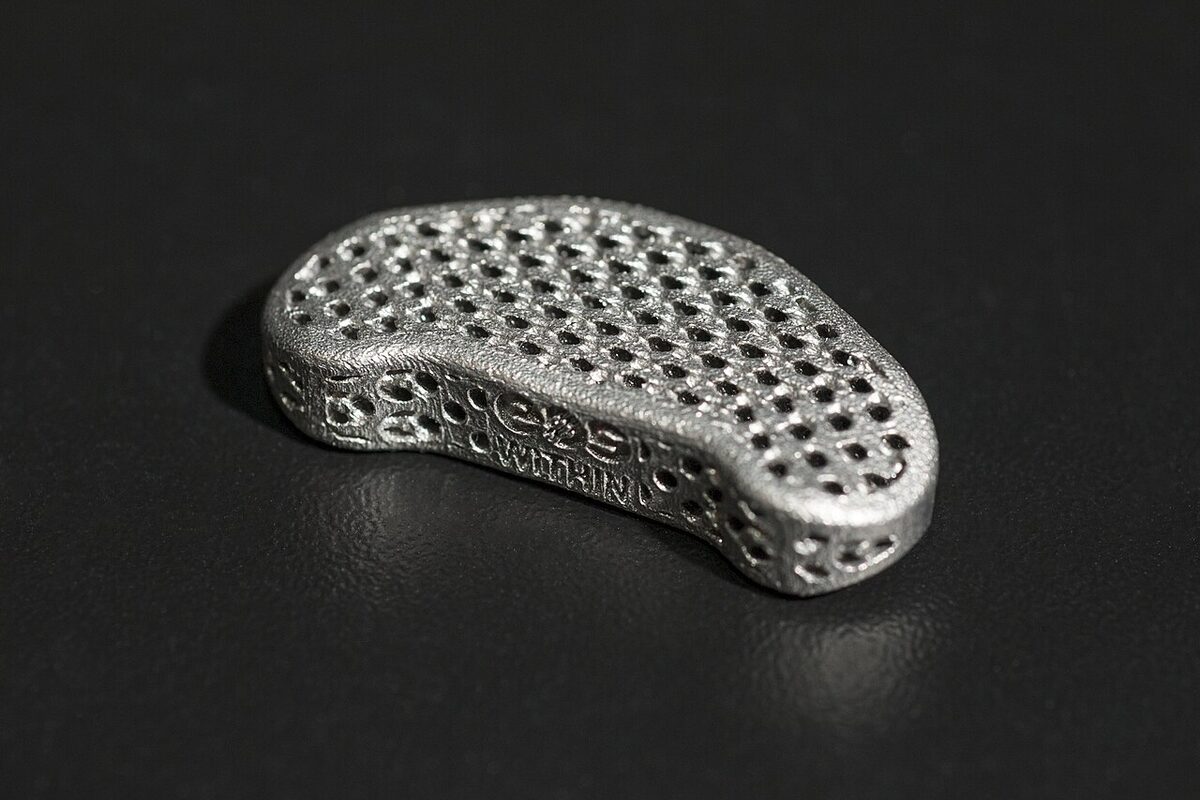
A spinal implant that started life as a machined part has been rebuilt around a printed lattice, and it is now going into patients. Providence Medical Technology, based in Pleasanton, California, announced on October 29 that surgeons had completed the first commercial cases with the CORUS Posterior Cervical Stabilization System 3D-T, a version of its CORUS PCSS implant that uses a proprietary 3D-printed porous titanium lattice. The device has FDA 510(k) clearance, and the first procedures took place in Los Angeles and in Mechanicsville, Virginia. 3D Printing Industry reported the clearance and first cases on November 10.
The story is less about a new idea in spine surgery than about something that keeps coming up in medical device work. When a company already has clinical evidence for an implant, additive manufacturing gives it a way to change the implant's surface and internal structure without starting over on the basic design.
What the Device Does
According to 3D Printing Industry, the CORUS PCSS 3D-T is indicated to stabilize spinal segments as a supplement to posterior cervical fusion in patients with cervical degenerative disc disease. In plain terms, it is hardware that helps hold vertebrae in the neck steady so bone can grow across the treated segment and fuse it. It is placed on both sides of the spine through a posterior approach, from the back of the neck, as a supplement to the fusion procedure rather than a replacement for it.
The first commercial cases were performed at Adventist Health White Memorial in Los Angeles by Dr. Mohsin Fidai and at Bon Secours Memorial Regional Medical Center in Mechanicsville by Dr. Abilio Reis. Providence debuted the system at the North American Spine Society (NASS) 2026 Annual Meeting, according to the PR Newswire release.
Why Print It
The change from the original CORUS PCSS is the lattice. Providence says the printed porous titanium structure has 1.5 times the surface area and 8 times the surface roughness of the original machined implant. 3D Printing Industry reports that the lattice is modeled on cancellous bone, the spongy tissue inside bones, and that its porosity and pore sizes are aligned with published research on bone ingrowth. The company also says the lattice spreads load evenly and leaves room to pack graft inside the device.
Each of those numbers maps to something a subtractive process struggles to deliver. A machined titanium part can be textured on its outer faces, but it cannot easily contain an interconnected internal network of pores sized for bone to grow into. More surface area means more interface between metal and tissue, and an open, bone-like architecture gives new bone somewhere to go, rather than just a surface to rest against. That kind of geometry is the one place where printing metal has a clear structural advantage over cutting it from bar stock.
Neither source states which metal printing process Providence uses or how it handles post-processing, powder removal from the lattice, or inspection. Those are the details that usually determine whether a porous implant is easy or difficult to qualify, and they remain proprietary here.
The Evidence It Builds On
Providence is not asking surgeons to trust an untested concept. The PR Newswire release says the 3D-T version builds on Level 1 evidence for CORUS PCSS. Level 1 is the top tier of clinical evidence and typically means randomized controlled trials.
3D Printing Industry identifies the study: the earlier CORUS PCSS was evaluated in a randomized trial registered as NCT04229017. When combined with multilevel anterior fusion, the device was associated with higher fusion rates at 12 and 24 months and a substantially lower two-year surgical revision rate compared with anterior fusion alone. Interim results were published in the journal Spine in May 2025.
Two cautions apply. First, those results describe the original machined implant, not the new printed version. The 510(k) pathway generally clears a device on the basis of substantial equivalence to a predicate device rather than requiring a fresh randomized trial, and 3D Printing Industry notes that Providence has not reported comparable clinical outcomes for the 3D printed version. Second, the published results were interim. Whether the rougher, higher-surface-area 3D-T improves fusion further is a reasonable hypothesis, not something either source claims has been demonstrated.
Co-founder Bruce McCormack, MD, is quoted in the 3D Printing Industry coverage of the clearance, saying the company kept the technique surgeons already trust and gave bone a porous lattice to grow into. For readers weighing the device, though, the substance lies in the indication, the lattice specifications, and the evidence trail laid out above.
What It Means for Makers
Nobody reading FilamentFeed is going to print a cervical implant in the garage, and nobody should. But the CORUS PCSS 3D-T is a useful case study in why industrial additive manufacturing keeps winning in orthopedics, and the lessons carry over to hobby work more than you might think.
Geometry is the product. The reason to print this part is not speed or cost. It is a lattice that a mill cannot easily produce. Makers who design with gyroid infill, TPMS structures, or lattice generators in CAD tools and slicer modifiers are using the same logic: put material where the load path and function need it, and use internal structure as a feature rather than an afterthought.
Surface is a design variable. Providence quantifies roughness as an improvement, not a defect. In consumer FDM printing, layer lines and surface texture are usually something to sand away. In biology, and in some functional applications such as adhesive bonding or grip surfaces, texture can be the point.
Iterate on a proven base. Providence kept a device with randomized trial data and changed the manufacturing method and internal structure. That is a disciplined way to adopt a new process: hold the validated form constant and change one major variable. It is the same approach that works when moving a known-good part from PLA to a nylon blend, or from FDM to resin.
Validation is the hard part. The printing is arguably the easy step. Proving porosity, cleanliness, and consistency to a regulator is where the time and money go, and it is why medical lattices come from specialist industrial shops rather than desktop machines.
Bottom Line
The CORUS PCSS 3D-T is a straightforward example of additive manufacturing upgrading an existing, clinically studied implant: the same basic device, now built around a bone-mimicking titanium lattice with, by the company's figures, more surface area and roughness. It is cleared, it is in commercial use at two U.S. hospitals, and its predecessor has randomized trial data behind it. What remains open is whether the printed lattice produces better outcomes than the machined original, and that will take time and data to answer.
