
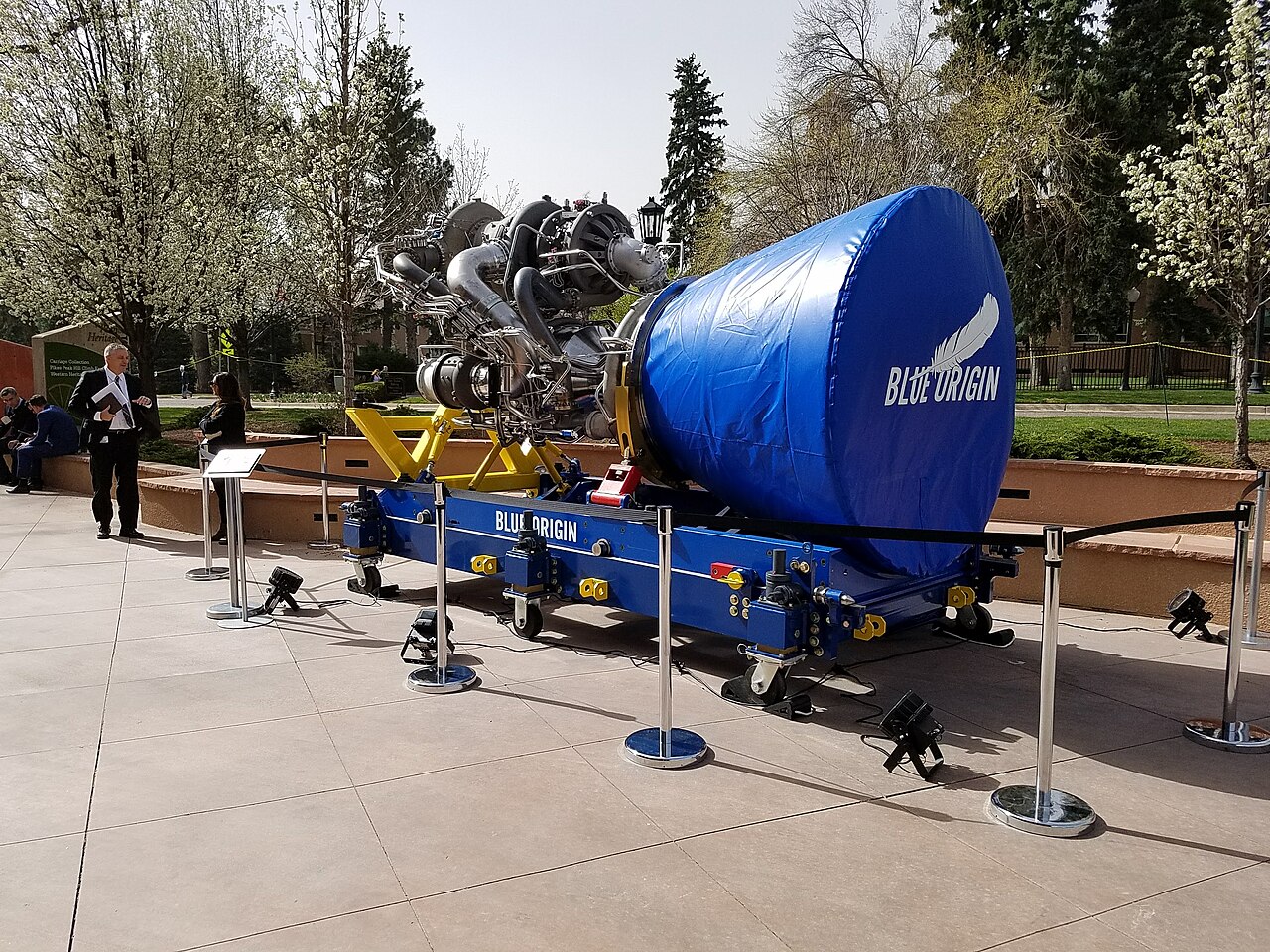
Blue Origin has a second booster engine, and by the company's own numbers most of it came out of a printer. In an announcement on November 5, the company introduced Northstar, a liquid oxygen and liquefied natural gas (LOX/LNG) engine rated at 715,000 pounds-force of thrust. Blue Origin says "more than 65% of the engine" is "produced through additive manufacturing," using large-scale AM capability it built in-house. Compared with BE-4, its current booster engine, Northstar is 30% lighter, has 50% fewer parts and makes more thrust. Blue Origin also says the engine can be assembled in less than a day.
Those are big claims, and right now they are only claims. A follow-up from TCT Magazine on November 9 confirmed the 65% figure with the company, but it also pointed out what Blue Origin hasn't said: which AM process it uses, which materials, and which components are printed. So the headline number is official, and almost everything behind it is unknown.
The Numbers, Side by Side
Northstar is not a new thermodynamic approach. Blue Origin says it keeps the architecture of BE-4: an LNG-fueled, oxygen-rich staged combustion cycle driven by a single-shaft turbopump. Oxygen-rich staged combustion is one of the hardest cycles to build. Hot, high-pressure oxygen-rich gas attacks metals, and the turbomachinery runs under severe thermal and mechanical loads. Keeping that cycle and the single-shaft layout means the changes are about how the engine is made and packaged, not about a new thermodynamic approach.
Here is what changes, according to Blue Origin:
- Thrust: up from 640,000 lbf (BE-4) to 715,000 lbf, roughly 12% more.
- Mass: down 30% compared with BE-4.
- Part count: down 50%.
- Assembly: under one day.
- Schedule: 11 months from program approval to development testing.
More thrust and less mass together make the thrust-to-weight gain larger than either number alone. For a booster engine, a better thrust-to-weight ratio is a clear advantage, though Blue Origin hasn't said how it would use the margin. Blue Origin describes Northstar as its second booster engine, joining BE-4 rather than replacing it. BE-4 is already in service. As TCT notes, seven BE-4s power the booster of Blue Origin's New Glenn, and two BE-4s power the first stage of United Launch Alliance's Vulcan.
Why Part Count Is the Real Story
The 30% mass reduction will get the attention, but the 50% drop in part count is probably the more important number for manufacturing. A rocket engine is mostly plumbing: manifolds, ducts, injector elements, housings, brackets and the joints between them. Every joint is a weld, a braze or a bolted flange. Each one has to be inspected, can leak, and adds time to assembly.
Additive manufacturing consolidates parts. Several machined pieces welded into one assembly can be printed as a single component, with internal passages that follow the flow path instead of the limits of a drill bit. Fewer interfaces mean fewer seals, fewer inspections and less hand assembly. That is the most likely explanation for the under-a-day assembly claim. Blue Origin hasn't confirmed the link, but it is the usual payoff when a design is built around AM from the start instead of adapted to it later.
Blue Origin says it took 11 months to move from program approval to development testing. Printed hardware can skip much of the tooling, casting and long-lead machining that traditional engine programs wait on. When a design changes, the next version can come off the build plate instead of going back into a supplier queue. Blue Origin hasn't broken down how much of that schedule it owes to AM, but the timeline fits what large-scale printing is supposed to deliver. That link is our inference, not a company statement.
What We Don't Know
The missing details are significant. "More than 65%" could mean 65% by mass, by part count or by value, and the announcement doesn't specify. The share of an engine that is printed says little until you know which parts. Printing a large structural housing is very different from printing turbopump components or a main combustion chamber that sees the cycle's worst conditions.
Materials are also unknown. An oxygen-rich staged combustion engine needs alloys that can survive hot oxidizing gas, and qualifying a printed version of such an alloy is a serious engineering project in its own right. Blue Origin says its large-scale AM capability is in-house but hasn't described the machines, the process family or post-processing steps such as heat treatment, machining and inspection, which usually decide whether a printed part is ready to fly.
Finally, the milestone Blue Origin cites is development testing, not flight, and its figures come from the company rather than from an independent flight record. Printed parts have to survive repeated hot-fire cycles before they count as proven.
What It Means for Makers
Nobody is printing a staged-combustion turbopump on a desktop machine, and nothing here changes what fits on your build plate. But the design reasoning behind Northstar applies at any scale.
The first lesson is that the gains come from redesigning for the process, not from swapping manufacturing methods. A part that was designed to be machined and is then printed as-is rarely gets lighter or simpler. The 50% part reduction only happens when engineers start from the function and let the process shape the geometry. Hobbyists face the same choice when deciding whether to print a bolted bracket assembly as-is or redesign it as one part with built-in features. Fewer fasteners and fewer interfaces mean fewer things to go wrong, whether the part is a printer mount or a rocket manifold.
The second lesson is about iteration speed. Blue Origin's 11-month timeline is, at industrial scale, the same benefit makers get when they print a revision overnight instead of ordering a machined part and waiting weeks. Tight design loops are the reason AM exists, and Northstar is a high-profile case of a company organizing a whole program around them.
The third lesson is to be skeptical of headline percentages. "65% printed" sounds definitive, but without the measurement basis, the materials or the specific parts, it is a marketing figure that hasn't yet been backed by engineering detail. That is worth keeping in mind the next time a vendor advertises a print-everything number.
Bottom Line
Northstar is a prominent claim that additive manufacturing can make up most of a high-thrust liquid rocket engine, not just a few selected components. If the figures hold through testing, it is a strong demonstration of AM's ability to consolidate parts and speed up development. Until Blue Origin discloses the process, materials and which parts are printed, the industry has the result without the method.
