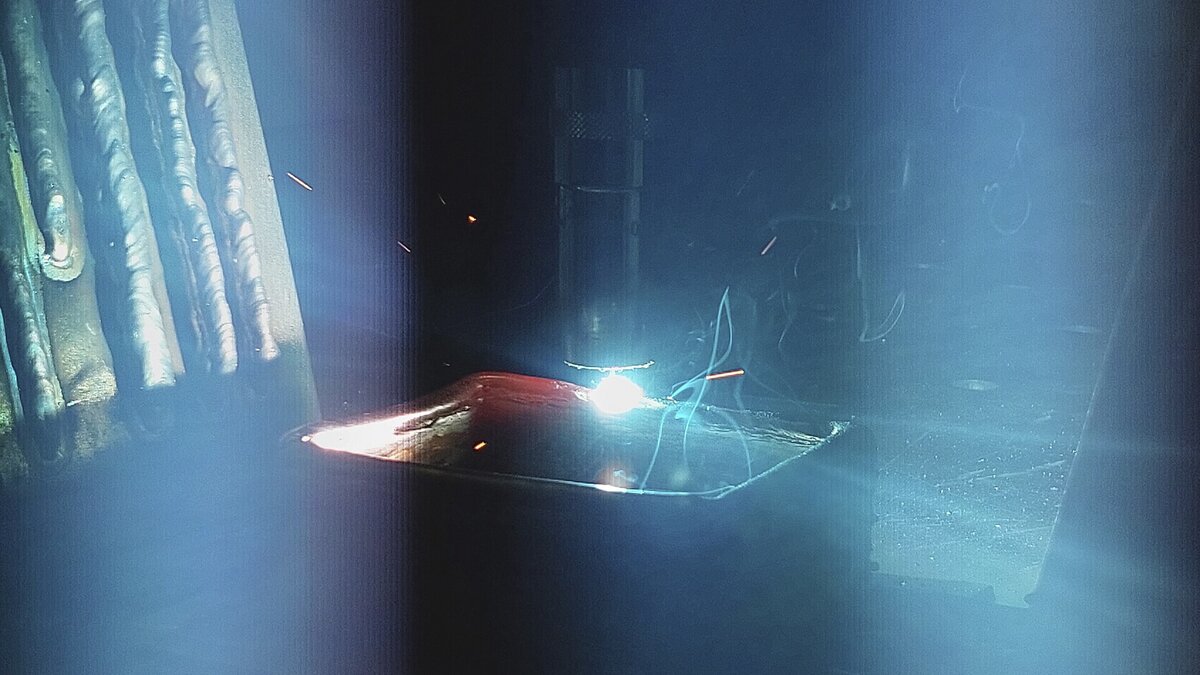
Additive manufacturing has a reputation for producing metal full of grains. Every pass of the heat source melts the part, lets it cool, and melts it again, and that cyclic thermal history normally breaks the material into many small crystals stacked against each other. A paper in Nature, "Additive manufacturing of ultralong and architected single crystals," describes a way around that. Researchers from Beijing Institute of Technology, Tsinghua University, Xi'an Jiaotong University and UCLA used a pulsed wire-arc process to grow Ti-6Al-4V single crystals a meter tall and about a centimeter across. They also printed what they believe are the first single-crystal lattices with complex zigzag ligaments, along with single crystals of tungsten, molybdenum, niobium and a molybdenum-niobium alloy.
Nobody should expect this on a desktop machine. The result matters because it goes against a basic assumption about how printed metal behaves, and it suggests that the thermal cycling layer-based processes are known for can be turned into a tool for controlling crystal growth.
How Do You Print One Crystal?
In a single-crystal metal the atomic lattice runs in one continuous orientation through the whole part, so there are no grain boundaries. The paper notes that conventional single-crystal production depends on strict quasi-steady thermal conditions, which conflicts with the intense cyclic thermal fluctuations inherent to additive manufacturing. Printing is a hard place to attempt it, because each new deposit reheats the material below and can start new grains.
According to the paper's abstract, the team's answer is "delicately controlled alternating and pulsed heat inputs" that steer single-crystal growth even while the part goes through cyclic thermal fluctuations. The process is called deep-squat pulsed wire arc additive manufacturing, or DSP-WAAM, as 3D Printing Industry reported. Wire-arc additive manufacturing feeds metal wire into an electric arc and builds up beads of weld metal. In this version, 3D Printing Industry says, the arc current switches between a high peak and a low base level, 200 A and 20 A in the modeled case. Thermal-fluid modeling showed that pulsing produced a broad, shallow melt pool with an outward-bulging solidification front, a shape that helps eliminate unwanted grains. A steady current at the peak level overheated the deposit until it collapsed, and a steady current at the base level could not melt the wire.
To design and interpret the process, the authors ran simulations in the commercial software FLOW-3D and ABAQUS. The abstract and figure captions do not give the full process parameters, so the exact recipe of pulse timing, current and travel strategy has to come from the paper itself.
What They Actually Built
The Ti-6Al-4V samples came in several sizes. Besides the meter-tall rods about 1 cm in diameter, the team printed pieces 6 mm and 20 mm across. The 20 mm piece was too wide to scan completely, so to check that it was one crystal and not a cluster of well-aligned grains, they mapped crystal orientation in nine regions across its cross-section, and the map confirmed a single continuous crystal. According to 3D Printing Industry, the paper finds no built-in theoretical ceiling on crystal width. What changes with size is the usable range of heat input and scan speed.
The lattice results show the geometric range of the process best. The team printed supportless zigzag lattices in which every strut is a single crystal. Strut angle and thickness had clear limits. An 8 mm strut printed successfully at 45 degrees, while 13 mm and 16 mm struts failed at 45 degrees and formed when the angle was raised to 60 degrees.
The refractory metals were held to fairly tight orientation tolerances. Orientation varied by under 2 degrees in niobium, under 5 degrees in tungsten and the MoNb alloy, and under 8 degrees in molybdenum. These metals have very high melting points, and printing them as single crystals extends the method well beyond one titanium alloy.
Why Creep Is the Headline Number
Creep is the slow, permanent deformation of a material held under load at high temperature, and it limits how long hot components can last. Grain boundaries play a large role in creep, so removing them should help. The question is by how much.
The answer in the paper is a lot. The abstract says bulk single-crystal Ti-6Al-4V shows an order-of-magnitude increase in creep resistance over what standard grain-size scaling predicts. The authors give two causes. One is the missing grain boundaries. The other is a hierarchical alpha/beta microstructure produced by the additive process itself, which they say regulates dislocation density, dislocation mobility and how voids evolve. The second point is notable. The printing process doesn't just avoid introducing defects. It produces its own internal architecture, and that architecture contributes to the performance.
The improvement depends on temperature. 3D Printing Industry reports that the printed titanium was tested at 700 °C against forged polycrystalline Ti-6Al-4V and values from earlier studies. At lower temperatures the result reverses: forged Ti-6Al-4V had the higher yield strength below about 500 °C, and the single crystal takes the lead above that. So this is not a general replacement for conventional titanium. It is a material that suits hot service.
What It Means for Makers
Nobody reading this will grow a single-crystal titanium bar in a garage. The process is built on wire-arc deposition of an aerospace-grade titanium alloy, and the paper leans on thermal-fluid and structural simulation to explain it. Still, there are a few reasons the result deserves attention from people who print things.
First, it reframes the thermal history of additive processes. Hobbyists spend a lot of effort fighting the side effects of repeated heating, such as warping, layer adhesion problems and residual stress. This paper treats deliberately shaped heat input as a way to control microstructure. Controlling microstructure through the heat schedule could eventually become more common across the industry, though that is speculation rather than something the paper shows.
Second, the lattice work shows the familiar design rules still apply. Overhang angle and feature size limit what the process can build, much as they do on any printer, and the 45-versus-60-degree result for thicker struts will look familiar to anyone who has watched an overhang fail.
Third, expect this to matter to industrial and research users before anyone else. The possible uses reported by 3D Printing Industry are reactor parts, laser mirrors and lightweight lattices for heat shielding in extreme-temperature settings. These are niche, high-value parts where an unusual microstructure can justify the expense.
Bottom Line
The demonstration is impressive. A meter of continuous crystal from a wire-arc printer, single-crystal lattice struts, and refractory metals printed with orientation spreads of a few degrees together make a strong case that printing can produce single crystals in free-form shapes. The creep data give the work a practical reason to exist, at least for components that run hot.
The limits matter just as much. The strength advantage reverses below roughly 500 °C, the geometric limits are real, and, as 3D Printing Industry notes, commercial benefits still need confirmation. This is a Nature paper, not a product launch. The next question is whether DSP-WAAM gives consistent results from part to part, and at a cost that fits the applications it is suited for.