
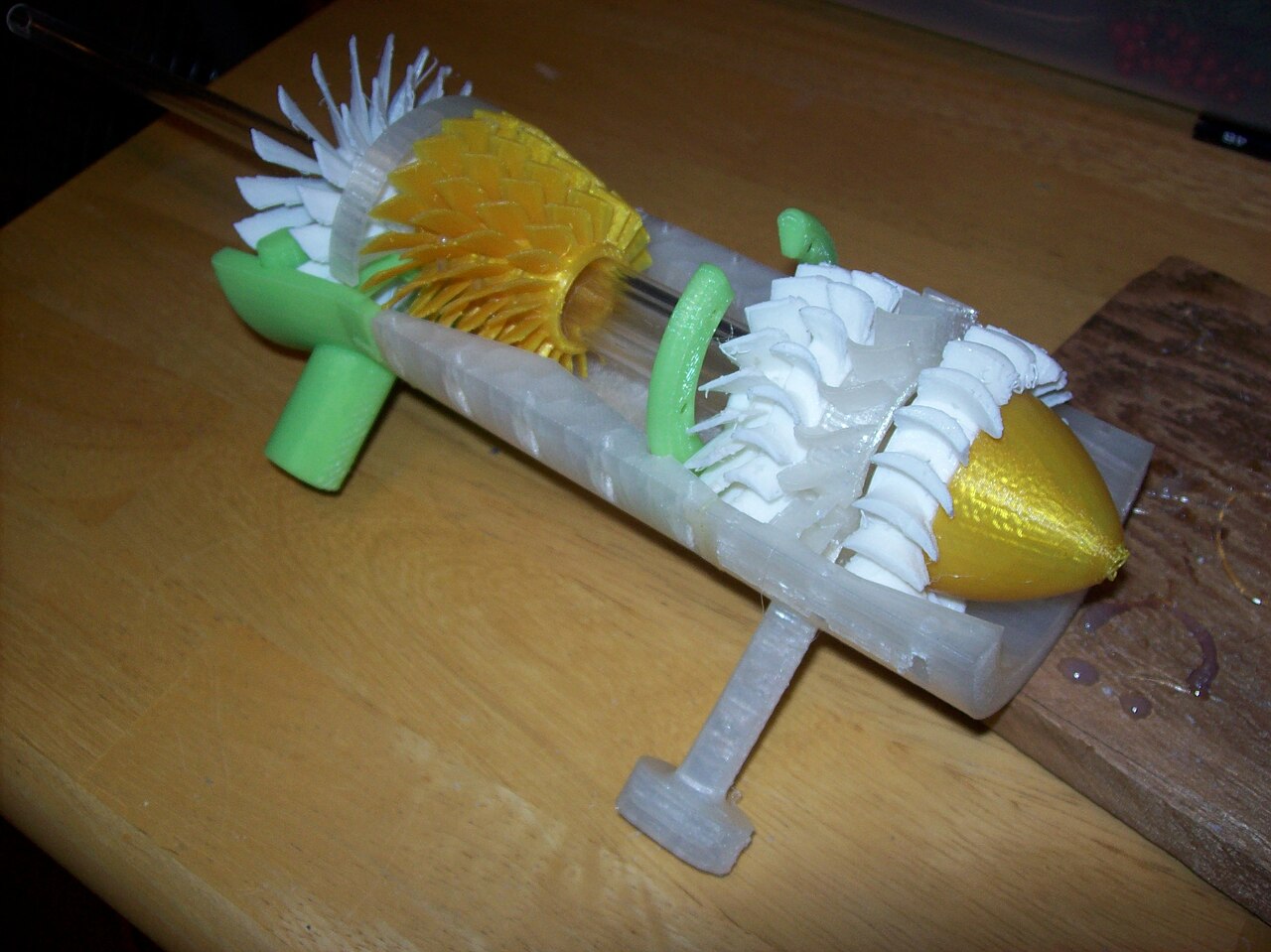
Jet engine programs are usually measured in years, sometimes decades, so the timeline is the most striking claim in Beehive Industries' latest announcement. The Denver-based company says its 100 lbf Frenzy 6 turbojet has completed its initial engine test objectives, covering starting reliability, performance and operability, four months after Beehive and the US Air Force finalized the engine's requirements. Beehive credits an additively enabled design process for the speed. The engine is built for small munitions, drones and UAVs, and a flight demonstration is targeted for 2027.
This story is about what Beehive's manufacturing push has produced so far: a second engine in a family the company is building to be cheap, quick to develop and made in large numbers.
From Requirements to First Fire
According to Beehive's October 29 release, the Frenzy 6 prototype first test-fired on September 23 at the company's Colorado headquarters. Beehive funded the prototype itself instead of waiting for a funded development program. That matters because it shows the company was willing to put its own money behind the claim that additive-first development can compress the schedule.
3D Printing Industry reports that during an early run in September, the prototype, which Beehive calls the Zero Engine to Test, or ZETT, spun up to 80,000 RPM. The name suggests a hardware article whose job is to run and generate data, not to look like a finished product. A test program needs to learn early whether the rotating hardware holds together, whether the engine lights and whether combustion stays stable. All three are much cheaper to find out on a test stand than during vehicle integration.
The test objectives Beehive lists (starting reliability, performance, operability) are the basic questions for any small turbojet. Starting reliability matters most for an expendable engine on a munition or drone, which may have to light on demand after a long time in storage. Operability covers how the engine behaves across its throttle range and through transients. Performance asks whether it produces the thrust it was designed for.
The Frenzy Family
The Frenzy 6 is the second member of the Frenzy family. The first was the 200 lbf Frenzy 8. Per 3D Printing Industry, high-altitude tests of the Frenzy 8 at a government facility in Ohio earlier this year confirmed reliable performance across its full operating range, and Beehive then moved to scale production to meet growing demand.
Beehive says the Frenzy 6 builds on its April announcement of a $29.7 million US Air Force contract to advance development of the Frenzy engine family, and on the maturation of the Frenzy 8. The Frenzy 6 reuses the larger engine's design principles and the lessons from developing it, so it starts from that base rather than from a clean sheet. The family approach is the key point. If one design methodology and one production base can turn out engines at several thrust classes, each new variant should cost less to develop than the one before. A 100 lbf engine and a 200 lbf engine serve different airframes, and having both lets Beehive address a wider range of small vehicles.
Beehive's chief technology officer describes the Frenzy 6 as entirely U.S.-designed and built. For defense customers that is a procurement consideration in its own right, separate from any argument about technology.
Why Additive Changes the Engine Development Loop
Neither source details which Frenzy 6 parts are printed or which processes are used, so we won't guess. The broader logic of an "additively enabled design process" is still familiar to anyone who has iterated a part on a printer, even at hobby scale.
Conventional turbomachinery development is often held back by tooling. Castings need patterns and molds, complex assemblies need many machined subcomponents brazed or bolted together, and every design change can send a team back into a supplier queue. When parts come straight from a digital file, the time between a design change and hardware on the test stand tends to shrink. Engineers can print, test, measure, revise and print again, and the cost of a failed iteration drops.
Beehive's executives, Chief Technology Officer David Kimball and Chief Product Officer Gordie Follin, both appear in the company's release. Kimball credits the four-month result to the company's additively enabled approach and the experience gained developing the Frenzy portfolio. This is a vendor's own framing of its own milestone. The independent evidence available so far is the sequence of events: requirements finalized, a test-fire within months, and the initial test objectives completed.
Scale Is the Real Bet
The number in Beehive's announcement that should get the most attention is not 100 lbf or 80,000 RPM. It is 8,000. Beehive says it has announced plans to build the capacity to manufacture more than 8,000 jet engines annually, supported by investments in additive manufacturing technology, precision machining and expanded production facilities. That is a high-volume target for a product category that has traditionally been built in small batches.
Small munitions and attritable drones are meant to be used up. If the engine is expensive, the vehicle is expensive, and the whole idea of cheap, numerous airframes falls apart. Printing a test article is one problem. Printing, finishing, inspecting and assembling thousands of flight engines a year to a consistent standard is much harder, and it depends on post-processing and machining capacity as much as on print capacity. Beehive's own list of investments, which pairs additive technology with precision machining, points the same way.
What It Means for Makers
Most readers won't be printing turbine hardware, but this story shows clearly where additive manufacturing is proving its value: shorter development loops. The four-month figure is the industrial version of something every maker already knows. When the part comes straight from the CAD file, you test sooner, fail sooner and fix sooner.
It also shows that printing alone is not enough. Beehive's plans, as it describes them, combine additive manufacturing with precision machining and expanded production facilities. The lesson holds at every scale. A printed part is often a near-net shape that still needs finishing, inspection and assembly before it's useful, and the companies doing this well treat the printer as one machine in a larger process.
Finally, watch the gap between a test stand and flight. Beehive's next steps are continued testing, a shift to vehicle integration and a flight demonstration in 2027. Plenty of promising engines have stalled between a good ground run and a working airframe. If the Frenzy 6 flies on schedule and the 8,000-a-year capacity comes online, it will be one of the stronger arguments yet for additive-first design of flight-critical hardware.
