Additive manufacturing has long made you choose between two kinds of printer. Light-based vat systems are fast and sharp, but they need runny resins, because thick or particle-laden material scatters the light and won't flow back level between layers. Extrusion-based direct ink writing (DIW) will push almost any paste you load into it, but it traces every line with a nozzle, which is slow, and it needs scaffolding under anything that overhangs. Engineers at Northwestern University say they have a process that removes most of that tradeoff. In a paper published in Science Advances and described in a Northwestern University news release, the team presents direct ink additive lithography, or DIAL. The method spreads thick, paste-like inks into thin sheets and then hardens them with patterned light.
The work was led by first author Pranav Kaarthik, a Ph.D. candidate, with senior author Ryan Truby, the June and Donald Brewer Junior Professor at Northwestern's McCormick School of Engineering. According to the university, DIAL pairs the speed and precision of light-based printing with the ink range of extrusion. It also works with particle-filled, light-scattering formulations that conventional vat printers have trouble curing.
How DIAL Works
The idea is easy to state. Rather than forcing a thick ink through a nozzle, or hoping it settles into a flat layer in a vat, DIAL lays each layer down mechanically. As VoxelMatters reports, a slot die deposits the ink and a doctor blade spreads it into a sheet as thin as 25 microns; the university's release describes the sheets as 50 microns thick.
Once a sheet is down, a 405 nm projector shines the layer's cross-section onto it and crosslinks the exposed ink. The projector has a 50-micron pixel pitch, which sets the in-plane resolution. Then the next sheet goes on top, and the cycle repeats.
The useful part is what happens to the ink the light misses. It stays in place, uncured, and holds up the layers above it. Since every layer is a full sheet of material, an overhang always sits on unexposed ink and never hangs over empty space. The university says this means DIAL needs no co-printed scaffolding for overhanging features. In DIW, that scaffolding is a second material or a sacrificial structure that has to be designed, printed and then removed.
The model ink in the study shows what kind of material the process is built for. It is a polyurethane-based resin thickened with fumed silica nanoparticles, which give it a yield stress. Like toothpaste or cream cheese, it holds its shape until force is applied: it flows briefly under the sweeping blade, then stiffens again. A material like that suits a syringe extruder and would be a problem for an ordinary resin vat.
The Numbers
The clearest benchmark in the paper is a log pile, the stacked crosshatch of rods that serves as the standard DIW test part. A 60 by 40 mm log pile printed in 30 minutes with DIAL, compared with 124 minutes by direct ink writing. That is where Northwestern's claim of printing parts more than four times faster than extrusion comes from. A nozzle has to trace every rod one after another, while a projector cures a whole layer's pattern in a single exposure.
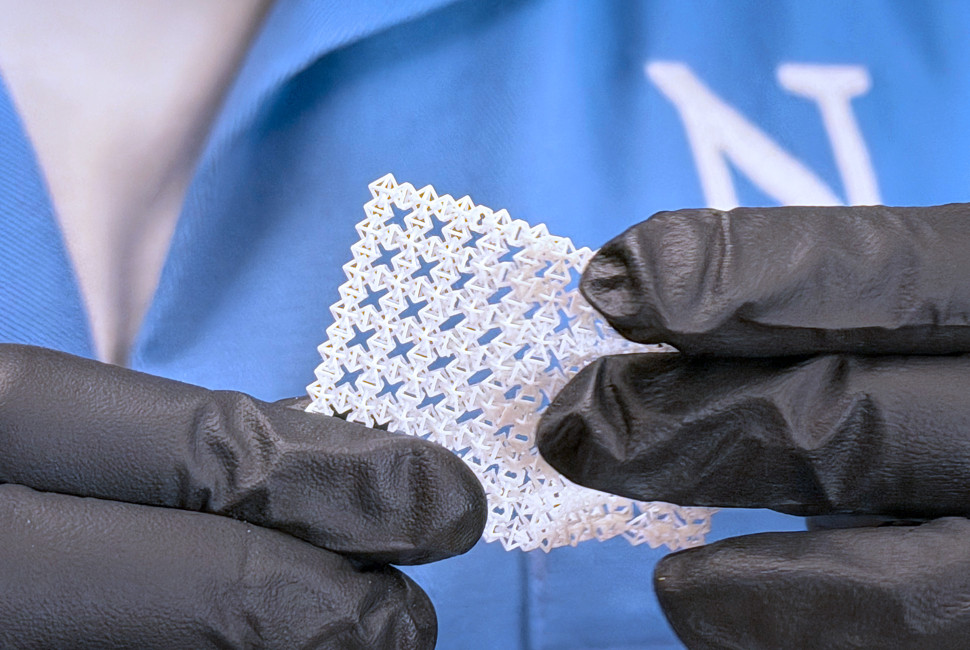
The authors called their print times conservative, since the printer's tool changes had not been tuned for speed. The team also reported fine features. Fins came out at roughly 150 microns, and a chain-mail test part, with interlocking links that are difficult to make with either extrusion or light-based printing, had struts of about 250 microns. The university adds that lattices with 150-micron walls could not be printed with conventional extrusion.
Beyond Polyurethane: Functional Materials
A faster way to print one resin would be a modest result. The researchers' bigger claim is that DIAL handles materials that are hard to print any other way, and they showed it with functional inks.
In one run of 15 minutes, the team printed 15 gyroid lattices made from an ionogel electrolyte, each about the size of a small coin-cell battery. The university says printing electrolytes into controlled 3D architectures could eventually support new energy-storage devices. Making fifteen of them in one batch suggests the process could work for small-batch production as well as for single demonstration parts.
The group also printed hydrogel cell-culture inserts patterned with inverted pyramids 0.5 mm deep. Hydrogels are soft and full of water, and they are a classic case of material that sags or collapses without support. In DIAL the surrounding uncured ink supports the part while it is built.
According to VoxelMatters, Kaarthik and Truby are listed as coinventors on a US provisional patent application. The research was funded by the National Science Foundation, the Air Force Office of Scientific Research and the McCormick School of Engineering, according to VoxelMatters.
What It Means for Makers
DIAL is a lab process, and you won't find it on a desktop printer this year. It still points at a problem that hobbyists and small labs already know well.
If you've used a paste extruder for clay, silicone, conductive inks or food, you've hit the overhang limit and the slow, line-by-line pace. If you've used an MSLA resin printer, you know how fussy those machines are about viscosity, and how filled or pigmented resins can lose detail or fail to cure through. DIAL sits between the two. The ink arrives in sheets the way it would through an extruder, and the layers are imaged the way they are in a resin printer.
For makers, three things are worth noting.
- The hardware is familiar. A 405 nm projector is the same wavelength class as consumer resin printers, and a slot die with a doctor blade is a mechanical recoater, not exotic optics. That doesn't make the process easy to copy, since sheet uniformity at 25 microns is a hard engineering problem. But nothing in the architecture needs a laser lab.
- Support-free overhangs come from the process itself. When the uncured material is the support, you skip support design and support removal, and you avoid the surface scars supports leave. Users of powder-bed systems already get this. DIAL brings it to pastes.
- There is a cleanup step. Uncured ink fills the build volume, so it has to be washed away from the finished part. The university says users can wash away the remaining ink and collect and reuse the excess left on the print surface. With a thick, filled paste and a fine lattice, how easy that is in practice is something the published material doesn't spell out, and it will be the practical question to watch.
Bottom Line
DIAL is a sensible engineering answer to a long-standing materials problem. It changes how each layer of ink is deposited, so the lithography step only has to cure it, and that lets light-based printing work with materials that used to belong to extrusion. A fourfold speedup on a standard log pile, 150-micron features and batch-printed ionogel and hydrogel structures make a strong first showing. With a provisional patent application filed, the next questions are whether the process scales and whether it turns up in a commercial machine or open hardware.