
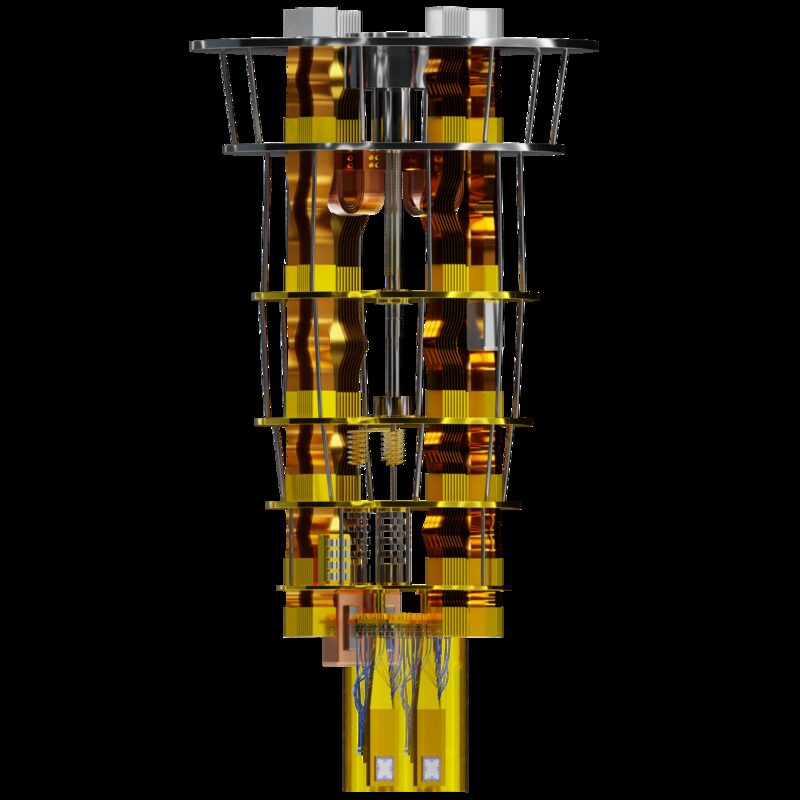
Superconducting quantum processors are notoriously fussy about their surroundings — a stray infrared photon or a misbehaving microwave mode can be enough to scramble a qubit's fragile state. On September 24, 2026, quantum-hardware startup QTREX Quantum reported its first-half 2026 financial results, and buried in the revenue numbers was a materials-science story that matters well beyond the balance sheet: the company has begun shipping a 3D-printable dielectric, called INSU300, that doubles as the raw material for laser-printed carbon shielding built directly into a chip's package.
The financial headline is itself notable for a hardware startup at this stage. QTREX posted H1 2026 revenue of $1.55 million, up 438% from $289,000 in the same period a year earlier, at a 61% gross margin. Net loss for the half came in at $6.4 million — the kind of ratio that's common for a company scaling manufacturing capacity faster than it scales headcount. CEO Dagi Ben-Noon framed the quarter around INSU300's launch, which the company says is the first RF dielectric material purpose-built for superconducting quantum computing.
Some of that revenue ramp reflects how young the operating business still is. QTREX Quantum trades on Nasdaq as QTEX and is headquartered in Ness Ziona, Israel, but the company in its current form dates only to an acquisition that closed April 6, 2026, for $2.0 million in cash. By its own accounting, the H1 2026 results cover just 86 days of operations under the QTREX name through June 30 — meaning the revenue growth, the gross-margin figure, and the INSU300 launch itself all happened inside a company that has been running in its present shape for less than three months of the reporting period.
From Printed Insulator to Conductive Shield
INSU300 is not a shielding material in the form it ships. It's a dielectric — an electrical insulator — that gets 3D-printed into a chip package and then selectively converted, after printing, into something else entirely: a graphene-like conductive carbon layer, produced by hitting the printed material with a laser.
That conversion process is the actual invention, and it's been in development for longer than the September launch suggests. Independent trade coverage from Investing.com in August 2026 described the underlying patent-pending technique, developed in partnership with Northeastern University: QTREX's dielectric — referred to in that reporting as "DF INSU300" — is exposed to laser processing that transforms the polymer into a graphene-like conductive carbon network. Researchers at Northeastern confirmed the conversion using Raman spectroscopy, a standard technique for verifying carbon's molecular structure, across 20 different laser conditions to characterize how processing parameters change the resulting material's properties. At the time of that August report, QTREX said it planned to commercially launch INSU300 by the end of Q3 2026 — a deadline the September 24 release confirms the company hit, with the product going live on September 23.
The resulting carbon layer isn't decorative. QTREX is using it as an integrated stray-photon absorber — a structure that soaks up the errant infrared and microwave photons that would otherwise leak into a superconducting qubit's environment and knock it out of its quantum state. Because the absorber is printed and laser-converted in place rather than bonded on as a separate component, it can, in principle, be shaped and positioned with more precision than a conventional discrete shield, and integrated directly into the additive-manufacturing workflow QTREX already uses to build chip packaging.
According to the September release, INSU300 has already moved past the lab bench: it's deployed for validation at two government or defense organizations, though QTREX's release doesn't name them. That's consistent with how quantum hardware components typically get vetted — national labs and defense research arms tend to be among the first customers willing to run new materials through qualification testing before they show up in commercial quantum computers.
What It Means for Makers
None of this is a desktop-printable material — INSU300 is aimed squarely at the specialized, cleanroom-adjacent world of superconducting quantum-chip fabrication, not FDM hobbyists or even most industrial polymer-printing shops. There's no indication in either source that QTREX intends to sell filament, resin, or print files to the wider maker community, and the laser-conversion step almost certainly requires equipment and process control far outside a typical desktop setup. What's worth watching, though, is the underlying principle: a single printed dielectric that becomes a functional conductor after the fact, using a laser rather than a second material or a plating step. That's a materials trick — print an insulator, then selectively convert regions of it into a conductor with light — that has obvious appeal anywhere additive manufacturing needs embedded circuitry without a multi-material print head or a post-process metallization bath. If the Raman-verified, 20-condition characterization work QTREX did with Northeastern holds up under further peer scrutiny, it's a data point for the broader "print now, activate later" school of functional materials that researchers have been chasing for years — even if quantum-chip shielding itself stays a niche, high-value application well outside what most readers will ever print.
Bottom Line
QTREX's 438% year-over-year revenue jump shows real commercial traction for a quantum-hardware supplier, and INSU300's arrival — on schedule, per the company's own stated Q3 target — gives that growth a concrete new product to point to. The more durable story for the wider fabrication world is the process itself: a 3D-printed dielectric that a laser can turn into graphene-like conductive carbon on demand, independently characterized at Northeastern University via Raman spectroscopy across 20 laser conditions. Government and defense validation is underway, but commercial deployment inside working quantum computers is still the test that matters most, and it hasn't happened yet.
Sources
- QTREX Quantum Reports First Half 2026 Financial Results — GlobeNewswire, Sept. 24, 2026
- QTREX develops laser-printed carbon conductors for quantum chips — Investing.com, Aug. 19, 2026
