
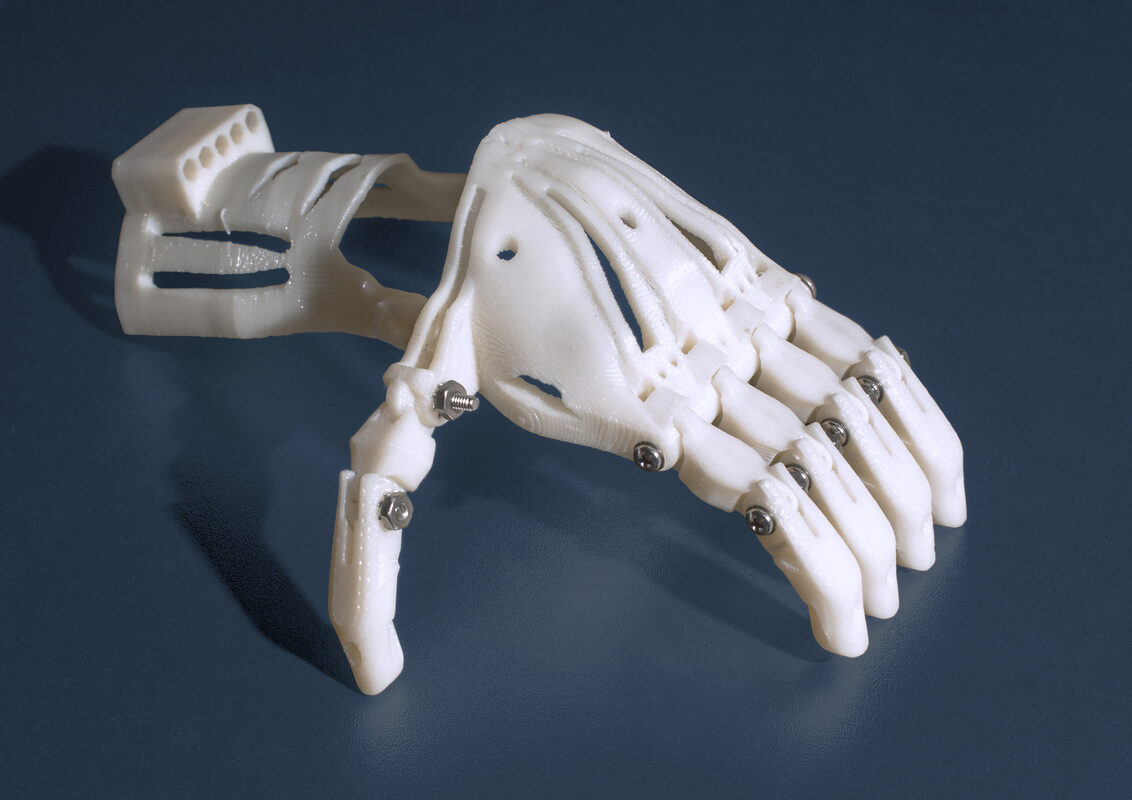
A team of biomedical engineering students at Queen's University in Kingston, Ontario, has developed a 3D-printed above-elbow prosthetic arm that requires no electronics, no motors, and no batteries — just the wearer's own body movement, transmitted through a harness system to drive both elbow flexion and independent finger motion. The device was built for the Burma Children Medical Fund (BCMF), a nonprofit that runs a prosthetics program for patients near the Thailand-Myanmar border, a region where reliable electricity, replacement batteries, and repair technicians are not something a clinic can count on.
The project is student-led, headed by Emese Elkind alongside teammates Olivia Radcliffe, Amina Najib, Cole McCauley and Hailey Parker. It grew out of an ongoing partnership between Queen's and BCMF founder Kanchana Thornton, with faculty support from Eva Purkey, Colleen Davison, Gabor Fichtinger and Parvin Mousavi. BCMF has run a 3D-printed prosthetics program since 2019, and Queen's students have been placed with the organization since 2023 — this above-elbow device is the most technically ambitious output of that pipeline so far.
Solving the Above-Elbow Problem Without Adding Complexity
Open-source 3D-printed prosthetics are not new, but what has remained a stubborn gap — and what 3D Printing Industry's coverage of the project specifically calls out — is a workable open-source solution for above-elbow amputations. Below-elbow devices can often anchor to a residual forearm and translate wrist or forearm motion directly into hand movement. Above-elbow amputees don't have that leverage point, so the device has to recreate two linked but distinct motions — bending the elbow and closing the fingers — from whatever movement remains in the shoulder and upper body.
Elkind summarized the core engineering challenge bluntly: "We need to recreate both elbow movement and hand function simultaneously, by only using the patient's body movements." The team's answer is a harness and cable-linkage system, entirely mechanical, that routes body-driven tension through the printed limb so the elbow and each finger can move independently rather than as a single locked motion. Because there's no circuit board, no actuator, and no battery to charge or replace, the device is meant to survive in a clinical setting where power is unreliable and spare parts are not a phone call away.
That constraint is also what makes the project harder than it looks. A motorized prosthetic can brute-force independent digit control with a servo per finger. A fully passive, body-powered design has to get that same functional range out of geometry, cable routing, and printed joint tolerances alone — the kind of problem that rewards iterative FDM prototyping far more than it rewards a single clever CAD pass.
Recognition Beyond the Classroom
The device has already been validated outside Queen's own program. The team took first place at the RESNA Conference in Chicago, a rehabilitation and assistive-technology engineering showcase, and was runner-up in a competition at Rice University. In a detail that says as much about the team's priorities as the device itself, the students donated half of their prize winnings back to BCMF, which used it to help fund surgeries, translation services, and transitional housing for patients.
Elkind framed the broader goal of the project in a way that doubles as a mission statement for the whole effort: "our job isn't just to make new technology, it's to solve real problems." That's a distinction that matters in prosthetics design specifically — a device that's technically elegant but unaffordable, unrepairable, or dependent on infrastructure that doesn't exist in the target clinic is not a solved problem, no matter how good it looks in a lab demo.
What It Means for Makers
For the maker and open-source hardware community, this project lands in familiar territory but pushes it a step further. A few takeaways:
- Electronics-free isn't a limitation here, it's the design brief. The team wasn't stripped of budget for motors and sensors — they deliberately built without them because a clinic near the Thailand-Myanmar border can't guarantee power or repair access. That's a useful reframe for anyone designing humanitarian or off-grid hardware: reliability under field conditions can matter more than feature count.
- Above-elbow remains the open hardware frontier. If you're active in the prosthetics-focused maker space and looking for an underserved niche to contribute printable parts, jigs, or harness designs to, above-elbow mechanisms — where a single input has to drive two independent joints — are where the real unsolved problems still live.
- Student-led doesn't mean lab-only. The RESNA win and Rice University placement show that university teams working with field NGOs can produce hardware that holds up against dedicated assistive-tech competitions, not just capstone demo day. Watch for a published open-source release from this team, given BCMF's existing 2019-launched 3D-printing program and its history of working directly with Queen's student placements since 2023.
- Prize money going back to the nonprofit is a signal worth noting. It suggests BCMF's program is being treated as an ongoing collaboration rather than a one-off senior project, which is generally a good predictor of whether a design gets iterated on and actually deployed rather than shelved after graduation.
The story has picked up fast in additive-manufacturing trade coverage: 3D Printing Industry published a dedicated writeup on June 30, 2026, and 3DPrint.com led its July 1, 2026 news briefs with the same project — both within days of each other, suggesting the device is getting a fresh publicity push likely tied to conference results or a program update rather than a brand-new build. Neither report indicates the design files have been published yet; makers interested in replicating or contributing to the harness mechanism should watch BCMF's and Queen's own channels for an open-source release.
