
The TF-179 Drone Boat did not come out of a shipyard. It came out of a downtown St. Petersburg, Florida building where robotic arms extruded its hull layer by layer — arms operated by the same company that once printed set pieces for Disney. Haddy, a self-described "AI-powered robotic 3D printing" manufacturer, announced on Saturday, August 8 that it has produced the unmanned surface vessel using large-format robotic additive manufacturing, pairing giant deposition arms with integrated milling to go from digital model to finished hull. Who ordered the boat, and what it will do once it hits the water, the company is not saying.
"The maritime industry is redefining how vessels are designed and manufactured," Haddy said in its announcement, as reported by Defence Blog. "The TF-179 Drone Boat is part of that evolution... enabling more agile development cycles, greater design flexibility, and a faster path from concept to deployment." VoxelMatters, covering the same announcement, went a step further and identified the end user as the U.S. military — though Haddy itself has left the customer and mission undisclosed.
Eight Robots in 30,000 Square Feet
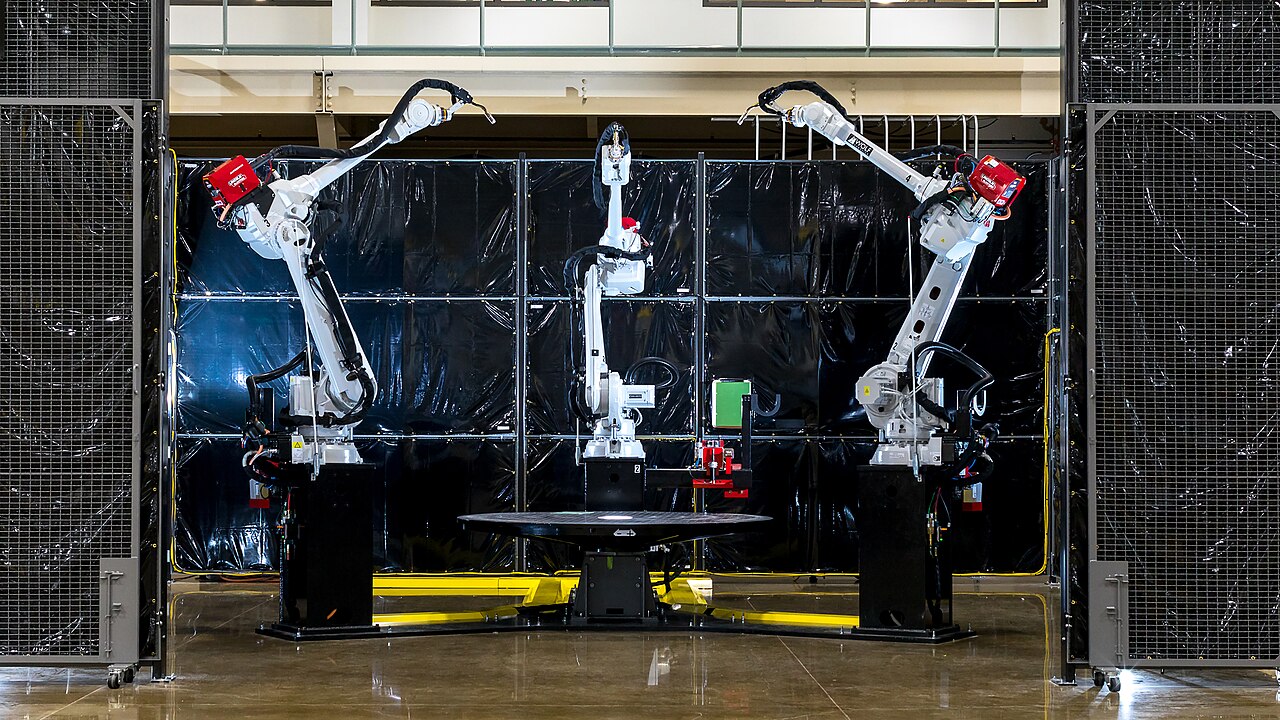
The hardware behind the TF-179 is worth dwelling on, because it looks nothing like a desktop printer scaled up and everything like a machine shop rebuilt around extrusion. Haddy's facility in downtown St. Petersburg covers roughly 30,000 square feet (about 2,800 square meters) and houses eight large-format additive manufacturing systems built by the Dutch robotics firm CEAD. Seven of the eight are mounted on rails, extending their reach so a single arm can traverse the full length of an oversized part like a boat hull.
The process is hybrid by design. The arms deposit material in thick beads, building the hull up layer by layer instead of assembling it piece by piece, and integrated milling then brings surfaces to final dimension and finish. Anyone who has chased dimensional accuracy on a large FDM print will recognize the logic: print near-net shape fast, then subtract your way to tolerance. Haddy says the combination of robotic printing, milling, advanced materials, and repeatable digital workflows lets customers move from design to hardware in days and weeks rather than months.
From Jungle Cruise to Drone Hulls
What makes Haddy an unusual defense supplier is where it came from. The company built its business printing furniture and entertainment scenery with the same giant robotic arms it now points at drone boats. Its client list includes Disney — with set work tied to Jungle Cruise and Monsters Inc — along with Walmart, the architecture firm Gensler, and furniture retailer Room & Board. Today the company's own pitch spans defense drone hulls, entertainment props and set pieces, marine boats and components, cement molds, and custom furniture and interiors, all running on the same underlying capability.
That range is less strange than it sounds. A themed restaurant facade, a statement-piece chair, and a boat hull have more in common as manufacturing problems than as products: each is a large, geometrically complex, low-volume part that would traditionally demand expensive one-off tooling. Robotic deposition erases most of that tooling cost, which is why the same shop floor can serve a theme park one month and a defense program the next.
The TF-179 is not Haddy's first hull with a military flavor, either. The company previously printed the carbon-fiber-reinforced hull of a low-profile, semi-submersible unmanned surface vehicle for HavocAI, a Rhode Island-based autonomous systems company — and took that vessel from design to sea trial in nine days. It has also partnered with Blue Ops, the maritime drone division of Red Cat Holdings, to help double that unit's production capacity for uncrewed surface vessels sold to U.S. and allied militaries. The furniture-to-defense pivot, in other words, is not a one-off stunt — it is a deliberate line of business with repeat maritime work behind it.
Why Attritable Boats Want a Printer
The context for all of this is the Ukraine war, which has rewritten the economics of naval power. Inexpensive, remotely piloted drone boats have repeatedly damaged or destroyed far more expensive warships of Russia's Black Sea Fleet, and the lesson navies are drawing is that quantity, cost, and iteration speed can matter as much as exquisite capability. An attritable vessel — one you can afford to lose — only works if you can build it cheaply and revise it quickly as the threat environment shifts.
That is precisely the profile large-format robotic printing fits. A conventional boatbuilding line commits to molds and tooling; changing the hull means changing the tooling, at real cost. A robotically printed hull is just a file. Revise the design digitally, and the same arms can be printing the updated version within days. For a class of vessel whose entire premise is rapid, disposable iteration, that loop — design, print, mill, deploy, learn, revise — is the product as much as any individual boat is.
What It Means for Makers
For the desktop and workshop crowd, the TF-179 is a useful data point about where the techniques we use every day scale to. The core workflow is recognizable: a digital model, material deposited layer by layer, post-processing to final finish. What changes at Haddy's scale is the toolhead (an industrial robot arm on rails), the bead size, the materials (carbon fiber reinforcement in the HavocAI hull), and the addition of subtractive finishing as a first-class step rather than an afterthought.
Two lessons transfer down to hobbyist scale. First, hybrid workflows win on big parts: printing near-net and machining critical surfaces is how the pros hit tolerance, and the same approach pays off on anything structural. Second, the real advantage of printing is not the part — it is the iteration loop. Haddy's pitch to its undisclosed customer is the same one your printer makes to you: when the design is wrong, you fix the file and run it again, and nobody has to retool anything.
It is also a reminder that additive manufacturing careers rarely travel in straight lines. The shop that printed Jungle Cruise scenery is now producing hulls adjacent to naval programs, using the same machines and much of the same know-how. The boundary between making props and making mission hardware turns out to be thinner than the org charts suggest — it is mostly a question of materials, tolerances, and who signs the purchase order.
