
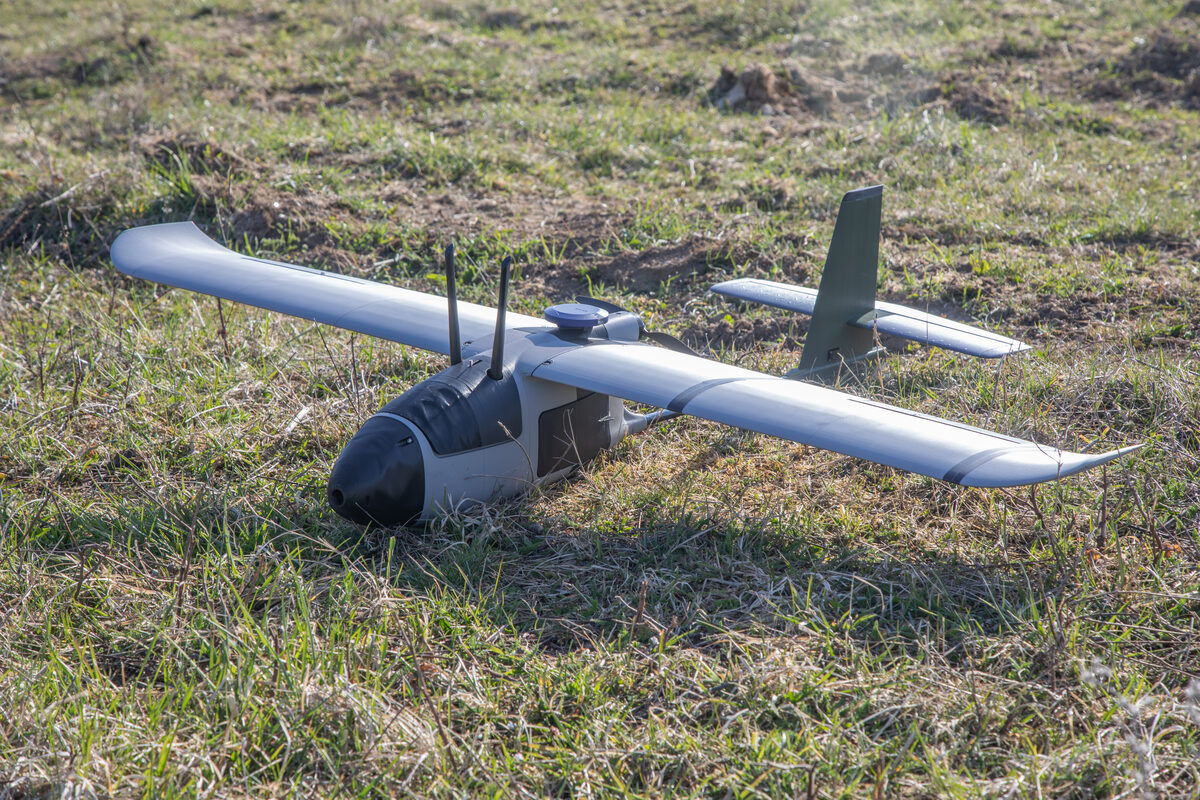
Most conversations about 3D printing and drones focus on the hobbyist end of the spectrum — printed airframes, quadcopter arms, FPV camera mounts. Less visible is the industrial side, where selective laser sintering machines running nylon powder have been quietly producing flight-certified components for years. According to a report from VoxelMatters, one Oregon manufacturer has spent nearly two decades printing flight-worthy SLS parts for customers that include drone-delivery pioneer Matternet and defense contractor AeroVironment.
The company is NW Rapid Manufacturing, based in McMinnville, Oregon, and its origin story explains why its printers are dialed in so specifically for uncrewed aircraft. NW Rapid was spun out in 2008 from Northwest UAV, a drone-engine builder founded in 2005 by Chris Harris. Northwest UAV built its early business supplying small single-cylinder engines to Insitu — maker of the Boeing Insitu ScanEagle drone — before Boeing acquired Insitu in 2008. That defense-and-aerospace pedigree carried directly into the spinoff: NW Rapid now routinely executes defense and aerospace contracts and establishes formal ITAR agreements whenever security requirements call for it, according to the company's own site.
Three Machines, One Very Specific Job
NW Rapid's production floor runs three industrial EOS SLS systems, according to VoxelMatters' reporting, including an EOS P 390 that was built in 2006 and first acquired by the company in 2008 and, per the report, is still going strong. That's notable in an industry that often treats hardware as disposable: a nearly 20-year-old P 390 is apparently still turning out end-use, flight-worthy parts, which says as much about EOS's build quality as it does about NW Rapid's process discipline. The parts coming off that floor aren't decorative — VoxelMatters lists engine cowlings, cooling shrouds, fuel tanks, mountings, and airframe components among the UAV parts NW Rapid produces, and General Manager Nick Classen told the outlet that moving those parts to SLS production has meant "a massive reduction in part count and weight" for the company's drone customers.
The material side is where the company's UAV specialization really shows. Beyond stock powders like Nylon 12 (PA 2201) and bio-based Nylon 11, NW Rapid has developed two proprietary formulations in-house specifically for drone applications, according to its own site. PA 640-GSL blends carbon fiber with hollow glass beads on a Nylon 12 base to produce parts that are very lightweight and dimensionally stable — exactly the trade-off an airframe or bracket needs, where mass budgets are unforgiving but warping or creep under load isn't an option. PA 840-GSL goes further: a Nylon 11-based blend that adds flexibility along with the same carbon-and-glass-bead reinforcement, and is electrically conductive because of its carbon content — a useful property for parts that need to manage static discharge or serve a dual mechanical-and-electrical role inside a drone's fuselage. Neither material is something you'll find on a filament retailer's shelf; NW Rapid says both were developed specifically for the UAV industry. VoxelMatters also reports that NW Rapid used PA 2201 alongside a related powder, GLS 840, to help Matternet iterate drone designs — a concrete example of that in-house material work showing up in an actual customer's hardware.
A Production Record, Not a Prototype Shop
NW Rapid's own materials don't put a headline number on cumulative flight time, but the customer list does a lot of the talking. Matternet is, per VoxelMatters, the creator of the first FAA-approved drone-delivery system in the United States — a network flying in regulated airspace with real liability attached — and AeroVironment is a U.S. defense-tech company that specializes in unmanned aerial systems. Getting SLS parts qualified for that kind of work is a materially higher bar than passing a single tensile test in a lab: the components have to survive repeated duty cycles, vibration, and altitude over years of service without cracking or delaminating, across production runs rather than one-off prototypes. VoxelMatters also notes that NW Rapid has broadened well beyond UAV work over time, now serving other UAV manufacturers as well as aerospace, automotive, and medical clients — a sign that the SLS process the company tuned for drone parts has proven itself general enough to sell into adjacent regulated industries.
The company isn't standing still on capacity, either. VoxelMatters reports NW Rapid plans to add a dual-laser EOS P 770 for high-throughput printing, along with a used EOS INTEGRA P 450 designed to bridge the gap between prototyping and series production — a newer-generation, more automated platform than the 2006-vintage P 390 currently on the floor. "We're really looking to double our capacity in 2027 and double it again in 2028," Nick Classen, NW Rapid's general manager, told VoxelMatters. That's an aggressive growth curve for a company that, by most public accounts, has operated well outside the spotlight for most of its 18-year history.
What It Means for Makers
NW Rapid isn't a name most desktop-printing hobbyists have heard of, and that's precisely the point of this story. It's a useful data point for anyone trying to gauge where SLS sits in the broader additive manufacturing landscape: not as an emerging technology still proving itself, but as an established, boring-in-the-best-sense production method that defense and logistics companies are willing to bet flight-critical parts on, at scale, for years at a stretch.
For makers scaling up from desktop FDM or resin printing toward production work, NW Rapid's approach is a useful template even if the budget for an EOS P 770 is nowhere in sight. The pattern is: identify a narrow, demanding application (UAV components), develop or source materials engineered for that specific use case rather than general-purpose stock, and let volume and repeat customers in regulated industries validate the process over time rather than a single certification test. It's also a reminder that a machine's build date doesn't determine its relevance — a 2006 EOS P 390 evidently still earns its keep next to newer hardware, provided the process around it is sound. And for anyone tracking where the used-industrial-printer market is headed, NW Rapid's plan to add a secondhand INTEGRA P 450 alongside a brand-new P 770 is a small but real signal that used SLS hardware has a viable second life in production environments, not just as bargain-bin lab equipment.
