
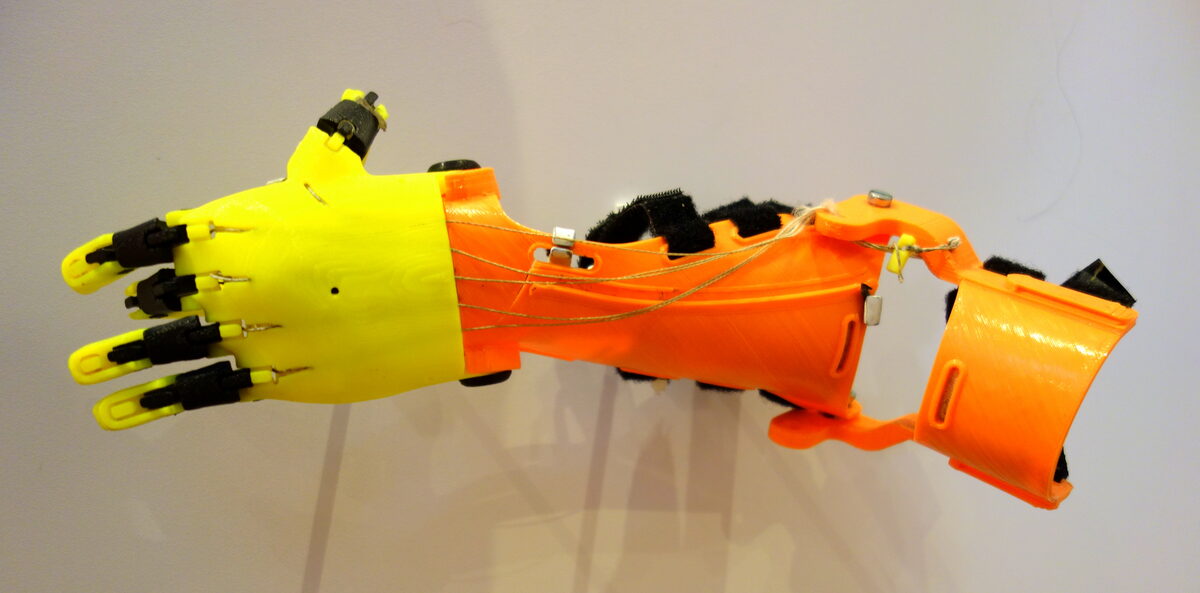
A team of undergraduate students at Queen's University in Kingston, Ontario has spent three years designing and open-sourcing a fully mechanical, 3D-printed above-elbow prosthetic arm for patients of the Burma Children Medical Fund (BCMF), a Thailand-based NGO that treats refugees and displaced people along the Thai-Myanmar border. The device requires no electronics, no motors, and no batteries — every joint is driven entirely by the wearer's own body movement through a harness system, making it durable and repairable in a setting where charging a myoelectric limb or sourcing replacement circuitry simply isn't realistic.
The project traces back roughly two decades, to a relationship between Queen's faculty members Dr. Eva Purkey and Dr. Colleen Davison and BCMF. That long-running partnership eventually connected the university's biomedical computing program to BCMF's 3D-printed prosthetics initiative, which the NGO launched in 2019. Rather than a single capstone project handed off and forgotten, the arm has been passed between a relay of student researchers: Olivia Radcliffe picked it up in 2023, Emese Elkind took over and drove the design through most of its major revisions in 2024, Amina Najib continued the work in 2025, and Cole McCauley and Hailey Parker are now carrying it forward in 2026.
How the Arm Works
According to 3D Printing Industry's technical writeup, the design centers on a harness that translates residual-limb and shoulder movement into independent motion at both the elbow and each individual finger — a level of articulation that's notable given the device has zero powered components. There's no battery to charge, no motor to fail, and no sensor calibration to maintain. Power comes entirely from the patient's own body, which is precisely the point: BCMF serves patients in a region where reliable electricity, technical servicing, and spare parts for powered prosthetics are not guaranteed. A fully mechanical limb sidesteps that fragility entirely.
BCMF's 3D prosthetics program runs on donated 3D printers, and the open-source design is built to work within that existing setup rather than requiring new equipment. That constraint keeps production accessible to BCMF's workflow as-is, and to any other clinic or maker group that wants to build on the open-source files once they're released. A prosthetic that's technically elegant but depends on equipment the NGO doesn't already have would defeat the purpose of designing for a resource-limited setting in the first place.
For Elkind, who led much of the design work in 2024, the project's impact went beyond the engineering brief. "BCMF's patients often need to work every single day to support their families. Having a prosthetic that is durable, functional, and useful to them can completely change what they're able to do independently," she told 3D Printing Industry. In a separate quote picked up by 3DPrint.com's July 1 news briefs, she called the work "life changing, and has reshaped the way I think about engineering, where our job isn't just to make new technology, it's to solve real problems" — a line that captures how directly the students have been embedded in BCMF's patient population rather than designing at a remove.
Competition Wins and a New Partner
The design's technical merits have been validated outside Queen's as well. The team took first place at the RESNA Conference in Chicago — RESNA (the Rehabilitation Engineering and Assistive Technology Society of North America) being the main North American professional and academic venue for rehabilitation engineering and assistive technology — and finished as runner-up in a competition at Rice University in Houston. In a detail that underscores the project's non-commercial framing, the students donated half of their prize winnings back to BCMF, earmarked for surgeries, translation services, and transitional housing costs for patients.
The Queen's Gazette also reports that Ottawa-based humanitarian organization Inter Pares has joined as a new partner in 2026, and credits Queen's computing faculty Gabor Fichtinger and Parvin Mousavi with securing funding from the Faculty of Arts and Science, MITACS, and other sources that has kept the multi-year student relay going. Dr. Purkey summed up the arrangement: "This is an example of a really special collaboration that I believe is truly mutually beneficial both to the students and to the host organization" — a collaboration where Queen's students get hands-on biomedical design experience against real clinical need, and BCMF gets a continuously improving, zero-cost prosthetic platform tailored to its patient population. BCMF founder Kanchana Thornton echoed that framing from the NGO's side: "Our collaboration with Queen's University has greatly benefited our 3D team, our beneficiaries, and the Queen's students interning with us."
Elkind's own path through the project illustrates how the relay works in practice: she started as a summer volunteer before working up to lead engineer over three years on the student team, known internally as the Queen's Biomedical Innovation Team (QBiT). She's now pursuing a master's degree while moving into a senior advisory role on the partnership, handing primary design work to McCauley and Parker rather than exiting the project entirely — part of why the relay has held together across five student leads instead of resetting each year.
What It Means for Makers
This project sits at the intersection of two trends the 3D printing community already knows well: open-source prosthetics and humanitarian print-on-demand hardware. What distinguishes the Queen's/BCMF arm from many hobbyist prosthetic projects (e.g., the e-NABLE community's hand designs) is its deliberate rejection of electronics entirely — not as a cost-cutting measure, but as a resilience strategy. A fully mechanical, harness-driven arm has no firmware to update, no battery chemistry to degrade in tropical humidity, and no proprietary parts to source across an international border. For makers designing assistive devices for field or humanitarian use, that's a useful reminder that "more sophisticated" doesn't always mean "more actuators."
The project is also a good case study in what makes an open-source hardware handoff actually work over multiple years: a stable institutional partner (BCMF), a rotating but overlapping cast of student contributors, and a design constraint — buildable on the printers the partner NGO already has, no electronics — that's simple enough to survive five successive owners without drifting. Anyone maintaining a long-lived open hardware project, prosthetic or otherwise, could do worse than borrow that structure. The files and build documentation aren't yet linked in the coverage reviewed here, so makers interested in replicating or contributing to the design should watch the Queen's biomedical computing program and BCMF's channels for a public release.
