
Raise3D used one announcement on November 10 to do two things. It disclosed new capital and it launched the hardware that capital is meant to support. According to the company's newsroom announcement, Raise3D has closed a US$15 million C2+ funding round and introduced the T Series, a pair of large-format FFF printers called the T450 and T700. The T450 costs US$4,999 (EUR 4,999) and the T700 costs US$15,999 (EUR 15,999). The release also includes two smaller pieces of news on the powder side of the business: a software update that raises the build height of the RMS220 SLS printer, and a new automated sandblaster for post-processing.
Most of a press release is the vendor making its own case. The useful part of this one is the money and where it goes. Raise3D says the round will fund development in large-format FFF, SLS and DLP, plus closer integration of its hardware and software. In other words, it is spreading the money across several process families rather than staking everything on one machine. The T Series is the first concrete result, and its spec sheet shows what Raise3D thinks large-format extrusion buyers will pay for.
Two Machines, One Architecture
The two printers share an architecture but are aimed at different jobs.
The T450 has a 450 x 350 x 400 mm build volume (63 liters), a heated chamber that reaches up to 70C, and a 0.4 mm nozzle as standard. That puts it above the typical enthusiast CoreXY in size while still treating it as a precision machine, not a bulk-extrusion one.
The T700 is a different class of machine. Its build volume is 700 x 500 x 1,000 mm, or 350 liters, which is more than five times the T450's. Its chamber is rated a little lower, at up to 60C, and it ships with a 0.6 mm nozzle. Both choices fit a printer aimed at large parts, where the main goal is moving more plastic per hour.
VoxelMatters reports a hot end rated to 420C and a bed that reaches 120C. Its material list includes ABS, ASA, TPU, carbon-fiber-reinforced PET, PPA and PPS. Running PPA and PPS takes both the high nozzle temperature and an enclosed, heated build space, which fits the T Series' listed materials.
Motion runs on what Raise3D calls 4 Motor Drive (4MD) CoreXY, which uses four motors instead of the usual two. The company quotes speeds up to 600 mm/s at 10,000 mm/s² acceleration. On a gantry this large, Raise3D says the four-motor design is meant to reduce vibration, ringing and layer shifting over long prints.
How TwinFlow Works
TwinFlow is the main technical feature of the launch. A conventional dual-extrusion printer has two nozzles that have to be leveled and calibrated against each other. TwinFlow instead feeds two filament paths into a Y-junction that merges them into one nozzle, and Raise3D offers two ways to use it.
In High-Flow Mode, both paths are loaded with the same filament. Each path supplies part of the material going into the melt zone, so the system can reach higher volumetric throughput than one feed path could manage alone. Raise3D rates the T450 at a maximum of 80 mm³/s. VoxelMatters reports the test conditions behind that number: Hyper Speed ABS V2 at 250C through the 0.4 mm nozzle. Raise3D says that is 23 to 45 percent above a high-flow reference range of 55 to 65 mm³/s. As the company itself notes, this is a measurement under specific test conditions. Other materials, temperatures and nozzle sizes will give different results, and the comparison baseline is Raise3D's own choice.
In Dual-material Support Mode, the two paths hold different filaments, for example a model material and a soluble support, or two colors. With only one nozzle, there is no second nozzle to align and no idle nozzle to ooze or drag across the print. In exchange, every change of material has to clear the shared melt zone. The announcement does not say how Raise3D handles purge volume or transition time, and that will matter to anyone planning to print multi-material parts at scale.
3Dnatives notes that the system supports up to 5 kg of continuous printing in 21 hours. On a machine like the T700, that matters more than peak speed, because a long job that runs out of filament overnight is a long job lost.
Sensors and Unattended Printing
VoxelMatters lists more than 20 sensors across the platform. They include spaghetti detection, nozzle-clump detection, filament run-out detection, a camera and power-loss recovery. None of these are new to the industry, but on a printer that can run for days they decide whether a failure costs a few grams of filament or most of a spool. Taken together with the 5 kg continuous-print figure, they show Raise3D designing for unattended production runs and not just for fast benchmark prints.
The Customer Example: One Pattern Instead of Four
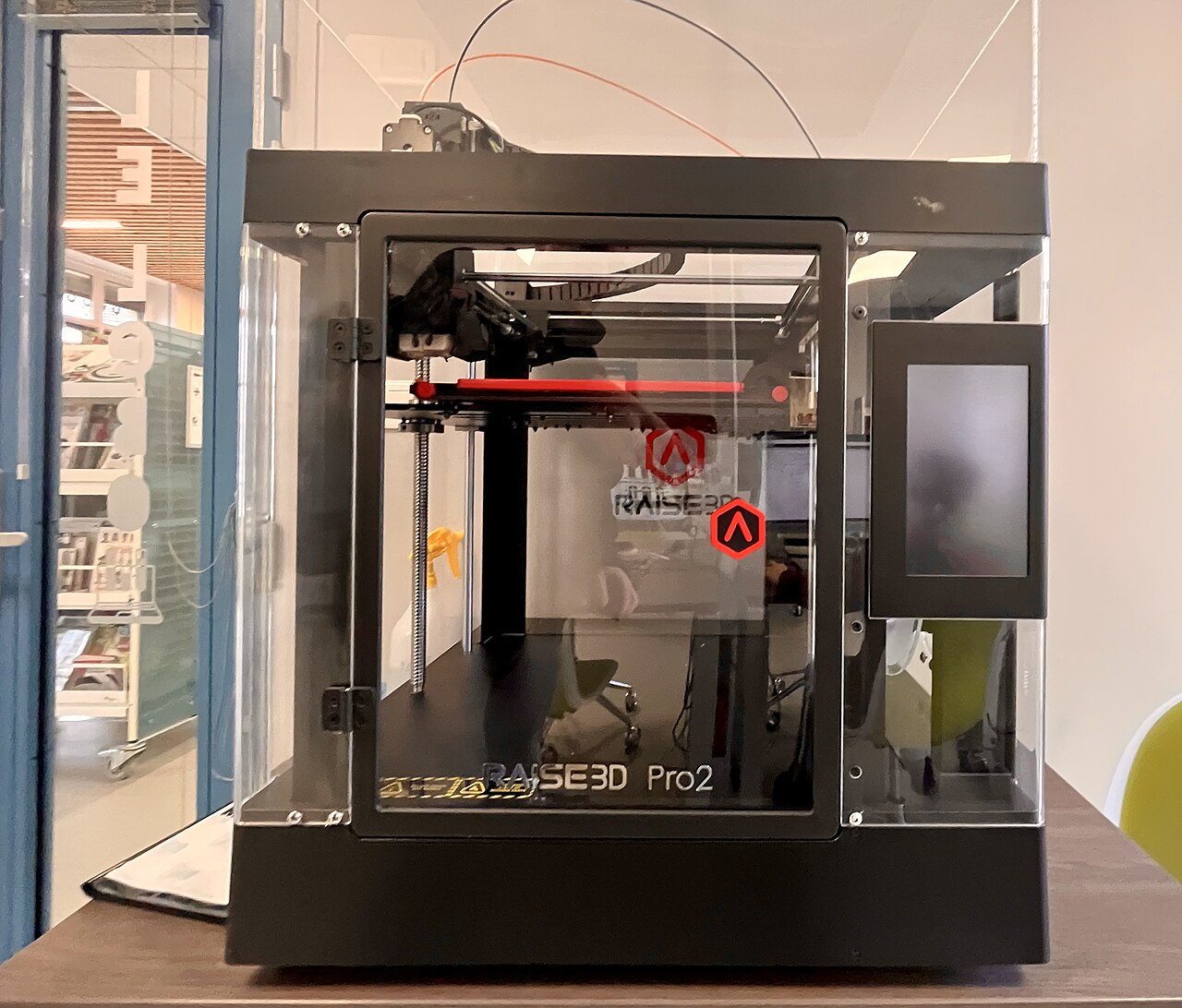
Raise3D's launch example comes from casting. According to 3Dnatives, RBP Metallurgy, a foundry in Mexico, previously had to print a casting pattern in four sections on a Raise3D Pro2 and join them afterward. On the T450 the same pattern prints in one piece, which removes three joints. Each joint in a foundry pattern is a place where alignment can drift, adhesive can fail, or the surface finish needs extra work, so this is a fair example of what extra build volume actually buys. VoxelMatters reports that the RBP Metallurgy pattern will be on display at Formnext next week. It also reports that CEO Edward Feng pointed to orthotics as an application where build size counts.
The Powder Side: RMS220 and B520
The other two announcements are smaller but show the same direction. Raise3D says a software update raises the build height of the RMS220 SLS printer to 450 mm as a software-enabled increase. The company has also introduced the B520, an automated sandblaster for parts from polymer powder bed fusion. An automated tool for post-processing fits the stated plan to tie hardware and software together across the workflow.
Bottom Line for Makers
For most hobbyists, the T450 is the model to look at. At US$4,999 it costs more than a consumer machine, but it is within reach for a small shop, a makerspace or a side business that keeps running into the build-volume limit of a 300 mm-class printer. The 70C chamber, 420C hot end and listed engineering materials make it a plausible machine for functional parts, not just a bigger prop printer. The T700 is a production purchase, and buyers should judge it on uptime and cost per part, not on its spec sheet.
The open question is TwinFlow. Merging two feeds into one nozzle is an elegant answer to both throughput and dual-material printing, but the published 80 mm³/s figure applies to one material under one set of conditions. Until independent testing covers a wider range of materials and measures how long material changes take, buyers should treat the headline flow number as a best case.
On availability, VoxelMatters reports that the T450 is on sale now, with European availability later in November, and that the T700 is open for preorder.
