
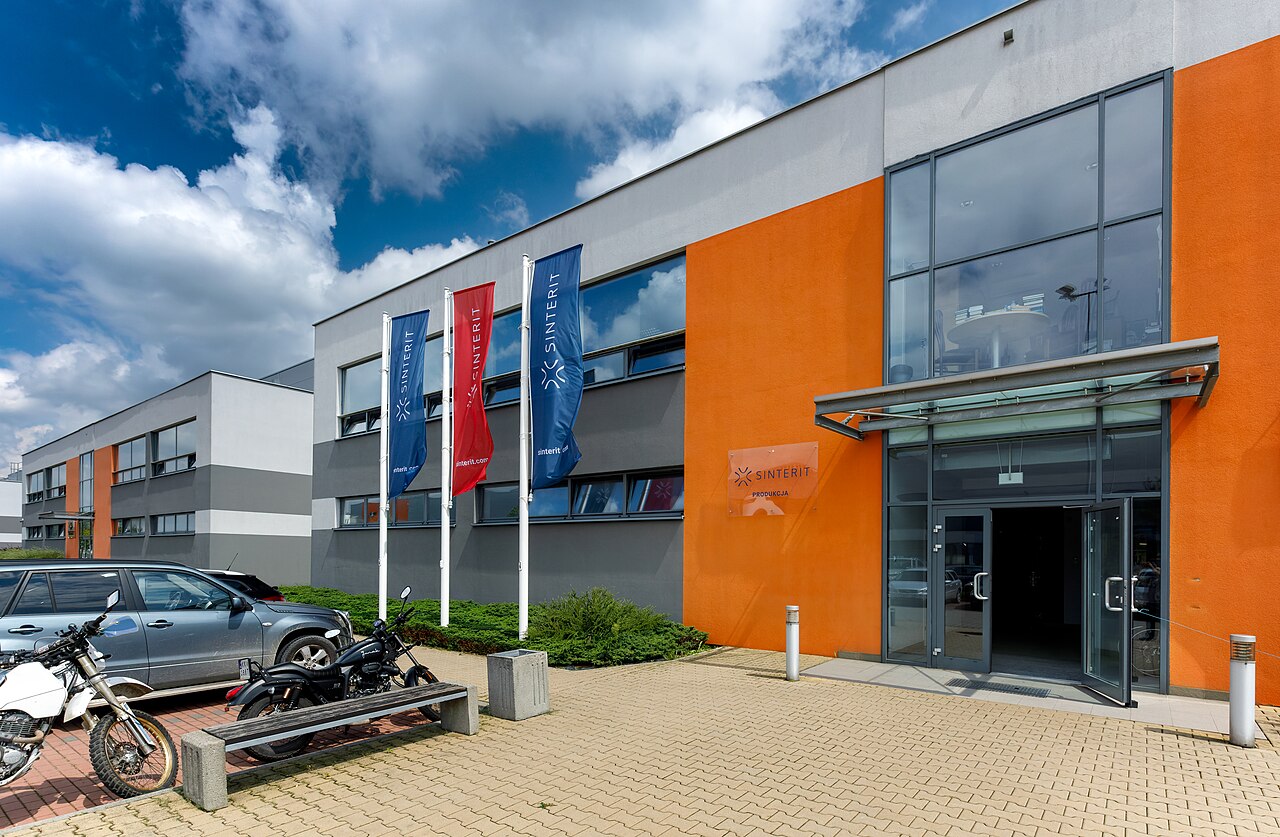
Sinterit, the Polish company that helped turn selective laser sintering from a factory-floor process into something that fits on a bench, is shutting down its printer manufacturing. According to VoxelMatters, a court appointed a temporary supervisor over the company on October 28, 2026, following a bankruptcy petition the company filed in July. In a statement posted on LinkedIn and quoted by VoxelMatters, the company said: "We are currently winding down our manufacturing operations. In coordination with the court, we are exploring options to continue our service, consulting and sales activities, with the aim of protecting the interests of Sinterit's creditors and customers to the greatest extent possible." FilamentFeed could not read the original LinkedIn post directly, so the wording here comes from VoxelMatters' report.
The company's website is no longer operational, according to VoxelMatters. For owners of Sinterit machines, that is the most concrete sign so far that the business they bought into has changed for good, whatever form the remaining service operation ends up taking.
A Year in the Courts
This is not a sudden collapse. The court record VoxelMatters lays out shows a company that has been in legal proceedings for most of 2026:
- April 17: Restructuring proceedings were registered, as an attempt to reach an agreement with creditors. VoxelMatters reports they are still ongoing.
- June 5: A bankruptcy case was opened. It was later closed.
- July 23: A new bankruptcy case was registered. It remains active.
- October 28: The court appointed a temporary supervisor.
Running restructuring and bankruptcy proceedings side by side is unusual, and it suggests the company was trying to reorganize while keeping the liquidation option open. Even so, Sinterit kept bringing out new hardware during this period. VoxelMatters notes that in the midst of these proceedings the company released its BIANCO2 compact SLS printer. Either way, the outcome now is a wind-down of manufacturing.
How Sinterit Got Here
Sinterit was founded in Krakow in 2014 by Michal Grzymala-Moszczynski, Konrad Glowacki and Pawel Szczurek, according to background reporting from 3D Printing Journal. Its first printer, the compact Lisa, arrived in 2015 at a price of just a few thousand euros. At the time, the SLS market was dominated by industrial machines costing hundreds of thousands of euros, which severely limited access to the technology. A desktop powder-bed nylon printer at a few thousand euros was a real change of category, and 3D Printing Journal credits Sinterit and Sintratec with creating the desktop SLS segment together in the second half of the 2010s.
The company also set itself apart with an "open parameters" feature, which according to 3D Printing Journal allowed the use of third-party materials and research experiments. For engineers and advanced users who wanted to try different powders, that openness was a big part of the appeal.
The money behind it came largely from one place. In 2017, Sinterit raised a EUR 1.1 million share issue financed by FIT AG, the German additive manufacturing group that is now its main shareholder. 3D Printing Journal, in a September 2025 piece, describes FIT AG's continued funding as a "financial drip-feed". VoxelMatters reports that FIT AG recapitalized Sinterit several times and also bought its printers, and says Sinterit lasted as long as it did largely because of that support. A strategic investor that is also a customer can keep a company running through slow periods. It can also hide how much the business depends on that one relationship. When the cash stops, there is not much left to hold it up.
The Fuse 1 Effect
Both sources point to the same turning point. In 2021, Formlabs entered compact SLS with the Fuse 1, and both VoxelMatters and 3D Printing Journal report that it took close to half of the segment. For a small specialist like Sinterit, a competitor of that scale changes the economics of every sale. 3D Printing Journal describes 2021 to 2023 as bringing serious market challenges for the company, even as it kept improving its Lisa X line and focused on lower-cost materials such as PA11 powder.
Sinterit is not the first casualty. Sintratec, the Swiss manufacturer that helped establish the category alongside Sinterit, filed for bankruptcy in early 2024. With Sinterit now winding down manufacturing, two of the companies that defined this category have left the hardware business within roughly three years of each other.
Formlabs is not a neutral observer. A Formlabs spokesperson told VoxelMatters: "We are sad to see another ecosystem player leave the arena, but SLS is a tough technology to crack." The company has also prepared a special offer aimed at Sinterit customers. VoxelMatters did not publish the terms.
The spokesperson's remark comes from the company that stands to gain, and neither source breaks down Sinterit's costs, so the reasons behind its struggles are a matter of interpretation. What the sources do show is a pattern: a small manufacturer in a narrow segment, a dominant new entrant, and years of dependence on its largest shareholder. 3D Printing Journal noted in 2025 that FIT AG had ordered more than thirty Lisa X and Suzy printers and provided further funding, and read that as a sign the company was struggling to sustain itself independently.
What It Means for Makers
If you own a Sinterit Lisa, Lisa Pro, or any later model, the practical questions are about service, parts and powder. The company says it is exploring ways to keep service, consulting and sales going in coordination with the court. That is a statement of intent, not a guarantee. Until a structure is announced, owners should assume support may become unreliable and plan for that:
- Stock up on consumables and wear parts you know you will need. A supply chain going through court proceedings can be interrupted with little notice.
- Document your process settings. Sinterit's open-parameters approach means many users have tuned profiles of their own. Export them, back them up, and record which powders and settings have worked for you.
- Keep copies of software and firmware installers you rely on. With the company website reported offline, assume vendor-hosted downloads may not come back.
- Look at the Formlabs offer carefully if it reaches you, but don't treat it as urgent. A working machine that meets your needs today is still a working machine.
For anyone thinking about buying into desktop SLS, the lesson is broader. The segment has narrowed sharply, and a category that once had two independent pioneers now leans heavily on one dominant vendor. That can bring stability and a mature ecosystem. It may also mean less price competition and fewer open, tinkerer-friendly alternatives of the kind Sinterit offered.
Bottom Line
Sinterit showed that SLS could be scaled down to a price and size that small shops and serious makers could justify, and its open-parameters approach gave users real control over a demanding process. But years of support from its main shareholder could not make up for a market reshaped by a larger competitor. Whether the company survives as a service and sales operation will decide how well existing owners are looked after. The manufacturer itself, on the company's own account, is winding down.
