
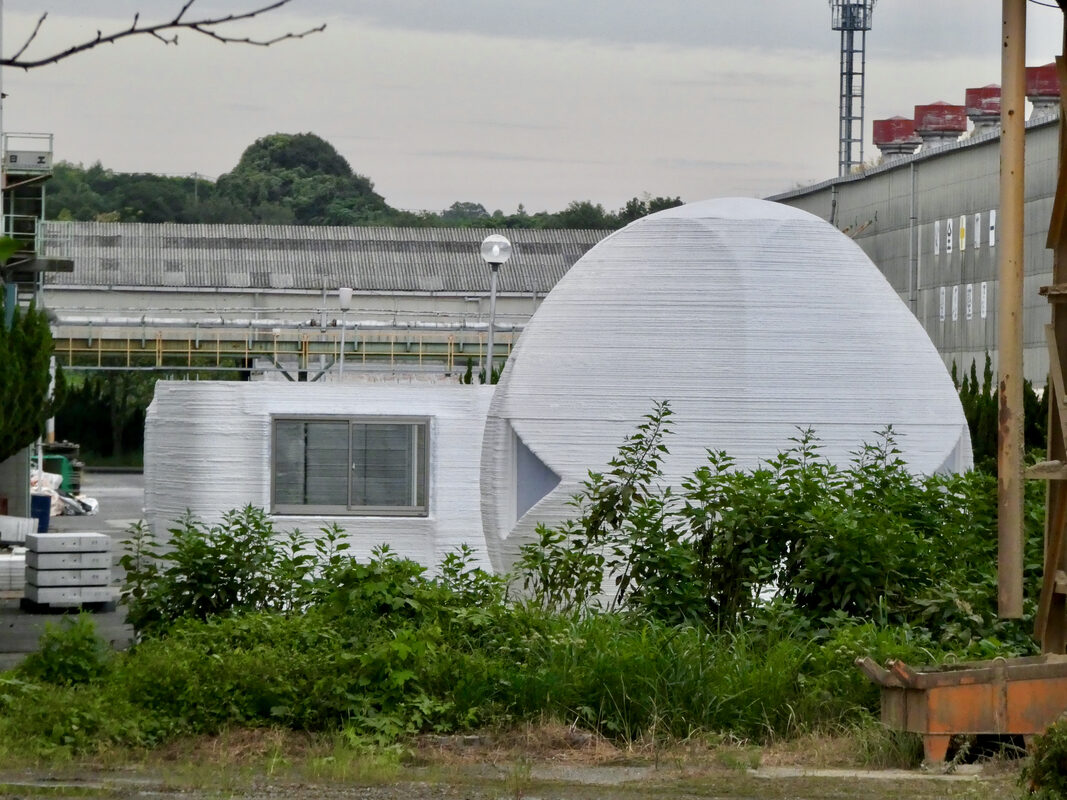
Denver-based additive-construction firm RIC Robotics has begun deploying two autonomous 3D-printing systems on Cleora, a 106-homesite, 55-acre planned community in Salida, Colorado, where roughly two-thirds of the housing stock — more than 65 homes — will be built by robots rather than framing crews. Seven homes are already complete, with multiple units sold. 3DPrint.com describes Cleora as one of the largest single 3D-printed housing builds underway, and a press release covered by ConstructionOwners.com goes further, billing it as the world's largest planned 3D-printed township.
The scale here is what separates Cleora from the scattered pilot houses and single-lot demonstrations that have defined much of the printed-housing conversation over the past several years. According to a July 8 press release from Cleora's development team, the site is platted for 106 homesites and 172 total doors spanning single-family homes, duplexes, accessory dwelling units, and mixed-use buildings. General contractor True North is overseeing the build, with RIC Robotics' autonomous printers used to construct the majority of the residential units. True North's first model home is currently under construction, and RIC says its shell is targeted for completion this month.
Two Printers, One Township-Scale Job Site
Running two autonomous printing systems concurrently on a single, multi-year residential build is itself a logistical statement. Unlike a research demo where a gantry prints one wall system under controlled conditions, a live subdivision job site means moving printers between lots, coordinating with conventional trades for roofing, MEP, and finishes, and hitting a sales calendar — all while roughly two out of every three homes in the community pass through the machines at some point in their construction sequence. RIC Robotics CEO Dr. Ryan Cox framed the milestone as proof of concept for the industry more broadly, saying the project "demonstrates how robotics can be integrated into a real community at meaningful scale." Founder Ziyou Xu echoed that the goal is to show "modern, architecturally distinctive homes can be delivered at scale without increasing costs" — a direct response to the persistent criticism that printed housing remains a novelty priced above conventional stick-built construction. Cleora Managing Partner Greg Kenny also spoke to the milestone, according to the release.
A Metro District Printed From the Ground Up
Beyond the houses themselves, Cleora's development team describes the project as establishing the county's first 3D-printed metro district — the special-purpose government entity common in Colorado that funds and maintains shared infrastructure like roads, water systems, and recreational amenities. In Cleora's case, that district's own critical infrastructure, including commercial, recreational, utility, and water-treatment systems, is being built with the same printing technology used for the homes. That's a notable extension of additive construction outside the residential envelope and into the civil-infrastructure layer that usually gets built with conventional concrete crews and precast components.
The project is also arriving alongside a policy tailwind — though it's a federal one rather than a Colorado-specific one, as some coverage has implied. 3DPrint.com's reporting ties Cleora to the "21st Century Road to Housing Act," a bill that has now passed both houses of the U.S. Congress after being introduced at the end of last year. Among its provisions is a grant program that fast-tracks construction projects built from what the bill calls "a collection of pre-approved housing designs" — the kind of standardized, code-reviewed plan sets that make repeatable robotic construction easier to permit at volume, in Colorado or anywhere else. Pairing a pre-approved design pipeline with a printer that executes the same wall geometry dozens of times over is a fairly direct match between policy incentive and manufacturing method.
Building the Workforce, Not Just the Walls
RIC Robotics has also partnered with Colorado Mountain College to train a construction-robotics workforce, according to the 3DPrint.com report. That detail matters more than it might first appear. Every additive-construction company eventually runs into the same bottleneck: printers need operators who understand both the machine's control software and the realities of a residential job site — grading, rebar placement, concrete mix behavior, inspection sign-off. A community-college partnership that trains locally, rather than flying in specialists for each deployment, is the kind of unglamorous infrastructure that determines whether a technology scales past its first few projects or stalls out for lack of trained hands.
What It Means for Makers
For the desktop and prosumer 3D-printing crowd, Cleora is a useful data point on where large-format extrusion technology is actually headed commercially, even if none of you will ever touch one of these machines directly. The underlying physics — layer-by-layer material deposition, toolpath planning, calibration drift over long prints — scale up conceptually from a Bambu Lab or Prusa on your desk to a gantry printing a load-bearing wall, even though the materials (typically cementitious mixes rather than thermoplastics) and tolerances involved are entirely different domains. What's genuinely worth watching is the workforce-training angle. Colorado Mountain College's involvement signals that "construction robotics technician" is becoming a defined career track, not just a job title improvised on-site. If you've been curious about additive manufacturing careers beyond hobbyist prototyping and want a sense of where the money and job growth in large-format printing is actually concentrating, community-college partnerships tied to real developments like Cleora are a better signal than any startup's funding announcement. It's also a reminder that "3D-printed house" has moved from press-release novelty — one home, one press day — to a repeatable production line with a general contractor, a sales office, and a government-adjacent infrastructure district attached to it.
Bottom Line
Seven homes finished and sold out of a planned 65-plus is still early innings, and RIC Robotics hasn't disclosed a full completion timeline for Cleora. But running two autonomous printers on a live, multi-phase subdivision — with a printed metro district and a formal training pipeline attached — is a meaningfully different proposition than the one-off showcase houses that have defined printed construction's public image so far. If Cleora delivers anywhere close to its 65-home target on a normal homebuilding schedule, it will be one of the clearest signals yet that additive construction is moving from demonstration to production.
