
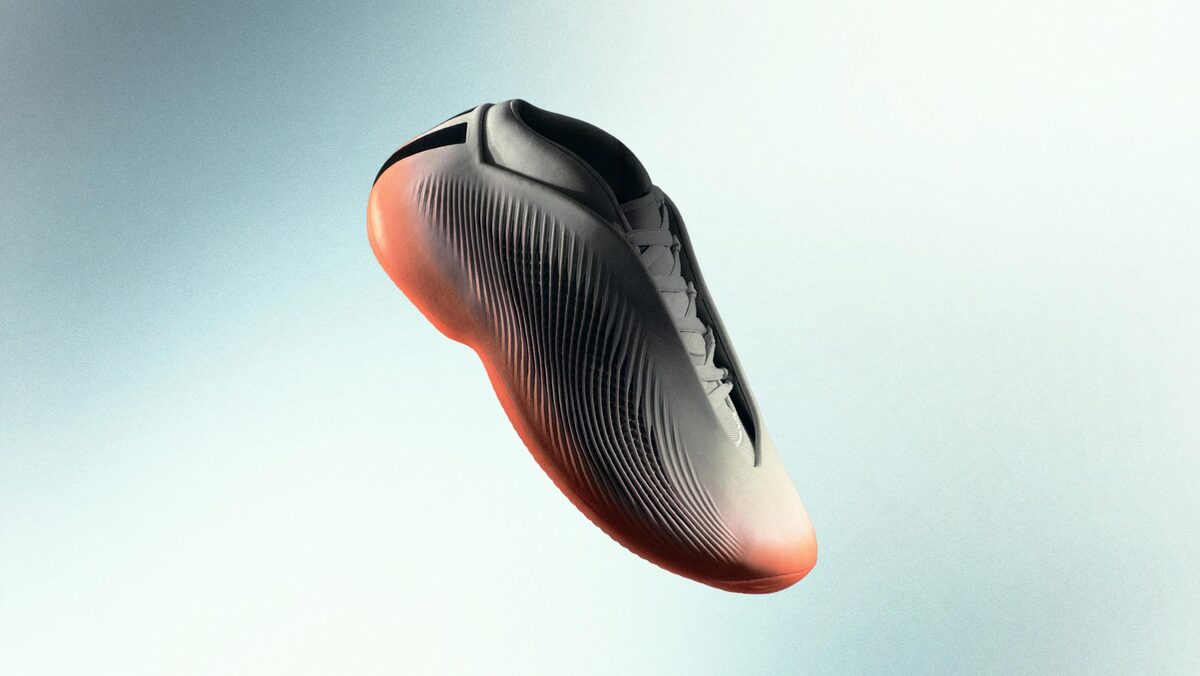
Adidas Basketball has introduced the BB.01, which the company is billing as the world's first 3D-printed performance basketball shoe. It's the debut product from Project: R.A.P. — Radical Athlete Perception — a new platform the brand is positioning as a long-term framework for building individualized athlete footwear through additive manufacturing rather than injection molding and stitched textiles. The shoe costs $250 and shipped into an unusually small global market: just 169 pairs.
For a maker audience that has watched sneaker brands flirt with 3D printing for the better part of a decade — Adidas's own Futurecraft 4D midsoles date back to 2017 — the BB.01 is notable less for the technology itself than for how far up the shoe that technology now extends, and for how deliberately Adidas is treating scarcity as part of the product.
What's Actually Printed
According to Sneaker News's breakdown of the shoe (SKU LC4118), the BB.01 combines a 3D-printed midsole engineered for impact absorption and stability with a 3D-printed lattice structure that extends into the side panels for breathability. That printed shell sits over a padded inner bootie — meaning the print job isn't the entire shoe, but rather a structural and ventilated exoskeleton wrapped around a more conventional soft-goods interior. The finished shoe weighs 15.13 ounces (428 grams), Sneaker News reports.
That construction mirrors a pattern common in industrial and orthopedic 3D printing: use additive manufacturing for the geometrically complex, mechanically tuned parts — lattice structures that would be difficult or impossible to injection-mold with the same localized density control — while leaving the parts best served by traditional soft-goods manufacturing (padding, comfort layers, fit) to conventional methods. Lattice-based midsoles have become something of a signature move across the industry precisely because lattices let engineers vary stiffness and cushioning zone-by-zone in ways a solid or foamed midsole can't easily replicate.
Adidas's own announcement frames the shoe in personalization-forward terms. In the Newsroom release, Alexander Taylor, SVP Innovation Design and Concepts, says: "We built Project: R.A.P. around a simple belief that athletes are capable of more, and the right technology can unlock it." Max Staiger, General Manager of Basketball, adds that the platform lets Adidas "focus on individual player needs better than ever." It's Adidas as a company — not a specific executive quote — that bills the BB.01 as "the world's first 3D printed basketball shoe," framing it as the opening move of a platform meant to eventually tailor footwear to individual athletes rather than a one-off product.
A Deliberately Tiny Drop
What separates the BB.01 from prior 3D-printed sneaker experiments is the release mechanics. Adidas is putting exactly 169 pairs into the world, split three ways: 50 pairs offered at the brand's Las Vegas flagship store on July 10, 89 pairs released through the adidas CONFIRMED app on July 14 (registration for that drop opened July 9), and 30 pairs allocated to Greater China. There is no broader retail rollout, no restock plan mentioned in either source, and no indication the BB.01 will move beyond this initial allocation.
That's a fundamentally different strategy than Adidas's earlier 3D-printed midsole efforts, which — after limited early drops — eventually scaled into mass-produced lines. The BB.01, at least as launched, reads more like a limited-edition collectible than a mass-market performance shoe, with the printing process itself functioning partly as a scarcity and marketing mechanism as much as an engineering one. A $250 price point for a shoe capped at 169 units globally puts total initial revenue for the drop at roughly $42,250 before any secondary-market premium — a figure that underscores this is a proof-of-concept and hype vehicle for Project: R.A.P., not a production-line replacement.
Sneaker News also notes that Project: R.A.P. isn't limited to basketball. The platform already encompasses 3D-printed soccer cleats, and Adidas has football (American) cleats in development, suggesting the BB.01 is one entry point into a cross-sport additive manufacturing initiative rather than a one-off basketball novelty.
What It Means for Makers
Nothing here is directly reproducible on a desktop FDM or resin printer — this is almost certainly industrial-grade powder-bed or MJF-style printing running lattice geometries generated through generative design software, the kind of infrastructure that lives in a footwear brand's advanced manufacturing lab, not a garage. But the BB.01 is still a useful data point for anyone tracking where lattice design and additive manufacturing are headed in consumer products.
First, it's another confirmation that zone-tuned lattice structures — the same design language showing up in printed bike saddles, prosthetics, and helmet liners — are being treated as production-viable for load-bearing, cyclically stressed applications like a basketball outsole and midsole, not just for lightweight non-structural parts. Second, the hybrid construction (printed shell over conventional soft goods) is a reminder that "3D-printed shoe" rarely means "entirely 3D-printed shoe" in practice; makers experimenting with printed wearables should expect the printed component to handle structure and airflow while textiles and foam still handle comfort and fit. Third, the extreme scarcity of this drop — 169 pairs against presumably far higher demand — signals that additive manufacturing's current unit economics for footwear still favor small-batch drops over mass production, even at a major brand with deep manufacturing resources. That gap between "technically possible" and "economically scalable" remains the central bottleneck for 3D printing's push into consumer apparel and footwear, and the BB.01 doesn't close it so much as spotlight it.
Whether Project: R.A.P. eventually produces a shoe ordinary consumers can buy in their size, on demand, printed to their individual gait — a natural extension of the personalization language in Adidas's own framing — will depend on whether Adidas can scale the print times, materials cost, and post-processing labor behind drops like this one down to something resembling normal retail volume. For now, the BB.01 is a showcase, not a supply chain.
