
Getting a set of dentures in the United States without insurance typically means months of waiting, multiple appointments, and a bill few uninsured patients can absorb. Remote Area Medical's Mobile Digital Denture Lab compresses that timeline into a single visit — dentist exam, digital impressions, CAD design, and a 3D-printed final product, done in roughly two to three hours. A good chunk of the workflow behind it was built by a 22-year-old who taught himself CAD, dental anatomy, and additive manufacturing from scratch.
Remote Area Medical (RAM) is the nonprofit best known for setting up sprawling, weekend-long free clinics — originally in remote or underserved regions, more recently in parking lots and fairgrounds across the U.S. — where volunteer doctors and dentists treat people who have no other way to access care. Dental work has historically been one of the hardest services to deliver at that scale, because conventional dentures made the traditional way could take months to produce and deliver.
From Impression to Insertion in One Sitting
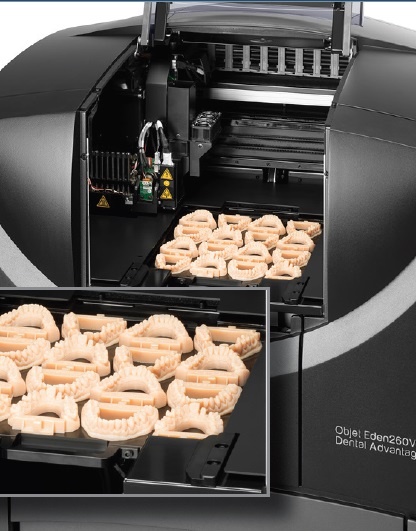
The Mobile Digital Denture Lab collapses that pipeline by moving every step of denture fabrication into a mobile unit parked next to the clinic itself. A patient sees the dentist, has digital impressions taken instead of the traditional tray-and-putty method, and those scans go straight into denture design software. From there, the models print in-house — no shipping a case out to an off-site lab and waiting for it to come back. RAM says the ideal turnaround from first visit to a finished, custom-fit denture is two to three hours, and patients typically walk out wearing them the same day.
That is the part of the story that gets the headlines, but the more interesting engineering story is who built the digital workflow that makes it possible: Connor Gibson, RAM's dental technology manager, is 22 years old and self-taught. He picked up CAD software, the anatomical knowledge needed to design a functional denture, and the specifics of dental 3D printing — resin selection, layer orientation, post-processing, fit tolerances — without a formal pipeline into the field. According to 3DPrint.com's July 11, 2026 news briefs, Gibson's personal record is 35 printed dentures completed in a single weekend clinic.
That number is worth sitting with for a second. A weekend RAM clinic runs roughly two days. Thirty-five dentures in that window means Gibson and the lab's process were moving through a full digital-impression-to-printed-part cycle at a pace that would be aggressive for a production dental lab running on a five-day work week, let alone a pop-up operation staffed largely by volunteers. It is a workflow problem as much as a printing problem — batching print jobs, managing resin cure and wash stations, and keeping a queue of patients moving through chairside scanning without bottlenecking the print farm behind it.
The Human Side of the Numbers
Gibson's own framing of the work, quoted by 3DPrint.com from a CNN interview, is less about throughput and more about what a denture means to the person receiving it: "Something that I was able to have a hand in makes a grown man burst into tears. To see that raw, human emotion and just know that I played a change in this person's life…it's very humbling, and I'm beyond blessed." Dentures are one of those medical devices where the functional outcome and the emotional outcome are hard to separate — the ability to eat solid food again, to smile without self-consciousness, often after years of avoiding both.
RAM has paired the technical build-out with a distribution deal that matters just as much as the printer specs: a partnership with Haleon and Walmart that puts the mobile lab in Walmart parking lots around the country. That's a meaningful logistics choice. Walmart lots are everywhere, they have power and space for a mobile unit, and they sit in exactly the kind of communities — rural and lower-income — where uninsured adults are most likely to live. It turns what could have been a boutique, one-city pilot into something that can plausibly tour at national scale.
What It Means for Makers
There's a version of this story that's purely a nonprofit-does-good-work piece, and RAM's mission genuinely is that. But for anyone who prints for a living or is weighing whether digital fabrication skills translate into other fields, the more instructive detail is Gibson's path into the role. He didn't come up through a dental-lab apprenticeship or a biomedical engineering program — he learned CAD, dental anatomy, and print-farm operations the way a lot of people in this community learn things: by doing it, badly at first, until it worked. That's a familiar arc to anyone who has gone from a hobbyist FDM printer to running production jobs, except here the stakes are a stranger's ability to chew food, and the tolerances are a lot less forgiving than a cosplay prop.
It's also a useful data point on where dental and medical 3D printing actually sits right now. Chairside, same-day dentures used to be the kind of thing demoed at trade shows as a five-years-out concept. RAM's lab suggests the workflow — intraoral scanning, CAD denture design, resin printing, and finishing — has matured enough that a self-taught 22-year-old, not a specialized dental-lab veteran, can run it at volume in a mobile unit with volunteer support. That's a meaningful signal about how far digital dentistry hardware and software have come down the accessibility curve, and it points to where volunteer-driven and low-resource medical programs elsewhere might find similar leverage: any device category where the bottleneck is a slow, centralized fabrication step is a candidate for the same compression RAM has applied to dentures.
