
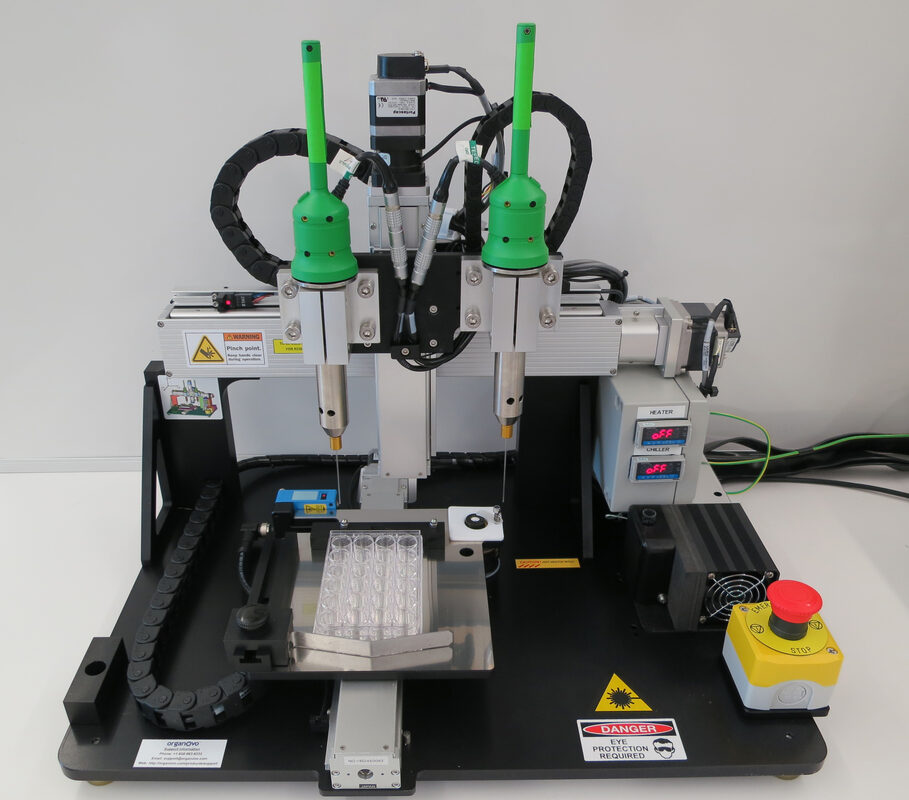
Auxilium Biotechnologies announced on July 9, 2026 that its AMP-1 bioprinting platform had produced kidney and liver tissue aboard the International Space Station — the first time either organ type has ever been manufactured in orbit. The constructs came out of Mission AXLM-3, a single spaceflight during which Auxilium's hardware also printed cartilage and more than twenty nerve-repair implants, marking the first time three distinct tissue types were manufactured on one mission and the first time a single platform produced both living tissue and implantable medical devices in the same flight.
The mission itself is already back on Earth. AXLM-3 launched aboard SpaceX-34 and splashed down off the California coast on June 17, 2026, after which Auxilium and its partners spent the following weeks analyzing the printed tissue before going public with results this week. Auxilium VP of Engineering Isac Lazarovits described the flight as a step toward "routine manufacturing operations in orbit," and the mission drew on support from BioServe Space Technologies, Space Tango, and NASA's In-Space Production Applications (InSPA) program — the kind of shared infrastructure that has increasingly made ISS-based manufacturing experiments logistically possible without every company building its own launch and station-access pipeline.
Why Kidney and Liver Are a Different Problem
Bioprinting cartilage or skin grafts in microgravity is now a well-trodden path for several orbital manufacturing outfits. Kidneys and livers are a different order of difficulty. Both organs depend on dense, branching internal channel networks — nephrons and blood vessels in the kidney, sinusoids and bile ducts in the liver — that have to stay open and structurally sound while the surrounding tissue is still soft and uncured. On Earth, gravity constantly fights the print: unsupported channels sag, collapse, or fuse before the bioink cross-links, and the workarounds (sacrificial supports, thickened walls, slower deposition) all trade away the geometric fidelity that makes the organ function in the first place. Auxilium's pitch is that removing gravity removes that constraint. According to the reporting on the mission, zero-gravity conditions let cells settle into proper structural arrangements and let the tissue mature biologically faster than equivalent prints made on the ground. That's the same logic that has driven space-based manufacturing interest in fiber optics and protein crystals: some geometries and material states are simply easier to hold when nothing is pulling them sideways.
The cell and tissue designs for the kidney and liver constructs weren't Auxilium's alone — they came from the Wake Forest Institute for Regenerative Medicine (WFIRM), a research group with a long history in tissue engineering. Auxilium's contribution was the orbital hardware and the print process; WFIRM supplied the biological blueprint for what those prints needed to become. WFIRM director Dr. Anthony Atala said the uniform cell distribution achieved aboard the station "points to real possibilities for manufacturing medical devices and tissues in space" — a validation of the underlying biology, distinct from Auxilium's claims about the hardware itself.
A Cartridge System, Not a Custom Rig Per Mission
The mechanism behind AMP-1 is described as cartridge-based, which is notable for anyone who follows desktop or industrial printing hardware: instead of reconfiguring the machine for each tissue type, operators load a cartridge containing the relevant bioink and cell material and print from it. Auxilium CEO Jacob Koffler described the approach directly: "You can send or load whatever you want into the cartridge, and then print it." That's the same modularity logic that made swappable filament and resin cartridges a baseline expectation in consumer 3D printing — except here the payload is living cells rather than PLA or photopolymer resin, and the build chamber is a space station module. The mission also demonstrated that the cartridges have shelf life: bioink cartridges can reportedly be stored in space for at least six months before use, which matters enormously for any system meant to operate on a schedule dictated by launch windows and crew availability rather than by ink freshness.
Koffler framed the broader ambition around medical response rather than research output alone, saying the platform gives crews "the capability to respond to medical emergencies in space." He also pointed toward future use on lunar or Mars missions, where a cartridge-loaded printer could in principle produce tissue or therapeutics on demand rather than requiring astronauts to carry every conceivable treatment with them from Earth.
What It Means for Makers
None of this hardware is heading toward a desktop bioprinter anytime soon, and Auxilium's constructs are still lab-analyzed research tissue, not transplant-ready organs — the reporting doesn't claim otherwise. But the architecture on display is worth paying attention to for anyone who thinks about print systems as systems, not just as extruders. The cartridge model is the same design pattern that has made consumer and prosumer printers more accessible over the past decade: separate the print engine from the material payload, and let the payload determine what gets made. Applying that pattern to bioprinting — where the "material" is a living cell population rather than a spool of filament — is what let one AMP-1 unit produce three unrelated tissue types and a batch of nerve implants on a single mission without swapping hardware. It's a reminder that a lot of what makes additive manufacturing scale isn't the print head, it's the logistics around it: how material is packaged, stored, and swapped in and out. The microgravity angle is also a useful data point for anyone skeptical that orbital manufacturing is more than a novelty. The claim here isn't "we can print in space too" — it's that certain geometries (fine, branching internal channels) are measurably easier to produce correctly without gravity fighting the process. That's a materials-science argument, not a marketing one, and it lines up with why other companies have chased space-based manufacturing for fiber optics and pharmaceutical crystals rather than doing it for its own sake.
For desktop and industrial print operators watching the bioprinting space from the outside, the practical takeaway is less about kidneys and more about validation: a cartridge-based, multi-material print platform just ran unattended-adjacent production of several different product types on one mission, with six-month-stable feedstock. That's an engineering benchmark other manufacturing-in-space efforts, and eventually terrestrial multi-material systems, will be measured against.
