
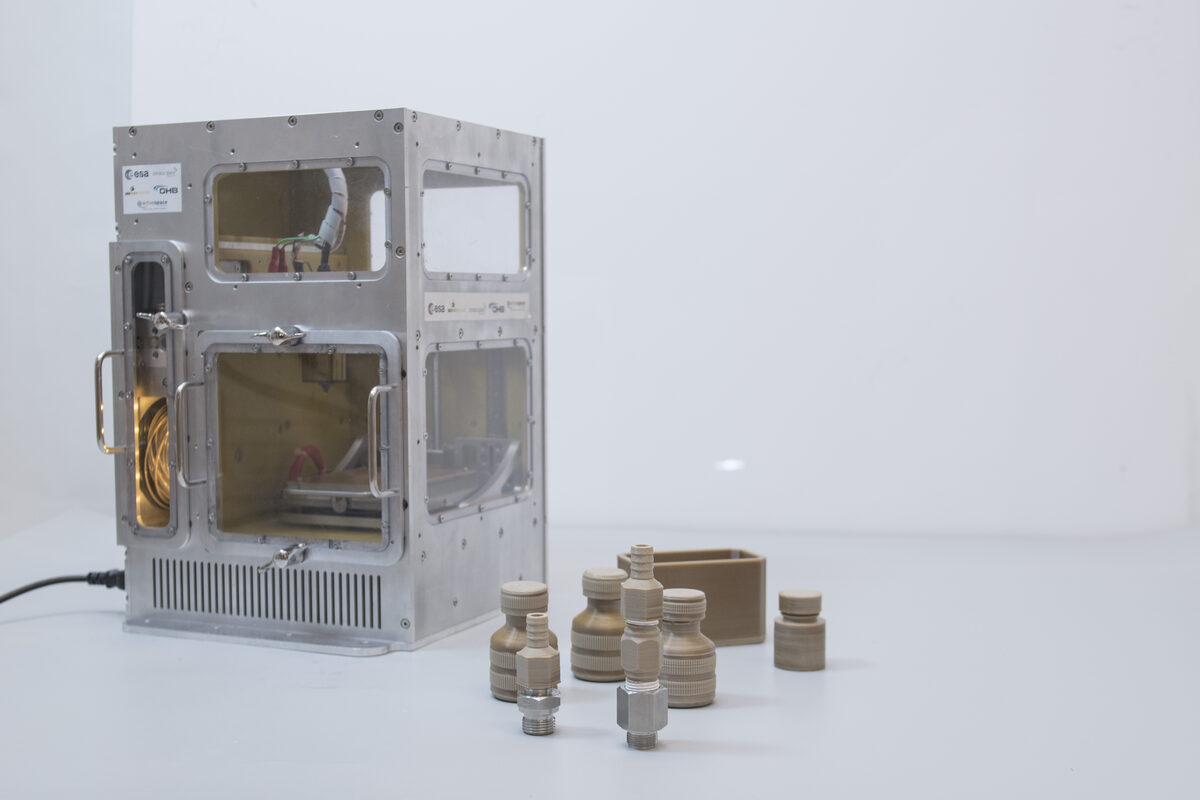
A Berlin-and-Warsaw startup just took additive manufacturing somewhere no one has printed before: the open vacuum of space. Orbital Matter's Replicator-2 CubeSat launched July 7, 2026 aboard a SpaceX Falcon 9 on the Transporter-17 rideshare mission, carrying four onboard printing modules designed to extrude and UV-cure photopolymer resin into rigid structural arms directly in orbit — no pressurized chamber, no astronaut standing by, no atmosphere at all.
That last detail is the headline. Every prior demonstration of 3D printing in orbit — including NASA's and Made In Space's well-documented work aboard the International Space Station — happened inside a pressurized module, where cabin air, controlled temperature, and gravity-adjacent convection all behave in ways engineers understand well. Replicator-2 is printing on the outside, exposed to what Orbital Matter CTO and co-founder Robert Ihnatișin describes simply as the "harsh space environment" — vacuum, radiation, and thermal extremes with no cabin atmosphere to moderate any of it. Orbital Matter has not published specific figures for the thermal cycling range, atomic-oxygen exposure, or cure conditions its printers are rated to survive, so those engineering details remain unverified for now. If it works as intended, though, this would be among the first demonstrations of structural additive manufacturing performed entirely outside a pressurized module.
What Replicator-2 Actually Is
Replicator-2 is an 8U CubeSat weighing approximately 13 kilograms — small by satellite-bus standards, but packed with hardware most CubeSats never carry, according to details reported by Forbes Romania. Each of the four print units, which Orbital Matter CTO Robert Ihnatișin calls P.A.D.S. (Printer Assisted Deployment Systems), extrudes a liquid photopolymer resin that is then hardened by an onboard UV light source, building up rigid one-meter arms one pass at a time. It's a variant of the same UV-curable resin chemistry familiar to anyone running an SLA or DLP desktop printer — just deployed in a context where the resin has to survive outgassing rules, radiation exposure, and a total absence of atmospheric pressure during cure.
The four printers split into two jobs. Two of the units are building a custom, in-house-designed foldable solar array, extruding the support arms that will unfold the panel into its working configuration once printing completes. The other two are standalone units; Ihnatișin told Spaceflight Now that one of them is printing a "secret antenna payload," without detailing the fourth publicly. Forbes Romania separately reported that the printed arms are intended to support a camera system as well as the solar panel and antenna as part of the overall deployment package. Either way, it's the same print-to-deploy approach rather than the spring-loaded or motor-driven deployment mechanisms that have dominated CubeSat design for two decades. Ihnatișin confirmed the four-printer configuration and the P.A.D.S. naming to Spaceflight Now ahead of the Falcon 9 launch, which lifted off at 12:12 a.m. PDT on July 7 from Space Launch Complex 4E at Vandenberg Space Force Base.
Why Print a Deployment Structure Instead of Folding One
Traditional deployable structures — solar arrays, antenna booms, magnetometer arms — are built on Earth, folded into a launch-safe stowed configuration, and released in orbit by springs, hinges, or shape-memory actuators. That approach works, but it caps how large a structure can be: whatever unfolds has to have first fit, folded, inside a fairing. Printing the structure in orbit sidesteps that constraint entirely. The raw material — spooled or reservoired resin — takes up a fraction of the volume of an equivalent pre-built rigid arm, and the "unfolding" step is replaced by the print job itself. That's the pitch behind Orbital Matter's longer-term goal, which the company states plainly in its own newsroom materials: Replicator-2 is "the first step toward megawatt-class arrays for orbital data centers." That's an enormous leap from a one-meter printed arm on a 13-kilogram CubeSat, but the logic is the same logic that's driven interest in space-based solar and in-orbit servicing for years — if you can manufacture structure in place rather than launch it pre-built, the mass and volume economics of large orbital infrastructure change dramatically. A data center in orbit needs power at a scale current deployable arrays can't easily reach, and print-in-place structural manufacturing is one of the few proposed paths that scales without requiring correspondingly enormous fairings.
What It Means for Makers
For the desktop and prosumer printing community, Replicator-2 isn't a product announcement — nobody's buying a P.A.D.S. module — but it's a meaningful validation of chemistry and process that maker-scale printing pioneered. UV-curable photopolymer resin, the same broad family used in every consumer SLA and DLP machine on the market, is now the working material for a manufacturing process operating outside a pressurized environment for the first time. That's a real-world stress test of resin behavior under vacuum and space's thermal extremes, conditions no hobbyist rig will ever need to survive, but ones that will generate engineering data on resin formulation, cure kinetics, and mechanical performance that could eventually filter back into terrestrial material science — assuming Orbital Matter eventually publishes it.
It's also a useful reminder of how far "additive manufacturing" has stretched beyond the desktop FDM and resin printers most readers are running. The core mechanism — extrude, then cure with light — is identical in principle to a home resin printer. The engineering that makes it survive space is what's novel, not the underlying process. If Orbital Matter's approach scales, the next generation of large space structures may be built the way we increasingly build small ones: printed to the spec needed, in place, rather than pre-fabricated and folded to fit a shipping constraint.
Orbital Matter has not published a timeline for full deployment confirmation or specified performance data for the printed arms, and neither of the company's public statements nor the Spaceflight Now report includes independent verification of print quality or structural performance in orbit. That data, if and when Orbital Matter releases it, will be the real test of whether this approach is viable beyond a single demonstration mission.
