
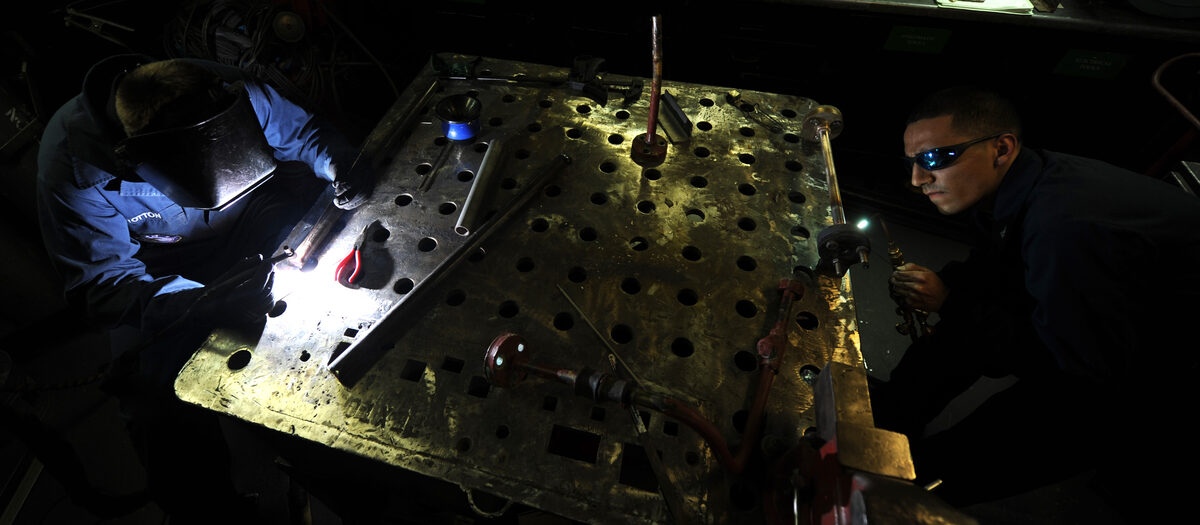
While most of the 25,000-plus personnel taking part in this year's Rim of the Pacific exercise were busy with live-fire drills and amphibious landings, a smaller team was running a different kind of test belowdecks: whether a warship can grow and machine its own spare metal parts without pulling into port. As Additive Manufacturing Media reports, Phillips Corporation deployed a containerized hybrid manufacturing system aboard the amphibious assault ship USS Essex (LHD-2) during RIMPAC 2026, pairing a Haas TM-1P CNC mill with a Meltio Blue wire-laser metal deposition head inside a single self-contained unit.
The pitch is straightforward, even if the engineering isn't: a broken bracket, valve component, or structural fitting that would normally trigger a supply-chain request — and days or weeks of waiting — could instead be additively built up and precision-finished on the spot, at sea, mid-deployment.
What Actually Went Aboard the Ship
The system combines two manufacturing processes that are usually kept in separate rooms, let alone separate machines. Meltio Blue is a wire-laser metal deposition (WLMD) head — a directed-energy-deposition technology that feeds metal wire through a laser-heated melt pool to build up geometry layer by layer, similar in spirit to welding but driven by CNC toolpaths. The Haas TM-1P is a compact toolroom mill, the kind of machine found in countless machine shops and school programs, here repurposed to face off, drill, and finish the deposited metal into a part that actually holds tolerance. Phillips describes the combined cell as enabling "repair, restoration and production of critical metal components" in one workflow — repair a worn part, produce a new one, or machine either to spec, without shipping the job off the ship.
Housing both inside a container matters as much as the machines themselves. A ship's hangar bay or maintenance space isn't a climate-controlled fab shop, and a containerized unit means the whole system can be craned on and off a vessel, plugged in, and run without permanent modifications to the ship. That portability is the entire point: the Navy isn't trying to build a shipboard machine shop from scratch on every hull, it's testing a deployable module that can move between platforms as needed.
The deployment aboard USS Essex is part of a broader effort led by the Naval Postgraduate School's CAMRE consortium (Consortium for Advanced Manufacturing Research and Education), working alongside Phillips Federal, the industrial-technology group FLEETWERX, and the Department of Defense. RIMPAC 2026, which runs June 24 through July 31, is the largest possible stage for this kind of test: more than 25,000 personnel, 40 surface ships, five submarines, and 140 aircraft are participating this year, giving the hybrid manufacturing team a genuinely operational — not laboratory — environment to work in.
Why Weld-Then-Mill, Not Just Print
Pure metal 3D printing gets a lot of press, but it has a well-known weakness for anything that needs to bolt, seal, or bear a load precisely: as-deposited metal surfaces are rough, and dimensional accuracy straight off a laser or arc deposition head rarely meets the tolerances mechanical parts require. Pairing deposition with subtractive machining in one workflow solves that in a single setup — the Meltio Blue head builds up near-net-shape metal geometry, and the Haas mill immediately finishes the critical surfaces, without moving the part to a different machine, fixture, or building. For a ship at sea, where space, time, and skilled labor are all scarce, collapsing "print" and "finish" into one containerized cell is the difference between a demo and something a maintenance crew could plausibly use.
Brian Kristaponis, president of Phillips Additive Manufacturing Solutions, framed the effort around reducing supply-chain delays — the operational pain point this whole program is aimed at. RIMPAC, he said, "provides an opportunity to evaluate how advanced manufacturing can help solve real sustainment challenges for the fleet." As Phillips puts it, "when critical parts are unavailable through traditional supply channels, the ability to manufacture or repair components closer to the point of need can help improve readiness and keep systems operational." A carrier strike group or amphibious ready group operating far from a home port can wait weeks for a single replacement part to work its way through requisition, shipping, and customs. A hybrid manufacturing cell that can fabricate a functional metal replacement in hours, using digital files instead of physical inventory, attacks that bottleneck directly.
A second write-up from 3DPrint.com, published July 9, confirms the same deployment aboard USS Essex in support of NPS's CAMRE program and frames it as a test of expeditionary production and repair capability in a genuinely operational environment rather than a controlled demo, RIMPAC's chaos, ship motion, and real maintenance demands included.
What It Means for Makers
None of this hardware is exotic to anyone who follows metal AM closely — Haas mills are workhorses in job shops worldwide, and wire-laser DED systems like Meltio's have been marketed at fabricators and repair shops for a few years now specifically because they're cheaper and more forgiving than powder-bed laser systems. What's notable here isn't the technology itself, it's the packaging and the mission profile: a hybrid additive-subtractive cell small and rugged enough to live in a shipping container and survive on a moving ship is a strong proof point for anyone building a mobile or remote fabrication shop, whether that's a maker running a machine shop out of a garage, a rural repair business, or a small manufacturer serving customers where a full machine shop isn't practical.
It's also a data point in the ongoing argument over deposition versus powder-bed metal printing for functional parts. Wire-fed processes are messier and less precise than powder-bed laser fusion out of the box, but they're dramatically cheaper, easier to maintain, and — as this test suggests — more tolerant of non-ideal environments. If the Navy's experiment shows sailors with modest training can run a hybrid cell reliably underway, that's a meaningful signal for anyone weighing a WLMD setup against a pricier powder system for repair-and-replace work rather than aerospace-grade production.
Don't expect a consumer spinoff of a Navy shipping container. But the underlying idea — pair a deposition head with a mill, keep the whole thing small enough to move, and use it to make one-off replacement parts on demand — is exactly the workflow a growing number of small machine shops and repair-focused makers are already chasing on a smaller budget.
