
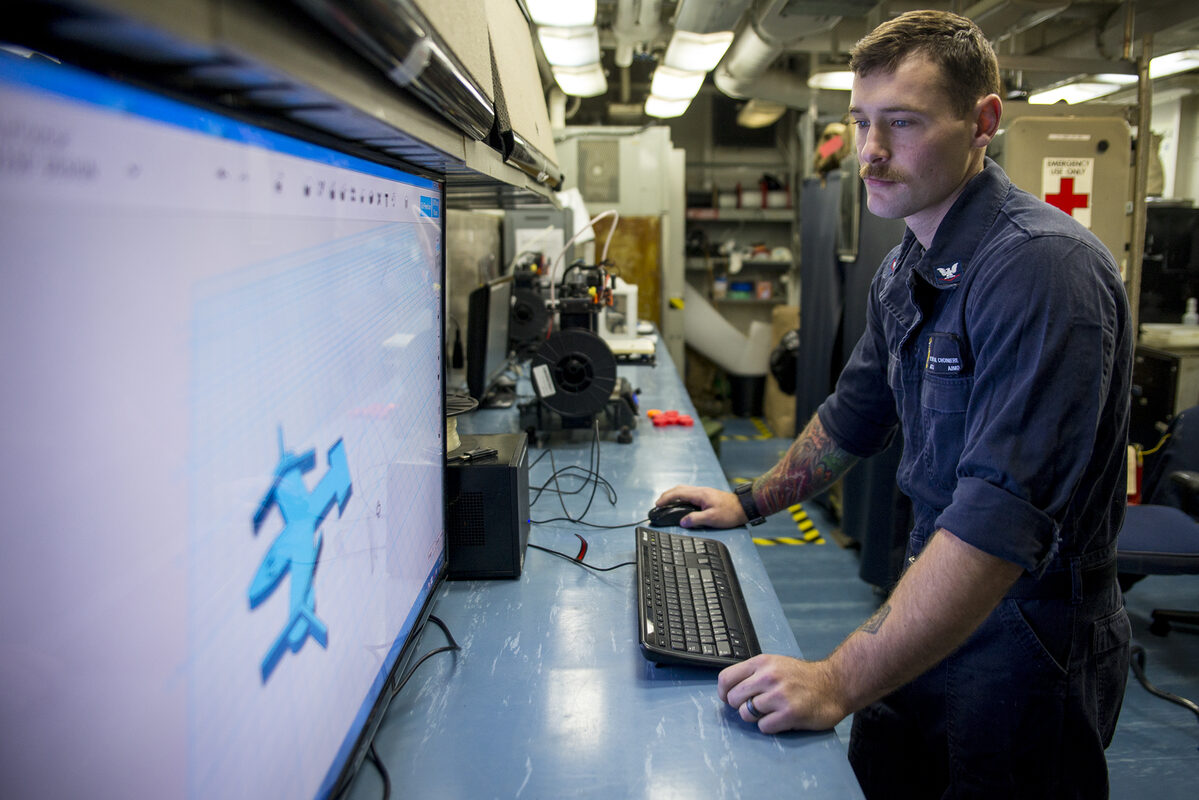
Somewhere in the Pacific, a Marine Corps logistics unit is solving a problem that has dogged navies for as long as ships have gone to sea: what do you do when a part breaks and the nearest supply depot is thousands of miles and several weeks away? Aboard the amphibious assault ship USS Essex (LHD 2), the answer increasingly involves a nozzle, a spool, and a build plate. According to a report from VoxelMatters, Combat Logistics Battalion 13 of the 13th Marine Expeditionary Unit is using embarked 3D printers to manufacture replacement parts and tools on demand during RIMPAC 2026, sidestepping the shipping delays and paperwork that typically stand between a broken component and a working one.
The timing is notable. RIMPAC — the Rim of the Pacific exercise, the world's largest international maritime war game — is running at unprecedented scale this year: 35 nations, roughly 40 surface ships, five submarines, more than 140 aircraft, and 25,000 personnel, according to the official DoD wire posted to DVIDS. Essex isn't printing parts as a side experiment tucked away from the main event — it's doing so inside what the Naval Postgraduate School is calling the largest advanced manufacturing demonstration in the history of the Department of War, one that the DVIDS release describes as the first time advanced manufacturing, artificial intelligence, and unmanned systems have all been integrated into a single operational demonstration.
What's Actually Being Printed
The specifics reported by VoxelMatters are the kind that make hobbyist makers sit up: thermostat covers and oxygen storage hardware, both of which are no longer manufactured by their original suppliers. This is the scenario that additive manufacturing evangelists have pointed to for a decade — not printing something exotic, but printing something mundane that simply cannot be bought anymore because the OEM stopped making it, the tooling was scrapped, or the part number was discontinued generations ago. For a warship built to serve for decades, obsolescence isn't a hypothetical; it's a maintenance reality, and a printer that can reproduce a housing or a cover from a scanned or modeled reference closes a gap that would otherwise mean cannibalizing another system or waiting for a fleet-wide parts search to turn something up.
Gunnery Sgt. Samuel Margarini and Cmdr. Jason Pirrallo, both quoted in the VoxelMatters piece, frame the value less around the novelty of the printers themselves and more around what they eliminate: the wait itself, and the administrative overhead of routing a parts request through the supply chain in the first place. That second point is easy to overlook from the outside. Even when a replacement part technically exists in a warehouse somewhere, getting it onto a moving amphibious assault ship in the middle of a multinational exercise means requisition forms, transport coordination, and — if the ship isn't near a port — waiting for a resupply window. A printer turns that multi-week process into a same-day one, provided the digital file and the material are on hand. A third voice in the VoxelMatters report, Navy Capt. David Foster, Essex's senior medical officer, points to why the oxygen storage hardware matters in particular — those parts feed medical systems onboard, which is exactly the kind of equipment nobody wants stuck in a multi-week parts request.
The Bigger Picture: Four Ships, Metal AM, and CAMRE
Essex's printers are one piece of a larger push. The DVIDS release describes four naval vessels outfitted with metal additive manufacturing systems for RIMPAC 2026, coordinated by the Naval Postgraduate School's Consortium for Advanced Manufacturing Research and Education, known as CAMRE, and built around what the Navy calls the Joint Advanced Manufacturing Center (JAMC) and the Joint Advanced Manufacturing System (JAMS), a digital command-and-control platform for routing manufacturing requests. The approach has already delivered results once before: during RIMPAC 2024, CAMRE produced and installed a 3D-printed stainless steel reverse osmosis pump sprocket bushing aboard the USS Somerset (LPD 25), according to the DVIDS release. What's different in 2026 is scale — metal AM systems spread across four ships instead of one, running alongside the FDM-style polymer printers doing the thermostat-cover-and-bracket work that VoxelMatters describes aboard Essex.
Framed together, the two reports describe a shift from ad hoc, single-ship printing programs toward something closer to a doctrine: distributed manufacturing built into how a battle group sustains itself, rather than a novelty demonstration run once and shelved. Whether that scales past this exercise into standard fleet practice is the open question, but running it across four vessels simultaneously, inside the largest RIMPAC on record, is a clear signal of where the institutional appetite is pointed.
What It Means for Makers
None of this is technology makers don't already recognize. The value proposition — print the part that's out of production, skip the supply chain, own the file instead of the vendor — is the same pitch that drives spare-parts printing in home 3D printing communities every day. What's different at sea is the stakes and the constraints: a printer on a ship can't just order more filament from an online store if it runs dry, can't easily swap to a different material mid-mission, and has to produce parts that are trusted to function in mission-critical systems, not just fit and look right. That combination — genuine supply isolation plus real consequences for a bad print — is closer to what off-grid, remote, or disaster-response makers deal with than what most desktop printer owners ever will.
The other takeaway worth sitting with is the obsolescence angle. Thermostat covers and oxygen hardware that are simply not manufactured anymore are exactly the kind of part that shows up in maker forums for cars, appliances, and vintage equipment — the difference is that the Navy has the engineering resources and the CAD and scanning pipeline to reproduce them reliably as plastic prototypes today, and increasingly, across the wider four-ship program, the metal AM capability to do it in materials that matter for parts that need more than a plastic stand-in. It's a data point in favor of an argument the desktop 3D printing world has made for years: a printer is most valuable not when it's making something new, but when it's the only way left to make something old.
