
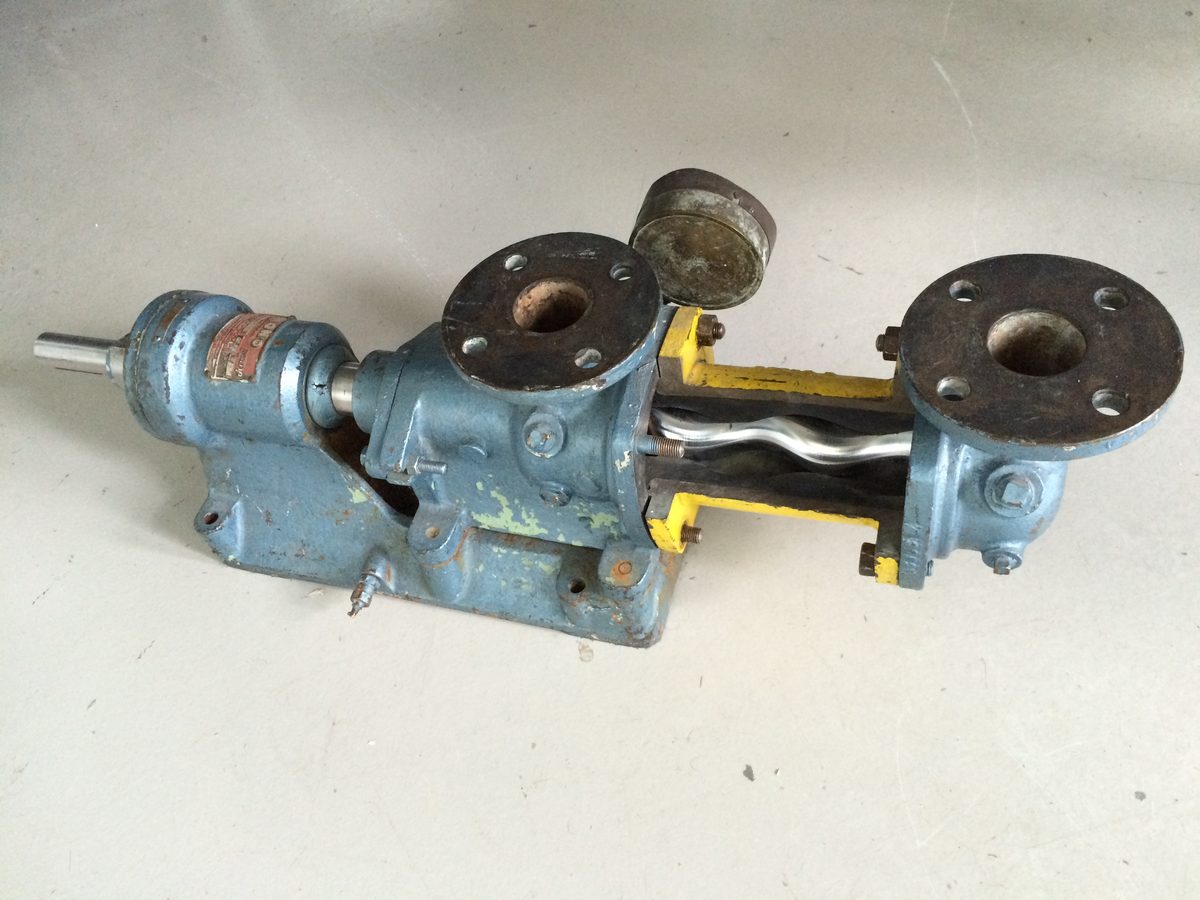
Most patents in additive manufacturing are about motion: gantries, galvos, recoaters, the choreography of getting a nozzle or an energy source to the right place at the right time. The one reported this week by 3D Printing Industry is about something less glamorous and, for a certain slice of the industry, considerably more consequential: a pump. US Patent No. 12,654,396 B2, "Pump for Additive Manufacturing," issued by the USPTO and assigned to nScrypt, came out of work at Sciperio — nScrypt's R&D arm — and covers a servo-controlled progressive cavity pump paired with a servo-motor-driven valve, with the ability to dispense materials above 1,000,000 centipoise.
That number is the whole story — and, if you have never worked with direct ink writing, close to meaningless without a reference point.
A million centipoise, in units you can feel
Water sits at roughly 1 centipoise. Motor oil is in the hundreds. Honey lands in the low thousands. A million centipoise is not a liquid in any intuitive sense — it is stiff putty or cold caulk, a material that holds its shape indefinitely and has to be forced anywhere you want it to go.
There is a good reason the interesting materials live up there. Conductive inks, epoxies, adhesives and biological materials get their useful properties from being densely packed with solids — metal flakes, ceramic particles, cells, filler. Loading a carrier fluid that heavily is what makes an ink conductive or a paste structural, and it is also what drives viscosity through the roof. The materials engineers most want to print are, almost by definition, the hardest to push through a nozzle.
They are also the materials that most need to stay put after they land. A printed antenna trace has to hold its cross-section without slumping, which rules out thinning the formulation down to something a conventional dispenser handles comfortably. You either build a machine that can move putty with fine control, or you print something less useful.
The hard part is starting and stopping
Anyone who has watched a filament printer lay down a perimeter knows the sins of a badly tuned extruder: a blob where the line starts, a gap where it ends. On an FDM machine those artifacts are cosmetic. In direct ink writing they are functional failures. An over-deposited blob at the start of a conductive trace is a short waiting to happen; an under-deposited gap at the end is an open circuit. Print a dense antenna array and every transition is a chance to scrap the board.
This is the problem the patent addresses. Conventional dispensing systems, as described, struggle to maintain consistent flow at the start and end of print paths or during complex geometries, producing over-deposition, under-deposition and other defects — specifically when running conductive inks, adhesives, epoxies and biological materials. The patented mechanism pairs the servo-controlled progressive cavity pump with a high-precision, servo-motor-driven valve that regulates material flow in real time for volumetric accuracy.
The architecture explains why this is a pump patent and not a firmware patent. A progressive cavity pump is a positive-displacement design — a helical rotor turning inside a stator, carrying discrete pockets of material forward with each rotation. Volume out is a function of rotation rather than applied pressure, which is what makes it viable for material that behaves more like clay than ink. Put a servo on the rotor and you get closed-loop control of that volume; add a second servo on the outlet valve and you get an independent way to start and stop the stream.
Pressure-driven dispensers have a compliance problem: the material stores energy on the way in and releases it on the way out, so the nozzle keeps oozing after the stop command. Two coordinated servos engineer that lag out rather than tuning around it.
The named inventors are Paul I. Deffenbaugh, Michael W. Owens, Dr. Kenneth H. Church, Joshua Goldfarb and Emily Sassano. Church, CEO of both Sciperio and nScrypt, framed the grant in plain commercial terms: "This patent reinforces our commitment to advancing the capabilities of direct digital manufacturing and additively manufactured electronics."
Why the patent is the product
What separates this from the usual defensive filing is that the technology is not aspirational. The pump is already built into the company's production systems and underpins nScrypt's QuantiHelix dispensing platform — IP wrapped around shipping hardware, not staked out ahead of it. It follows related work, including the earlier SmartPump technology and a patent covering a modular mobile direct digital manufacturing system.
The commercial targets follow directly from the capability: printed electronics and electronics packaging, antenna manufacturing, microelectronics, and US Department of Defense point-of-need production. That last one is the strategically interesting entry. Point-of-need manufacturing — building electronics where they are needed rather than shipping them from a distant factory — favors vendors with a defensible technical position rather than a commodity process, and a granted patent on the dispensing mechanism is exactly that kind of position.
It is also a reminder that AM is not one market. In printed electronics the barrier to entry is materials handling, not motion control, and patent position matters more in a niche with no commodity alternative.
One caveat: these details come from two trade outlets, not the filing itself, so anyone who needs the actual claim language should pull 12,654,396 B2 from USPTO search.
What it means for makers
Nothing here changes what comes out of your bed slinger, and you are not dispensing million-centipoise epoxy on a hobby budget. What it should change is how you think about the category boundary. DIW shares a vocabulary with FDM — nozzle, toolpath, layer, extrusion multiplier — and almost none of the underlying physics. There is no melt, no filament acting as its own piston, no thermal transition doing half the work of controlling flow. The whole problem is fluid mechanics under closed-loop control, which is why the innovation lands in the pump rather than the slicer.
The second takeaway is more practical. The start/stop artifacts that make DIW hard are the same ones you fight on any extrusion machine, and the responses are architecturally comparable. Pressure Advance and linear-advance schemes in hobby firmware model and cancel exactly the compliance lag that a dedicated second servo removes at the source. One compensates in software; the other engineers out the cause. Both answer the same question — where does material go in the interval after you tell it to stop? If you have ever chased seam blobs through a tuning tower, you have been working a scaled-down version of a problem worth patenting.
