
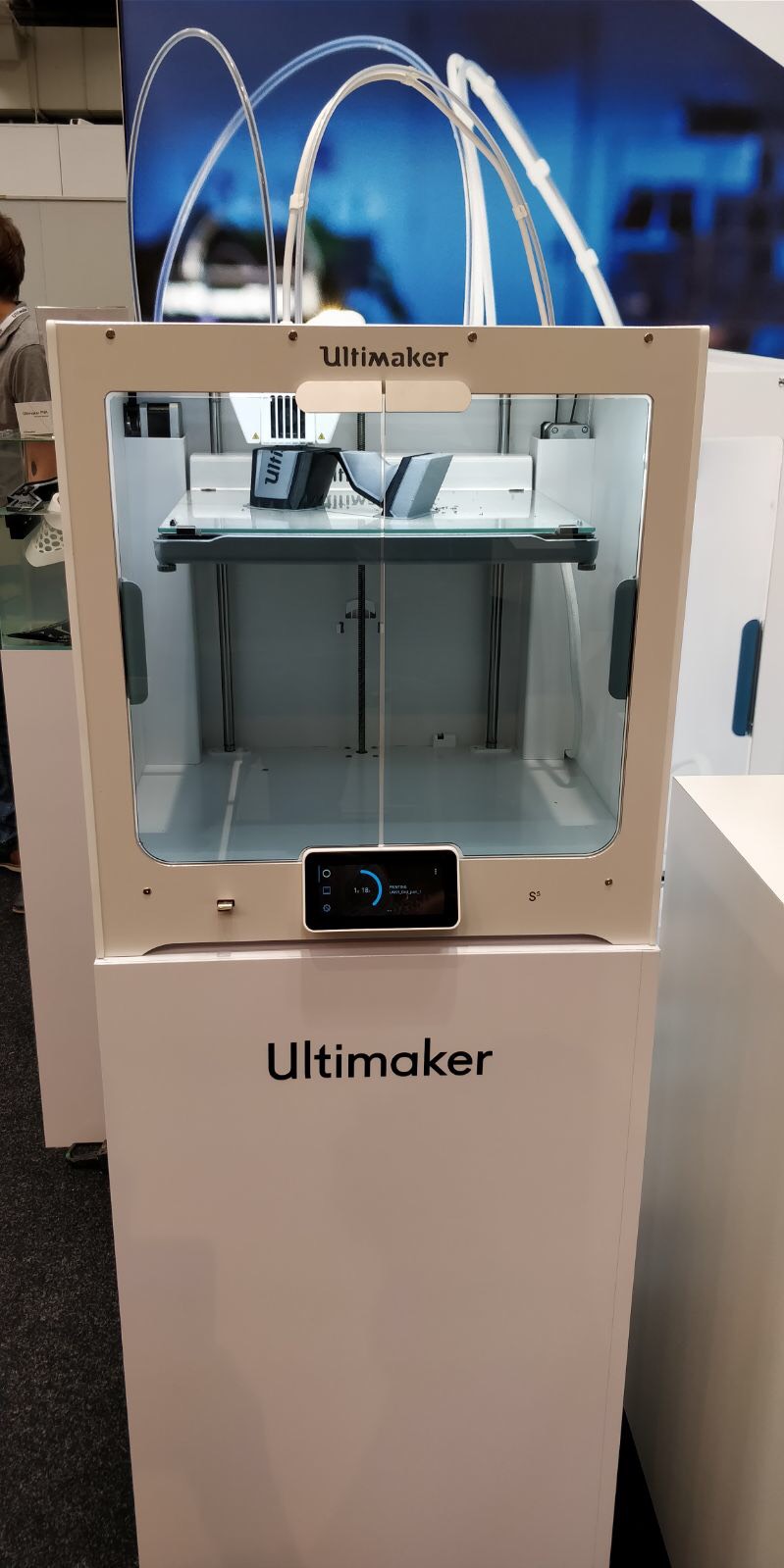
Most stories about desktop-class FFF printers moving into "real" manufacturing involve jigs, fixtures, or maybe a short run of end-use plastic parts. According to a success story UltiMaker published on September 15, 2026, one Singapore MedTech startup has taken that idea considerably further: it is running a fleet of UltiMaker machines inside a certified cleanroom to mass-produce a synthetic skin substitute for treating severe burn wounds — and regulators in four regions are now reviewing it.
The company is Bioactivx, and its product is called Bioactiv Matrix. It's described as a fully synthetic, animal-free regenerative wound-care material, which matters clinically because many existing skin substitutes rely on collagen or other components sourced from animal tissue — a supply chain that brings its own sterility, consistency, and (for some patients and regulators) ethical complications. Bioactivx's pitch is that its version sidesteps all of that while still promoting scar-free healing and faster wound closure, according to secondary coverage from TCT Magazine published two days later, on September 17. TCT also reports the product requires no special storage — a detail that matters enormously for anything meant to reach a burn ward outside a major hospital system.
The Manufacturing Chain: Filament In, Sterile Product Out
What makes this a story for a 3D-printing audience rather than just a medtech one is the production method. Per UltiMaker's write-up, the process is vertically integrated in a way you rarely see even in industrial AM: Bioactivx compounds its own proprietary active-ingredient filament in-house, then prints that filament into finished product on a fleet of UltiMaker printers, all inside an ISO 13485-certified cleanroom. ISO 13485 is the quality-management standard specific to medical-device manufacturing — it's the same family of certification that governs everything from surgical implants to diagnostic hardware, and it's a considerably higher bar than the general ISO 9001 certification you'll see cited by most contract manufacturers.
In other words, this isn't a case of taking an off-the-shelf desktop printer and running it in a cleaner room. It's a company that built its own material — presumably a filament carrying whatever active pharmaceutical or biologically active compound gives Bioactiv Matrix its wound-healing properties — and then engineered a repeatable, regulator-facing production line around printers that most FilamentFeed readers would recognize as consumer- or prosumer-grade hardware in other contexts.
Bioactivx CEO Dr. Teo Peili's stated rationale for the platform choice is notably unglamorous, in the best way: "We chose UltiMaker because of its reliability, ease of use, and open architecture," she said in the UltiMaker success story. "That openness was essential — it let us develop and fine-tune our own proprietary print process rather than working around the limitations of a closed system." That's the same trio of reasons a hobbyist might give for picking a particular printer off a shelf — it just happens to be underpinning a device now working through health-authority review in multiple jurisdictions. Dr. Teo went further in the same piece, framing the launch as an early step rather than an endpoint: "This is just the starting point. Our vision is a future where advanced, scar-free healing is available to every patient, wherever they are — and UltiMaker is a key partner in making that possible."
Where the Regulatory Approvals Actually Stand
It's worth being precise about what has and hasn't happened yet, since "FDA approved" and "under review" get conflated constantly in 3D-printing medical coverage. According to UltiMaker, Bioactiv Matrix has secured approval from Singapore's Health Sciences Authority (HSA) — that's a real, completed regulatory clearance in the product's home market. Submissions are now underway, per the same source, in the United States, the European Union, Australia, and across ASEAN. None of those additional approvals have been granted as of the September 15 publication date; they're filed or in-process, not cleared. If Bioactivx clears the FDA or EU pathways, that would mark a considerably higher bar than HSA approval alone, given the scrutiny biologically active wound-care products typically receive in those markets.
On September 17, TCT Magazine reported that UltiMaker and Bioactivx signed a memorandum of understanding to co-develop a scalable, on-demand medical printing solution for regenerative wound care — a formalization of the partnership around scaling up 3D-printing-enabled production, rather than a one-off engagement. Per TCT, the stated goal of the arrangement is to bring wound-care production closer to the point of need and reduce dependency on cold-chain logistics and centralized manufacturing, which tracks with the "no special storage" claim in the same report. UltiMaker CEO Michiel Alting von Geusau framed the collaboration in broader terms in the success story: "Bioactivx's certification and regulatory approval is a powerful proof point for the medical 3D printing industry. It demonstrates that with the right process and quality controls, 3D printing on UltiMaker platforms can meet the exacting standards required for certified, end-use medical devices — not just prototypes. This collaboration is about more than one product. It's a blueprint for how distributed, on-demand 3D printing can transform medical manufacturing — making critical treatments faster to produce and easier to deliver, wherever they're needed."
What It Means for Makers
For the maker and small-manufacturer audience, the interesting part isn't the wound-care science — it's the manufacturing model. Bioactivx's approach is a real-world demonstration that a cleanroom print farm built on open-architecture, non-industrial-branded hardware can pass muster for ISO 13485-certified medical production, provided the surrounding process (material compounding, quality control, facility certification) is rigorous enough. That's a meaningful data point for anyone who has assumed medical-grade AM manufacturing requires proprietary industrial systems costing hundreds of thousands of dollars per unit.
It's also a reminder that the material, not just the printer, is usually the hard part. Bioactivx didn't buy a medical-grade filament off a shelf — it developed and compounds its own active-ingredient filament internally, which is almost certainly where the bulk of the company's IP and regulatory burden actually lives. The printers are described as reliable and open, not exotic; the differentiator is what's being fed into them.
For makers and small shops watching the broader trend of desktop and prosumer FFF hardware creeping into regulated, high-stakes manufacturing, this is one more example — alongside prior stories about 3D-printed surgical guides and prosthetics — that the ceiling on "hobbyist" printers keeps getting redrawn upward, provided the process engineering around them is built to a genuinely different standard. Whether Bioactiv Matrix clears the FDA and EU is a separate, and slower, story to watch.
Sources
- On-Demand 3D-Printed Wound Care: Bioactivx Success Story — UltiMaker, September 15, 2026
- UltiMaker to support Bioactivx in scale-up of 3D printing-enabled synthetic skin substitute — TCT Magazine, September 17, 2026
